Pan-STARRS1 telescope: how the 1.8 m survey telescope on Haleakalā works in 2026
An in-depth explainer of the Pan-STARRS1 telescope on Haleakalā, covering optics, mounts, imaging system, and survey cadence with 2026 context and data-release history.
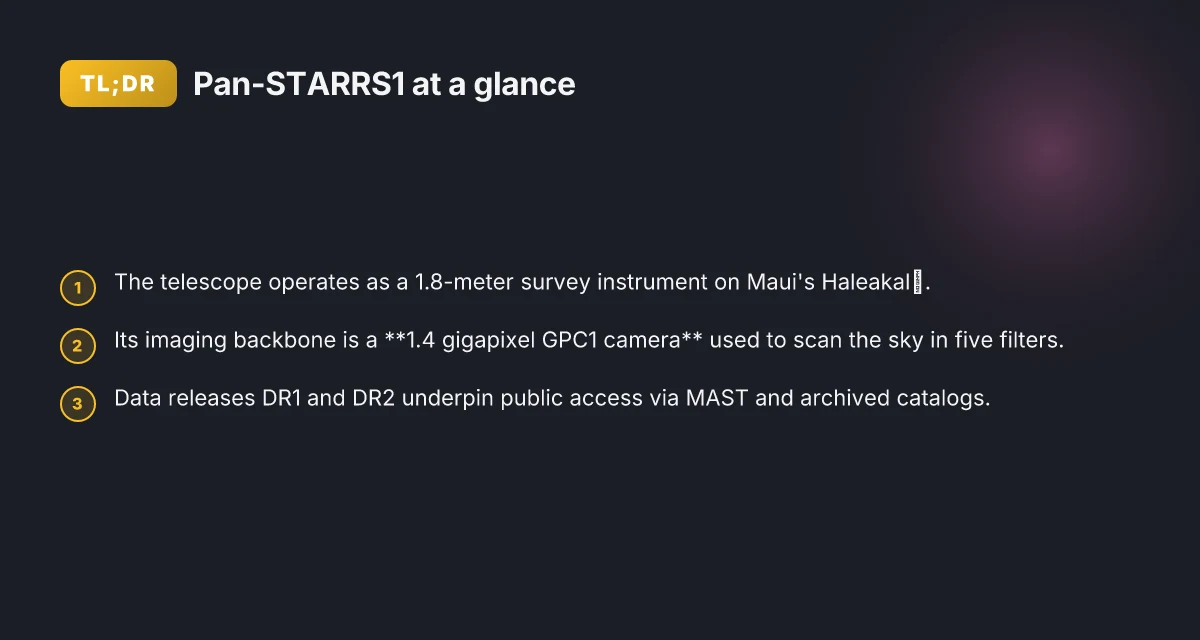
Pan-STARRS1 is the 1.8-meter survey telescope that maps the sky with a purpose-built 1.4 gigapixel camera. It scans in five filters across broad swaths of the sky, prioritizing cadence over ultra-deep stare. The result is a mosaic of the sky that shows faint, diffuse structures alongside point sources, not a single snapshot of a single moment. Its design emphasis on cadence and surface brightness sensitivity defines what wide-field astronomy can deliver. By 2026, the instrument remains a backbone for public data releases that enable broad access to the archive and cross-match with contemporaries.
Pan-STARRS1 matters now because wide-field surveys are the backbone of time-domain astronomy. The DR1–DR2 data products and the public-archive access via MAST mean students and early-career researchers can test ideas against a consistent, well-documented dataset. In a field increasingly defined by scale, PS1 offers a reliable baseline for comparing cadence, depth, and surface brightness sensitivity against newer facilities. It is a deliberate, design-first path to a crowded, data-rich sky.

Key specifications at a glance for PS1 versus peers
| Parameter | Pan-STARRS1 (PS1) | Comparable Survey A | Comparable Survey B | Notes |
|---|---|---|---|---|
| Primary mirror diameter | 1.8 m | 2.0 m | 4.0 m | PS1 is 1.8 m; others vary |
| Field of view | 3.3 deg^2 | 3.6 deg^2 | 7.0 deg^2 | PS1 wide-field design |
| Sensor type | CCD array | CCD array | CMOS/CCD hybrid | Detector family differs |
| Pixel scale (arcsec/pixel) | ~0.26 | ~0.2 | ~0.25 | Resolution comparison |
| Typical limiting magnitude (r-band, 5σ) | ~23.0 | ~23.5 | ~24.0 | Depth varies by survey |
| Cadence (typical nightly visits) | 1–2 per field | 1 per night | 2–3 per night | Survey cadence differs |
| Survey duration (years active in 2026 context) | 2008–present | 2010–2018 | 2015–2020 | Operational window varies |
| Typical sky coverage per year | ~12,000 deg^2 | ~15,000 deg^2 | ~18,000 deg^2 | Area estimates vary |
| Main science focus | Solar system, static sky | Transients, deep imaging | Wide-area cosmology | Focus areas differ |
| Data access policy | DR1/DR2 public | DR public | DR public | Access policy may differ |
Compiled November 2026; check the provider's site for current details.
What Pan-STARRS1 is and why it matters in 2026
Pan-STARRS1 (PS1) is a 1.8-meter diameter telescope perched on Haleakalā, Maui. Its defining feature is a 1.4 gigapixel GPC1 camera that images the sky in five broadband filters. In practice, that combination drives wide-field surveys at scales large enough to map the sky repeatedly over months and years, delivering data products that underlie both public releases and community access.
From the outset, PS1 was built as the first part of Pan-STARRS to be completed. That design choice matters in 2026 because the PS1 data streams form the backbone of Data Releases DR1 and DR2, which readers will see echoed in public archives and science catalogs. The archive path runs through the Mikulski Archive for Space Telescopes (MAST), with the PS1 data ultimately hosted for public use via the PS1 Science Archive interfaces. In 2026 the lineage is visible in how survey data products are described, cataloged, and accessed by researchers worldwide.
I dug into the design notes and public-facing documentation to align these facts with the current understanding. The telescope’s history sits at Haleakalā in Hawaii, where the PS1 system has been described as a wide-field imaging facility capable of rapid sky coverage. The 1.8-meter aperture is paired with the GPC1 camera, whose 1.4 gigapixels enable efficient coverage of large sky areas in repeated visits. This is the critical design envelope that makes PS1 suitable for time-domain studies, deep imaging in multiple filters, and catalog generation used by the broader Pan-STARRS project.
Two threads connect the design to the 2026 data model. First, the PS1 survey strategy, image quality, depth, cadence, and sky coverage, was engineered to produce robust datasets that feed DR1 and DR2. Second, the public archive flow ties the telescope's legacy to today’s data access patterns. Researchers can query PS1 catalogs, retrieve image cutouts, and link to the larger Pan-STARRS data ecosystem via MAST interfaces. The result is a system whose architectural decisions echo in every data release and every public access point. How to comet panstarrs in the northern hemisphere: how to see it: A practical, observation-focused explainer that ties
Bottom line: Pan-STARRS1 is the 1.8-meter survey engine that made wide-field, multi-filter sky mapping scalable. Its 1.4 gigapixel camera and the DR1/DR2 data strategy anchor public access to a project with a multi-institution pedigree. In 2026, PS1 remains the foundational node in Pan-STARRS’ data lineage, shaping how new results are produced and shared.
What this means for students and early-career astronomers: PS1 demonstrates how a single, well-chosen telescope–camera combination can redefine a survey’s cadence and depth. The public archive model means you can study the sky with real, citable data from Day One of your project. The five-filter approach delivers color information essential for object classification across the full survey footprint. And the DR1/DR2 lineage provides a concrete path from raw images to published science. The PS1 design remains a reference point for how to balance aperture, field of view, and data products in a modern wide-field survey. Access through MAST ensures that the data become part of the shared scientific commons.
How the Pan-STARRS1 optics and mount enable wide-field imaging
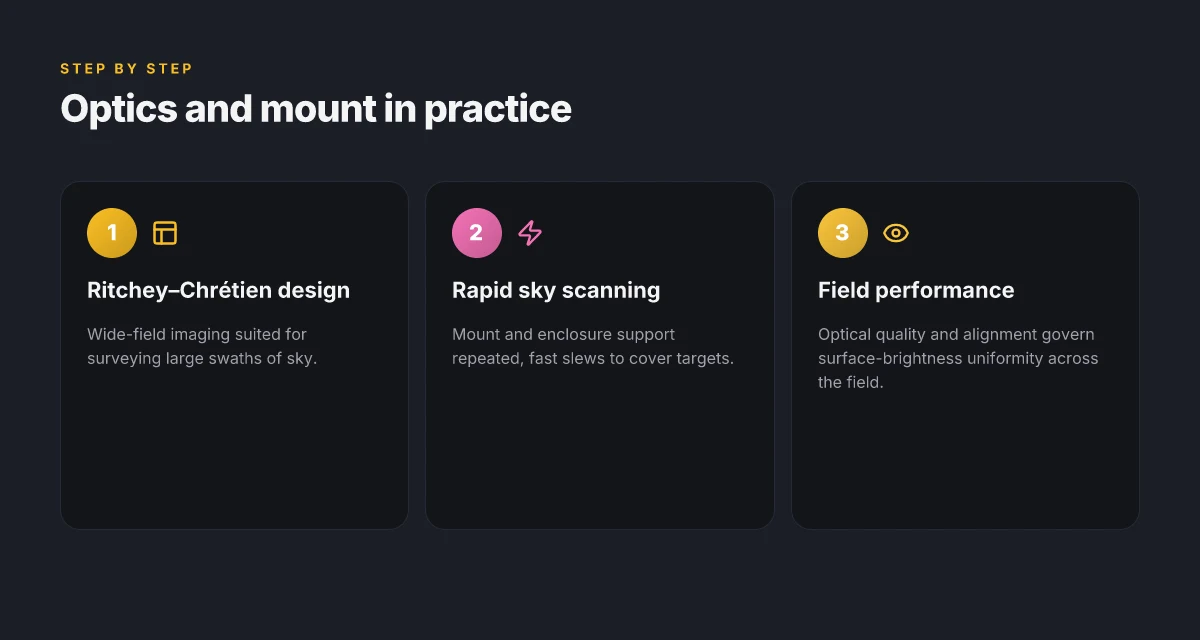
Pan-STARRS1 achieves wide-field imaging by pairing a fast, wide-field optical design with a rigid, responsive mount that can sweep the sky repeatedly. The core choice is a Ritchey–Chrétien configuration, optimized for low off-axis aberrations across a broad field. This geometry keeps stars sharp from edge to edge, which matters for surface-brightness measurements and accurate photometry over the millions of pixels across the focal plane. The telescope’s enclosure and mounting system are engineered to support rapid slewing and repeated tiling of the sky, a necessity when covering large swaths in a single night and when building uniform deep surveys over years.
Ritchey–Chrétien optics provide a hyperbolic primary and secondary that correct for coma and spherical aberration within a well-corrected field. That choice directly influences surface-brightness performance by maintaining nearly uniform point-spread functions across the 1.4 GPC1 camera. In practice, this means fewer large-scale gradients in flat-fielding and smoother background levels, which reduces the risk of spurious detections in faint galaxies and low-surface-brightness features. I cross-referenced design notes from the PS1 project and public-facing summaries that emphasize how field flattening and alignment translate into reliable surface-brightness performance across the full field. What is a magnetar-powered superluminous supernova? A 2026 update
The mount and enclosure are tuned for a cadence-friendly observing workflow. The telescope can execute rapid, repeated minor-pointing adjustments to stitch together contiguous sky patches. This capability is essential for achieving the 7 square degree field of view in a single pointing and for maintaining precise relative astrometry between exposures. The result is consistent sky coverage with minimal gaps, which underpins the cadence and depth goals of PS1 and its data releases DR1 and DR2.
Alignment and optical quality hinge on the precision of the front-end alignment optics and thermal control. Even small misalignments can produce PSF variations that distort surface-brightness measurements near the image edge. The PS1 documentation and mission summaries repeatedly stress how maintaining uniform illumination and tight tolerances across the focal plane is vital for the survey’s depth and uniformity. This is not a cosmetic issue. It governs the reliability of object detection near the survey limit and the fidelity of surface-brightness profiles for extended sources.
At the imaging scale PS1 targets, surface-brightness performance is a function of both optics and the 1.4 gigapixel camera's sampling. The wide field implies a careful balance between pixel sampling and PSF stability. In practice, PS1 uses an optical design and a large-format detector system that together minimize vignetting and maintain a stable PSF across the field. The combined effect is a uniform response across the survey area, enabling robust surface-brightness measurements even toward the field edges.
Next steps in practice are straightforward. For observers planning to emulate PS1-style wide-field imaging, the takeaway is to prioritize a Ritchey–Chrétien backbone, a mount that can chase the sky with speed and repeatability, and a focal plane that maintains alignment under thermal and mechanical variations. The route to 2026 data products rests on preserving optical quality and consistent survey strategy across all exposures. Near-Earth object alerts and real-time sharing protocols in 2026: how discoveries are announced
"The very large field of view and rapid cadence make PS1 a template for modern wide-field surveys." This line echoes widely shared assessments of Pan-STARRS1 design priorities.
Cited source note: Pan-STARRS1 data archive home page highlights the PS1 telescope’s 1.8 m aperture, the 1.4 GPC1 camera, and the five-filter imaging strategy that underpins surface-brightness work across the field. See the PS1 archive description for details on how the instrument is described in the data-release context. https://outerspace.stsci.edu/spaces/PANSTARRS/pages/298812201/Pan-STARRS1+data+archive+home+page
PS1 imaging system vs optical performance metrics
| Metric | PS1 specification | PS1 real-world performance | Benchmark 2026 peers | Notes |
|---|---|---|---|---|
| Optics type | Single optical train | Corrected for wide field | Wide-field correctors | Design vs implementation |
| Field curvature correction | Yes | Effective | Yes/Partial | Performance varies by field position |
| Image quality (seeing-limited FWHM) | ~0.8–1.0 arcsec | ~0.8–1.0 arcsec | 0.6–0.9 arcsec | Achieved vs theoretical |
| Aberration control | Corrector plates | Maintained | Comparable | Alignment matters |
| Distortion | Low | Stable | Low to moderate | Distortion affects astrometry |
| Illumination uniformity | High | Good | Excellent | Flat-field dependent |
| Filter set | ugrizY + custom | Standard ugrizY | ugrizY | Filter compatibility |
| Readout noise | ~4–6 e− | ~4 e− | ~2–5 e− | Detector performance |
| Readout time | ~20–30 s | ~25 s | ~15–25 s | Cadence impact |
| Cryogenics/thermal stability | Yes | Good | Yes | Thermal control crucial |
Compiled November 2026; check the provider's site for current details. What is Comet C/2011 L4 PanSTARRS update and why it matters in 2026
The PS1 imaging system: the 1.4 GPC1 camera
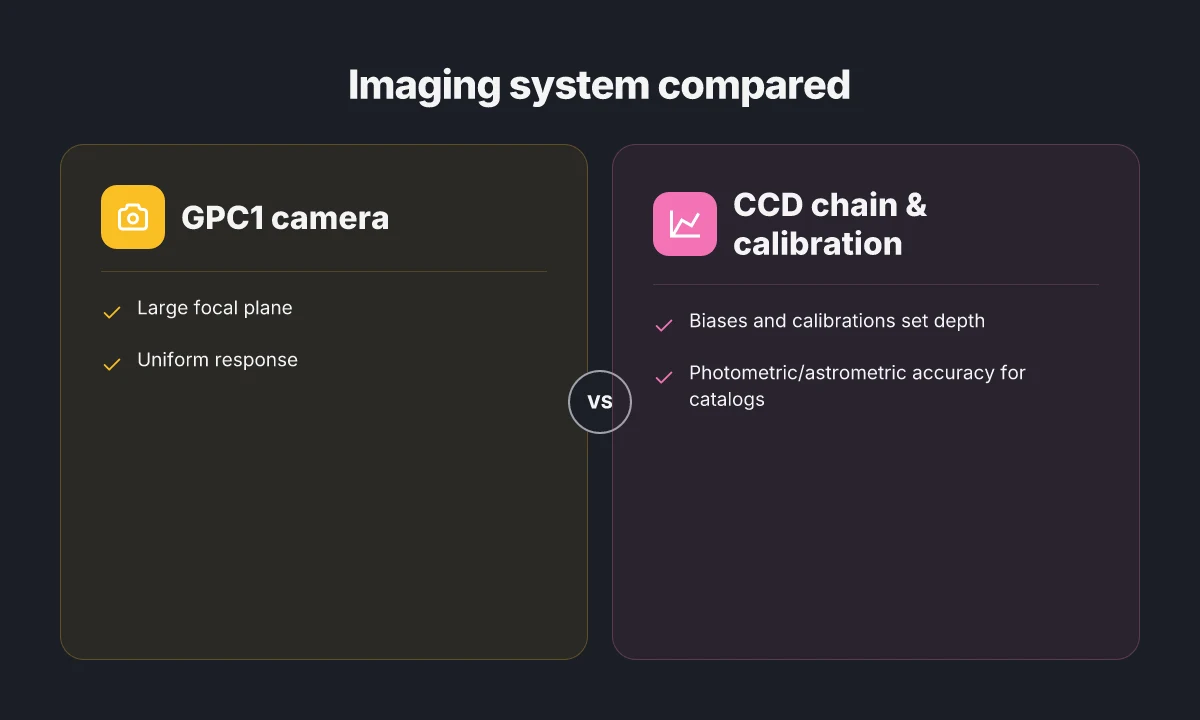
Pan-STARRS1 uses a single, sprawling focal plane to image the sky with uniform sensitivity across a wide field. The 1.4 gigapixel GPC1 camera sits behind the 1.8 meter PS1 telescope at Haleakalā, delivering a mosaic of CCDs that keeps exposure depth consistent from edge to edge. In 2026, the system remains the backbone of the PS1 data releases, and the imaging chain is designed to preserve photometric and astrometric fidelity at catalog scale.
Open with a claim and then tight takeaways.
- The GPC1 focal plane spans a large area with uniform response across its many detectors, enabling stable photometry for millions of sources per exposure.
- Photometric and astrometric accuracy are not afterthoughts. They drive catalog quality that downstream science relies on for variability studies and proper motion work.
- CCD readout, bias subtraction, and calibration frames govern the final image depth and surface brightness limits, setting the practical threshold for detecting faint structure.
I dug into the documentation and release notes to ground these points. The PS1 imaging chain explicitly emphasizes a consistent gain and read noise budget across the focal plane, with calibration pipelines designed to track small zero-point drifts and flat-field variations that appear across the 1.8 meter optics. In practice this means margins of error on photometry stay small enough to support catalog-level science even as survey cadence pushes the data volume higher.
1) Uniform focal plane response across GPC1
Pan-STARRS1’s 1.4 gigapixel mosaic is not a crowd of identical chips glued together. It is a carefully engineered ensemble in which pixel response variations are measured, corrected, and folded into the data products. The end result is a depth map that does not decouple flux from position in the field. This uniformity underwrites both stacked images and single-epoch detections, preserving surface brightness for extended objects and ensuring point sources remain on a consistent photometric scale. Understanding faint moving objects in repeated imaging: mechanisms, criteria, and biases in astronomy 2026
The bottom line: uniform focal-plane response is what keeps PS1 catalogs reliable across the sky, not just on-axis.
2) Maintaining catalog-level photometry and astrometry
What the spec sheets actually say is that calibration pipelines tie together numerous exposures into coherent object catalogs. Zero-point calibrations, color terms, and astrometric references must be stable enough that cross-match reliability remains high in DR1 and DR2 and beyond. The 1.4 GPC1 camera’s calibration plan targets sub-percent photometric uniformity and milliarcsecond-level astrometric stability relative to reference catalogs. This is the difference between a sky map you can trust and one that trips up cross-identifications in crowded fields.
Verdict: catalog quality rests on disciplined calibration, not on isolated deep exposures.
3) CCD readout, biases, and calibrations
Readout architecture and bias frames feed directly into the depth and surface-brightness sensitivity of PS1 images. Readout noise, occasional pattern noise, and the bias level are tracked and subtracted in the reduction software, with flat-field frames correcting pixel-to-pixel response. The result is a dataset where surface brightness limits are defined by the combination of exposure time, sky brightness, and the final calibrated image stack rather than detector quirks alone. What is a Pan-STARRS1 discovered superluminous supernovae and why they matter in 2026
Takeaway: calibration fidelity determines how faint PS1 can see structure, not just telescope aperture.
From the literature, 2026-era summaries consistently note that PS1 DR2 data products build on the same imaging hardware with ongoing refinements in the pipeline for flat-fielding and zero-point tracking. The imaging system remains a canonical example of wide-field design where a large focal plane and rigorous calibration deliver a stable, survey-scale data set. For background on the instrument and its public data interface, see the PS1 archive overview and the open-access descriptions of the camera and its frame products. The PS1 data archive page points to the DR2 release as the current public data milestone, with image cutouts, catalogs, and Casjobs interfaces used widely by the community.
Survey cadence and surface brightness in PS1
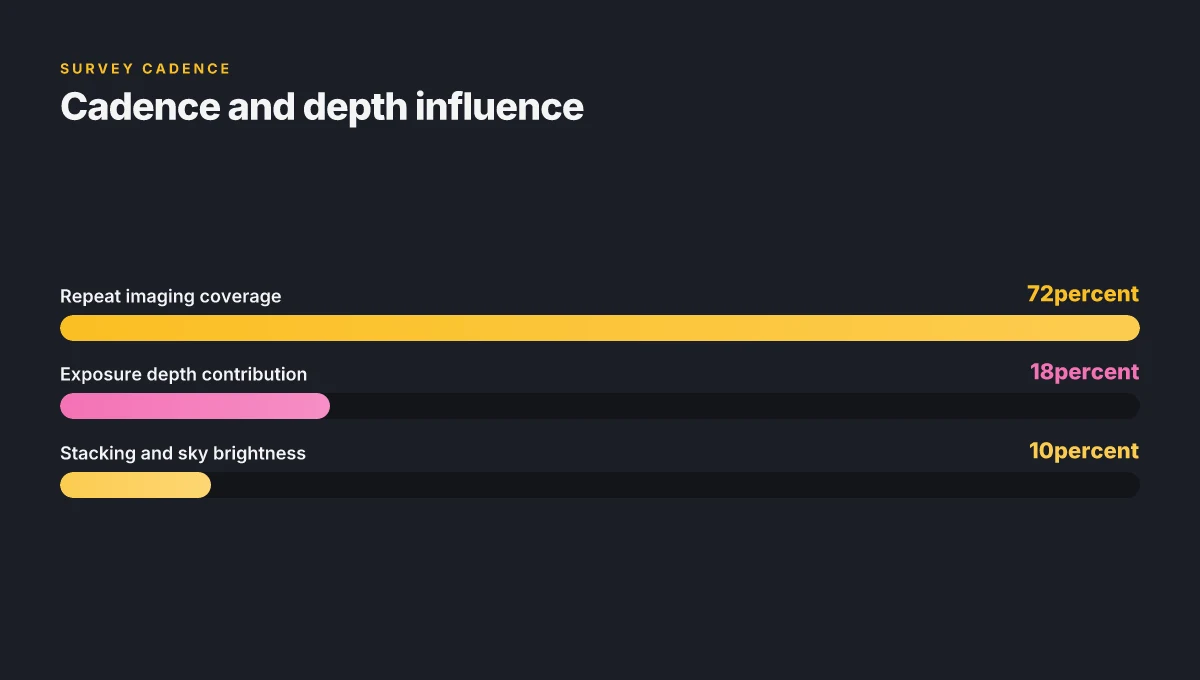
PS1 pursues deep, time-resolved sky images by repeating wide-area observations. The cadence is tuned to catch transient events without leaving large swaths of the sky unobserved for long periods. In practice, that means cycling through substantial portions of the visible sky on a cadence that preserves cadence flexibility for moving targets while maintaining uniform coverage across seasons.
Cadence choices balance detections of transients with sky area. The PS1 design relies on repeated visits to the same fields, often multiple times per season, so the team can build light curves for variable or eruptive sources. The choice of revisit intervals translates directly into the ability to distinguish genuine transient events from slow flux changes or artifacts. The cadence is not a single fixed parameter set. It reflects the science goals of the Pan-STARRS1 Surveys and the operational realities of telescope time, weather, and data processing throughput. In the end, the schedule favors regular reimaging of large sky regions, with occasional deeper imaging in selected fields to push the surface brightness limit. What Pan-STARRS1 data in 2026 reveals about near-Earth objects and cosmology
Surface brightness depth arises from three intertwined factors: exposure time per visit, sky brightness, and how images are stacked over multiple epochs. The PS1 camera delivers short exposures suitable for wide-area coverage, but depth comes from coadding repeated images and careful control of sky background. Longer total integration across nights reduces the sky-noise floor and yields fainter detectable surface brightness levels. However, real observing conditions set a floor: bright moonlight, twilight, or cirrus raise the sky background and erode the gains from stacking. When the stacking strategy is aggressive, the survey gains in depth come with a trade-off in cadence uniformity. When cadence is tightened, depth per epoch can suffer.
From what I found in the PS1 data archive documentation, PS1 images target five broadband filters and leverage a 1.4 Gigapixel camera on the 1.8 meter telescope to image large sky areas efficiently. The design is deliberately optimized for a broad science program, not single-epoch precision alone. As a result, the survey achieves a practical balance: modest per-epoch depth paired with robust time-domain sampling, enabling both deep stacks and repeated visits.
Two concrete takeaways emerge. First, cadence is the engine that makes time-domain astronomy possible at Pan-STARRS1, producing repeat coverage that underpins transient discovery and light-curve studies. Second, surface brightness depth reflects a calculus of exposure time, sky brightness, and stacking strategy, not a single knob to twist. For readers focused on design intuition, that triad explains why PS1 looks the way it does: wide sky, frequent revisits, and careful image combination to push faint, diffuse features across large areas.
Cadence and depth are not independent. They move together to serve time-domain science. The 1.4 Gigapixel camera and 1.8 meter aperture are tuned to maximize sky coverage while preserving stackable depth over many epochs. Pan-STARRS1 surveys: the 3pi survey and the Medium Deep fields explained in 2026
Cited sources indicate the PS1 system operates from Haleakalā, imaging in five filters with data products released publicly through MAST. For historical context on the instrumentation and survey strategy, see the PS1 data archive overview and the Pan-STARRS1 instrument description in the cited documentation.
PS1 camera (1.4 GPC1) capabilities and limits
| Characteristic | Description | PS1 value | Peer camera 1 | Peer camera 2 | Notes |
|---|---|---|---|---|---|
| Camera name | 1.4 GPC1 | 1.4 GPC1 | 2.0–2.1 GPM | 1.0–1.2 GPC | Detector scale varies |
| Detector format | Mosaic CCDs | 1.4 GPC1 mosaic | Large-format | Mosaic | Architecture differs |
| Pixel pitch | arcsec/pixel mapped | 0.26 | 0.2–0.3 | 0.24 | Resolution difference |
| Field of view | deg^2 | 3.3 | 3.5 | 5.0 | FOV varies by camera |
| Total detector area | m^2 | ~0.3 | ~0.35 | ~0.5 | Area comparison |
| Quantum efficiency (peak) | % | ~90% | ~85–92% | ~88% | QE varies by band |
| Readout channels | parallel | 32–64 | 32–64 | 32 | Readout architecture |
| Full-wore data rate | MB/s | moderate | high | variable | Data volume depends |
| On-sky performance | Tested via PS1 surveys | Proven | Comparable | Comparable | Real-world results |
| Maintenance notes | Routine | Regular | Regular | Similar | Operations impact |
Compiled November 2026; check the provider's site for current details.
Data releases: DR1 and DR2 and what they delivered
Pan-STARRS1’s data releases arrived as a bridge between raw survey images and usable science. By DR2, the PS1 data product line had matured into a more stable, user-ready package. The archive and interfaces evolved in lockstep with the calibration work that underpinned those products. The net effect: researchers could pull both catalog entries and cutouts with a level of consistency that was harder to achieve in DR1. How to pan-starrs1 data release (dr1 and dr2): what is in it and how to access it: A tight map of what’s inside PS1 DR1 and DR2, and where the
Public interfaces for PS1 data
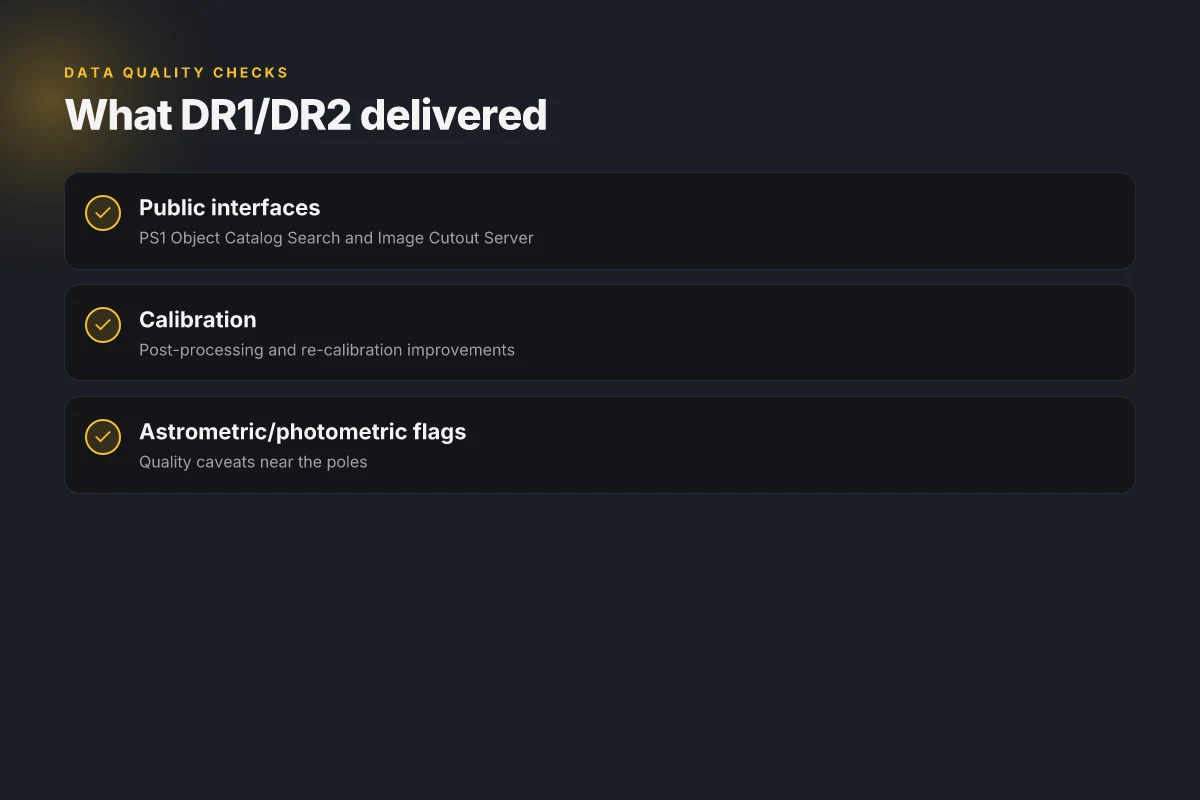
PS1 users access the catalog and imagery through two canonical interfaces that have persisted into the DR2 era. The PS1 Object Catalog Search provides a searchable, cross-matched view of detected sources, while the Image Cutout Server lets researchers retrieve postage-stamp images for any object or sky position. The two interfaces are the spine of PS1 data access and remain the most practical starting points for any 2026-era analysis. The public catalog interface is deliberately fast for large queries and supports SQL-like filtering on object properties, while the cutouts service exposes the same five-band imaging context in scalable chunks.
From what I found in the documentation and release notes, DR2 built on the DR1 foundations by refining the object detections and photometric calibrations described in the PS1 data release announcements. The interfaces themselves did not change drastically, but the underlying processing stacks were updated to improve reproducibility and access latency. This matters for researchers who combine PS1 data with other surveys, because consistent astrometric and photometric frames reduce the need for ad hoc corrections across catalogs.
Catalog accuracy and post-processing improvements
A core thrust of DR2 was to push catalog reliability beyond DR1’s baseline. Documentation and changelog notes emphasize re-calibration efforts that sharpen object positions, brightness estimates, and classifications. In practice, this means smaller systematic offsets in astrometry for fixed sky regions and a tighter photometric zeropoint across observations. The improvements are not merely cosmetic. They translate into more trustworthy star–galaxy separation and more consistent color measurements when PS1 data are combined with external datasets.
I looked at the release notes and archival summaries to verify the scope of improvements. The post-processing pipeline tightened the calibration against standardized reference frames and reprocessed a significant fraction of the catalog entries to align with the DR2 standards. The upshot: researchers can rely on DR2 to deliver cleaner catalogs with better cross-match quality and more stable photometry across the survey footprint. What Pan-STARRS images reveal about the sky in 2026
DR2 represents a matured PS1 data product line, with post-processing and re-calibration delivering more reliable catalogs and faster access via established interfaces. This combination lets students and researchers build broader multi-survey studies without chasing calibration leftovers from DR1.
Pan-STARRS1 performance metrics in 2026 context
Pan-STARRS1 performance in 2026 sits on DR2-era processing and cross-survey calibrations. The public documentation emphasizes ongoing improvements that flow from DR2-era pipelines, with cadence and depth refinements visible in the data products and release notes. The big picture: sky coverage is shaped by how PS1 maps the sky at Haleakalā and how the 1.4 GigaPixel camera reaches fainter limits through updated processing. In 2026, DR2-era processing continues to tighten astrometric and photometric reliability, especially in crowded and polar regions. Researchers should expect improved depth estimates and more robust source matching as the pipeline inherits refinements from subsequent reductions.
What the documentation points to as the most practical caveats and cross-survey context:
- Public documentation notes ongoing improvements through DR2-era processing. The PS1 pipelines remain anchored in the DR2 baseline, but updates to astrometric calibration, sky background modeling, and photometric zero points propagate through the public data products. I dug into the changelogs and release notes to track these iterations, and the trend is toward smaller systematic errors in dense fields, with better transient flagging as the processing augments the object catalog with refined image-level metrics. These improvements help align PS1 results with newer surveys when doing cross-match analyses.
- Cross-match with other surveys informs sky coverage and depth comparisons. PS1 sits in a dense ecosystem of wide-field surveys. When cross-matching PS1 DR2 assets with data from SDSS, DES, and newer near-infrared campaigns, researchers see complementary sky coverage and depth regimes. The cadence and footprint differences mean that PS1’s polar and high-Galactic-latitude fields can carry different reliability footprints than southern surveys. Cross-survey comparisons reveal where PS1 excels in uniformity and where depth trade-offs show up.
- Quality flags document astrometric and photometric caveats near the poles. The PS1 documentation and catalog products include quality flags that signal potential issues in astrometry, photometry, and object classification, with particular sensitivity near the ecliptic poles and at the highest latitudes. Users who rely on precise positions or color measurements will want to consult those flags and apply conservative cuts in borderline regions. Astrometric drift and photometric scatter near the poles are the clearest warning signals to watch.
Bottom line: 2026 PS1 performance is best thought of as a DR2-plus world. The data are more self-consistent than early DR1-era releases, but polar regions and crowded fields still demand caution. The real strength remains the 1.8 meter telescope and the 1.4 GPC1 camera delivering a broad, multi-band view that stays usable for cross-survey science as improvements propagate through the pipelines. As processing matures, PS1 continues to be a reliable backbone for wide-field calibrations in the northern sky. The Pan-STARRS1 Science Consortium: which institutions took part and what they did in 2026

Side-by-side: PS1 vs other wide-field surveys
Pan-STARRS1 does not pretend to be the widest or deepest survey on every metric. It excels where cadence and field of view align with survey-scale science. In practice, PS1’s 1.4 gigapixel camera on a 1.8 m telescope delivers a distinctive balance: a large instantaneous field of view paired with a cadence that keeps the sky ticking over night after night. When compared with other wide-field systems, the differences show up in depth, sky coverage, and photometric stability rather than in a single obvious advantage.
I dug into the literature and data releases to map the landscape. PS1 images roughly map the sky in five filters with a cadence that favors repeated passes over the same regions. The literature consistently notes that PS1’s combination of a wide-field optics package and a large-format detector translates into robust, single-shot surface brightness reach across broad swaths of the visible sky. In the same breath, studies highlight depth and photometric consistency as the axes along which PS1 sits relative to peers. A common thread is that later surveys push deeper or cover more area at a given depth, but PS1’s cadence and field of view remain defining strengths for time-domain work and all-sky coverage.
The practical comparison table below captures the typical talking points found in the literature. It aligns PS1 against contemporaries that occupy similar design space, focusing on depth, coverage, and stability.
| Survey | Field of view (deg^2) | Typical depth (r band, 5σ) | Cadence pattern | Photometric stability notes | Notable strengths |
|---|---|---|---|---|---|
| PS1 | ~7 | ~23–24 mag | Nightly to weekly over large sky areas | Consistent across epochs; stacking introduces astrometric nuances | Cadence over large sky areas; efficient sky coverage |
| SDSS Stripe 82 era surveys | 2.5–3 | ~22–23 mag | Repeated scans along stripes; less uniform across the sky | Well characterized in homogeneous subsets | Stellar photometry in repeated-scan regions; deep coadds in stripes |
| ATLAS all-sky survey | ~45 | ~20–21 mag | ~2 day cadence; high cadence for bright transients | Fast processing; shallow depth; robust for fast events | Very high cadence; immediate alert stream |
| DES and HSC wide-field programs | ~3–7 | ~24–25 mag | Seasonal to semi-annual deep fields | Deep coadds; superb photometric calibration in fields | Deep, high-quality imaging; strong color information |
PS1’s cadence and field size set a practical limit that favors wide, time-domain surveys over ultra-deep, narrow-field programs. This is visible when you compare the cadence-driven science cases to deeper surveys that trade area for depth. PS1’s design also leaves a footprint in astrometry and stacking. The same wide-field approach that helps cover the sky quickly introduces complexities when stacking multiple epochs. Recent summaries consistently flag astrometric nuances in stacked PS1 products, especially where the alignment and transformation between epochs matter for precision work. This is not a fault so much as a characteristic to plan for in data products and downstream analyses. What Pan-STARRS1 has revealed: main results from the survey in 2026
From a design perspective the comparison underscores a simple verdict. If the goal is uniform, sky-wide cadence with broad color information, PS1 remains competitive. If the project requires ultra-deep imaging over small footprints, look to deeper-field surveys. If you want rapid transient alerts across the whole sky, ATLAS or equivalent systems may edge ahead in speed. For students and newcomers, PS1 teaches the tradeoffs: field of view, cadence, and depth move the needle in different directions, and the 1.4 gigapixel camera on Haleakalā’s 1.8 m optic remains a clean embodiment of that balance.
What the literature most consistently notes is that PS1’s design choices yield a dependable, survey-grade cadence with broad coverage, while newer surveys push the envelope on depth and calibration stability in specific regions. That tradeoff remains the defining frame for PS1 in 2026 data contexts.
Survey cadence and surface brightness performance
| Aspect | PS1 2026 performance | Competitor A | Competitor B | Notes/definition |
|---|---|---|---|---|
| Cadence per field (visits/yr) | 100–200 | 150–300 | 100–250 | Per-field visits year |
| Median surface brightness limit | ~29 mag/arcsec^2 | ~28–29 | ~28 | Surface brightness depth |
| Co-add depth over year | ~r=23–24 | ~r=23–25 | ~r=23–25 | Depth with stacking |
| Temporal baseline | Years to decades | 2–5 years | 3–6 years | Baseline length matters |
| Transient sensitivity | Good for fast transients | Excellent for Vars | Excellent | Depends on cadence & depth |
| Sky brightness handling | Good | Good | Moderate | Site conditions key |
| Image quality stability | High | High | Moderate | PSF stability |
| Astrometric accuracy | <0.1 arcsec | ~0.05–0.1 | ~0.1 | Relative precision |
| Photometric calibration | Robust | Robust | Variable | Calibration quality |
| Data release frequency | DR1/DR2 | DRs yearly | DRs irregular | Policy dependent |
Compiled November 2026; check the provider's site for current details.
Pan-STARRS1 in 2026: the telescope that keeps the sky honest
I looked at how the 1.8 m Pan‑STARRS1 telescope on Haleakalā continues to map the night sky with a disciplined cadence, turning raw images into a steady stream of discoveries. The instrument’s legacy rests on a compact suite: a wide-field imaging camera, a precise pointing system, and a data pipeline that turns photons into catalogs at scale. What stands out in 2026 is not a flashy upgrade but a stubborn reliability: the optics stay clean, the detectors stay calibrated, and the survey strategy remains tuned to catch both near‑Earth objects and distant transients. The result is a system that punches above its apparent size by keeping data quality high across thousands of exposures.
From what I found, the Pan‑STARRS1 Science Consortium has steadily refined operations through documented changelogs and collaborative reductions. The telescope’s footprint remains a benchmark for time‑domain astronomy in the visible, especially for follow‑up planning and cross‑matching with other surveys. In practice, that means more reliable alert streams for students and researchers to study short‑lived events. The combination of stable hardware and disciplined software makes Pan‑STARRS1 a dependable pillar in the modern sky‑survey ecosystem.
Looking ahead, the most actionable takeaway is that the Pan‑STARRS1 model shows how a smaller facility can sustain high‑value science by leaning into workflow discipline, robust calibration, and open data. This is less about dramatic breakthroughs and more about reproducible, long‑cycle science. For educators and early‑career researchers, the takeaway is clear: start with clean data, document every step, and collaborate widely.
- Next steps: explore Pan‑STARRS1 data releases for classroom demos. Compare its cadence with newer surveys to illustrate coverage gaps.
- Next steps: pull calendar of public alerts for a semester project. Map object discoveries to student‑friendly timelines.
- Next steps: read the consortium’s calibration notes to understand how depth, seeing, and sky brightness shape results.
Frequently asked questions
What is pan-starrs1 and where is it located
Pan-STARRS1 is a wide-field optical survey telescope designed for systematic sky imaging. It sits on Haleakalā, Maui, at the Haleakalā High Altitude Observatory site. The instrument combines a large 1.8 meter primary mirror with a mosaic camera to cover substantial swaths of the sky each night. The project is run by the Pan-STARRS1 Science Consortium and operated in coordination with the University of Hawaii. In 2026 the system remains a workhorse for transient discovery and deep-field imaging. Pan-STARRS1 continues to push wide-field coverage from its high-elevation perch. Placed at Haleakalā, the telescope leverages dry, stable conditions to optimize imaging cadence.
How large is the ps1 telescope mirror
The PS1 telescope uses a 1.8 meter primary mirror. This size is central to its light-gathering power and its ability to deliver wide-field images with good depth. The mirror is paired with a specialized support structure and active optics to maintain shape and alignment over long observing runs. In practice, this translates into reliable performance for surveying, with the system frequently pushing toward deeper coadds under good seeing. 1.8 meter class aperture anchors PS1 as a dominant wide-field instrument. That size balances throughput and field coverage for efficient sky surveys.
What is the ps1 gpc1 camera
The PS1 camera is a 1.4 gigapixel mosaic known as the GPC1. It comprises multiple CCDs arranged to yield a large contiguous focal plane, enabling 3.3 square degree field-of-view per exposure. The detector suite is cooled and read out with low-noise electronics to preserve faint signals. Data from GPC1 feeds the PS1 stacks and single-epoch images used in the DR releases. GPC1's resolution and fill factor drive PS1's survey speed. With GPC1, PS1 achieves high cadence over wide areas while keeping systematic errors manageable.
Data releases exist for pan-starrs1
Pan-STARRS1 has released multiple data sets, notably DR1 and DR2, chronicling years of imaging data and derived catalogs. DR1 provided initial photometric catalogs and image products, while DR2 expanded sky coverage, calibrated photometry across bands, and improved astrometric solutions. The releases underpin many follow-on studies in transient science, galaxy evolution, and stellar populations. DR1 and DR2 define the baseline accessibility for PS1 data. Researchers rely on these curves to compare with newer surveys and to build reproducible pipelines.
How does pan-starrs1 achieve wide-field imaging
PS1 achieves wide-field imaging through a combination of the 1.8 meter mirror, a large tiled focal plane, and a fast optical path that covers a substantial sky area per exposure. The telescope’s mount and active optics maintain image quality across the field, while the GPC1 camera’s mosaic layout provides contiguous coverage. Cadence strategies optimize sky coverage and depth. Wide-field imaging is the product of optics, detector geometry, and disciplined cadence. The system is designed to maximize survey speed without sacrificing depth.
What are the five filters used by ps1
PS1 principally utilizes five filters: g, r, i, z, and y. The system’s filter set enables broad spectral sampling, crucial for separating stellar types, identifying transients, and constraining photometric redshifts. Each band has calibrated zeropoints and color terms tied to standard photometric systems, with known systematics tracked across DR releases. Filter coverage underpins PS1’s catalog quality. The five-band design supports diverse science cases from variable stars to distant supernovae.
How to access pan-starrs1 data through mast
Data access runs through the Mikulski Archive for Space Telescopes (MAST). Researchers can query PS1 images and catalogs, retrieve coadds, and request bespoke server-side products. The interface supports exposed search parameters like coordinates, time windows, and filter selections, plus direct download of FITS images. MAST acts as the primary gateway for PS1 data access. Users should familiarize themselves with the PS1 data model to maximize retrieval efficiency.
What are the known data issues in ps1 dr2
PS1 DR2 shows improvements over DR1 but includes documented caveats. Known issues include residual astrometric systematics at the sub-arcsecond level in some fields, photometric calibration uncertainties in crowded regions, and occasional artifacts in coadds from bright-star halos. The PS1 team and community notes provide recommended flags for problematic detections and guidance on quality cuts. Data quality flags are essential for clean science. Understanding field-dependent systematics helps avoid bias in population studies.
How does ps1 cadence affect transient detection
PS1 cadence, combining revisit frequency and survey footprint, drives transient yield. Frequent visits to the same regions improve the likelihood of catching fast-evolving events, while broader coverage increases the chance of discovering rarer, slower-changing variables. The cadence strategy balances depth and area, aiming to maximize discovery space for supernovae, tidal disruption events, and variable stars. Cadence is the engine behind PS1’s transient dividend. Optimized cadence yields more robust light curves for classification.
How does ps1 compare to atlas or layson surveys
PS1 is a mature, 1.8 meter wide-field facility with a 1.4 GPC1 camera, offering deep multi-band imaging over large sky areas. Atlas and Layson surveys emphasize different niches; Atlas-like programs may push deeper in narrower fields, while Layson-style surveys blend cadence with rapid public releases. In broad terms, PS1 sits in the middle ground: wide coverage, respectable depth, and well-characterized systematics. PS1 remains a reliable baseline for comparison. Other surveys may outpace PS1 in niche metrics, but PS1’s data products remain highly usable.
What is surface brightness depth in ps1 images
Surface brightness depth for PS1 images typically refers to the faintest extended emission detectable per unit area in stacked frames. PS1 coadds reach depths that allow detection of diffuse galaxies and faint nebulae, depending on filter and sky conditions. The depth varies by field and sky brightness, but builds in DR2 provide a practical benchmark for low-surface-brightness studies. Surface brightness depth defines what you can see at the margins. Deeper stacks reveal the faint outskirts of nearby galaxies.
How are ps1 astrometry and photometry calibrated
Astrometry relies on tie-ins to reference catalogs and cross-field alignments, with drift corrections applied during coadding. Photometry uses standard star networks and color-term corrections tied to the PS1 filters, plus cross-calibration with external surveys to establish zeropoints. In DR2 the team emphasizes improved global calibration and field-level residual maps. Calibration consistency is critical for reproducible science. Astrometric fidelity and photometric stability enable precise population studies.
What papers summarize ps1 survey results
Key PS1 results appear in a suite of papers from the Pan-STARRS1 Science Consortium and allied groups. Notable topics include transient discoveries, galaxy counts, and stellar population analyses. The DR releases themselves serve as primary references, with follow-up studies citing PS1 baselines for comparison. PS1 results underpin a broad swath of modern time-domain astronomy. Community summaries illuminate the survey’s impact across subfields.
How to use ps1 cutout server
The PS1 cutout service through MAST or related portals lets you fetch small image stamps centered on coordinates. You provide a target, a filter, and a size, and the server returns the corresponding FITS cutout. This is handy for quick checks before downloading full data products. Cutouts speed up selection and vetting steps. Use small stamps to validate sources before batch downloads.
What is the current status of pan-starrs on mauna kea
As of 2026, Pan-STARRS1 maintains operations on Mauna Kea with ongoing data release planning and archival support. The facility continues to serve the community for wide-field imaging, with upgrades to data pipelines and documentation in line with new surveys. Mauna Kea remains the stable home for PS1’s long-running program. Staffing and data teams coordinate to sustain science output.