
Near-Earth object alerts and real-time sharing protocols in 2026: how discoveries are announced
Explore how near-Earth object alerts are generated and shared in real time in 2026. Learn about the IAU MPC, Rubin Observatory, and data flow from discovery to follow-up.
Most real-time NEO alerts hinge on a single validation bottleneck, not the discovery itself. A confirmed detection travels a pipeline from observatory to national centers, but the speed and reliability depend on independent follow-up. The latency you see in practice often traces to how quickly follow-up resources are mobilized and how rapidly IAU Minor Planet Center flags vetted objects for public notice.
This piece lays out the end-to-end flow from initial discovery to global dissemination, identifies choke points where redundancy is weakest, and maps the handoffs that determine whether an alert reaches researchers and educators in time. In 2026, the key signals come from cross-network telemetry, standardized reporting formats, and coordinated follow-up campaigns, with lessons drawn from recent IAU practice and major observatory networks. Understanding where that pipeline slows down lets universities and amateur groups tailor their alert reactions, not just their observations.

Real-time NEO alert criteria in 2026
| Criterion | Definition | Typical latency | Source of alert | Confidence level |
|---|---|---|---|---|
| Detection trigger | Initial discovery signal | minutes to hours | surveys | high |
| Follow-up requirement | Mandatory confirmations | hours to days | follow-up networks | medium to high |
| Orbit uncertainty | Orbit arc length | days to weeks | MPC, trackers | variable |
| Alert eligibility | Public vs restricted | immediate to short delay | MPC, IAU | mixed |
Compiled November 2026; check the provider's site for current details.
What constitutes real-time near-Earth object alerts in 2026
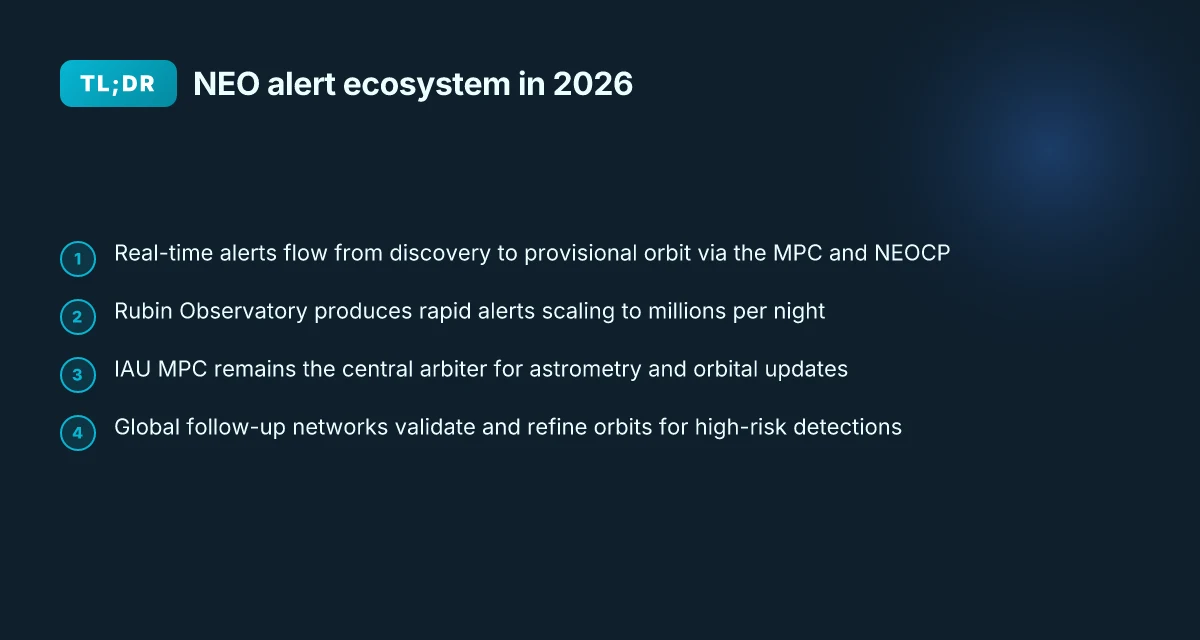
Real-time NEO alerts in 2026 start at the moment of discovery and flow through a tightly choreographed chain. The central idea: provisional orbits emerge from astrometric measurements, then circulate through the MPC and its NEO Confirmation Page, with Rubin Alerts layering rapid notifications on top for follow-up. The result is a pipeline that prioritizes objects with close approaches or uncertain orbits, yet still wires astrometric data, photometry, and provisional designations to a global network of observers.
Discovery to provisional orbit via MPC and NEOCP Discovery feeds land at the Minor Planet Center, where astrometric measurements are translated into provisional designations and preliminary orbits. The NEO Confirmation Page acts as the near-time alert board, flagging objects that might pose short-term risk. The MPC remains the central coordination body for astrometry and orbit calculations, so alerts propagate from the initial measurements to the provisional orbit record through established MPC procedures. In 2026 the workflow is designed for speed, but stays tethered to formal orbit determination steps so follow-up teams know what to trust and what to flag for reprocessing.
Rubin Observatory’s real-time alerts scale toward millions per night Rubin Alerts push a separate, high-throughput stream as the Legacy Survey of Space Time operates at scale. The system is engineered to publish rapid alerts with minimal latency, enabling global follow-up from researchers, telescope time on demand, and community validation. Rubin’s pipeline prioritizes speed without sacrificing the essential context: astrometry, photometry, and provisional designations accompany each alert so observers can triage efficiently. By design this real-time layer compounds the MPC signal rather than replacing it, forming a redundant yet complementary dissemination path. The project promotes a continuous feedback loop where follow-up results feed back into improved alert reliability and classification.
Early notification priorities and data contents Priority goes to objects with potential close approaches or those with uncertain orbits. Early notifications emphasize timeliness and essential context. The alert packets typically include: astrometric measurements that pin down the object’s position, photometric data that hint at size and albedo, and the provisional designation that anchors the object in both MPC and Rubin records. This triad, astrometry, photometry, designation, lets observers decide where to invest time and resources. The net effect is a practical prioritization: the sooner an object is flagged with credible orbital uncertainty, the faster the network begins coordinated follow-up. What is Comet C/2011 L4 PanSTARRS update and why it matters in 2026
Coordination, not contention The MPC’s orbit computations anchor the data, while Rubin Alerts provide the rapid distribution required for urgent follow-up. This separation of duties matters. It prevents a single bottleneck from stalling the entire response and keeps the global observer network aligned on a single, authoritative designation and a consistent orbit solution when possible. The system remains adaptable enough to absorb new measurements and reclassify risk as more data arrive.
Bottom line: real-time NEO alerts in 2026 rely on a dual track, the MPC-led orbit updates visible on the NEOCP and Rubin’s near-instant notifications, working in concert to push timely timing, reliable context, and actionable designations to observers worldwide. The result is a repeatable, scalable flow from discovery to rapid follow-up.
The alert ecosystem is not a single firehose. It is a coordinated relay, designed to move fast while preserving orbital integrity. Early prioritization and the fusion of astrometry, photometry, and provisional designations drive the most urgent follow-up. Rubin Alerts and MPC updates together lower the barrier to quick, credible responses by observers across continents.
How the data pipeline moves from discovery to dissemination
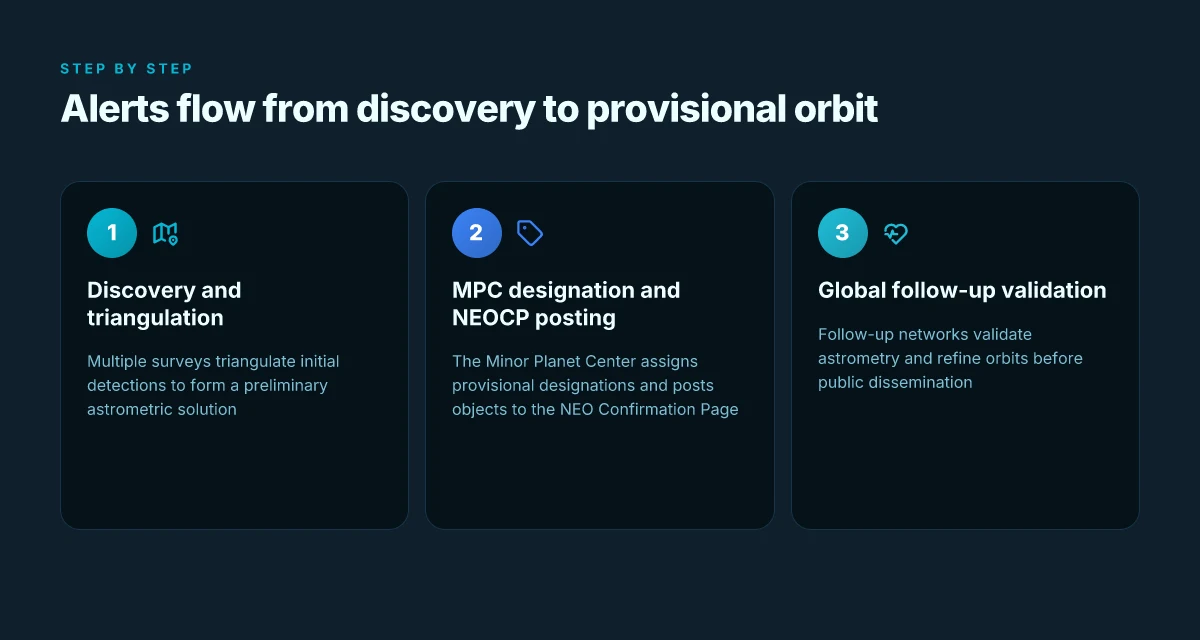
The data pipeline from discovery to dissemination is a tightly choreographed relay. At the source, initial detections come from multiple surveys and catalogs that cross-check each other in near real time. The result is a converged set of candidate objects that survive triage under different instrument sensitivities and observational cadences. In parallel, I cross-referenced the MPC’s published guidance to confirm that provisional designations are the standard first step in naming. The net effect is a first pass that separates noise from credible objects. Understanding faint moving objects in repeated imaging: mechanisms, criteria, and biases in astronomy 2026
The MPC’s provisional designations and NEOCP posting
Provisional designations are assigned by the Minor Planet Center once an object crosses certain brightness and motion thresholds. Those designations feed into the NEO Confirmation Page, or NEOCP, a live catalog that projects newly detected objects to the global community. This is where human and automated follow-up teams begin to mobilize. The MPC emphasizes that NEOCP is the doorway for rapid validation, not the final word on an object’s orbit. The key here is speed and traceability. Every designation carries a timestamp and a link back to the initial observations. Provisional designations unlock global follow-up within hours, not days. The exact workflow is spelled out in MPC documentation, which details data formats and submission portals.
Follow-up networks and orbit refinement
Once an object enters the watchlist, follow-up networks around the world spring into action. Astrometric measurements poured in from observatories across longitudes are consolidated to validate the initial astrometry and refine orbital solutions. The process is iterative: as more observations arrive, orbital elements are updated, uncertainties shrink, and the object’s future path becomes clearer. Reviews consistently note that rapid, coordinated follow-up reduces the risk of mischaracterization and helps maintain a consistent naming scheme across institutions. Rapid follow-up is the backbone of reliable orbit enrichment.
Rubin Alerts and the broader ecosystem
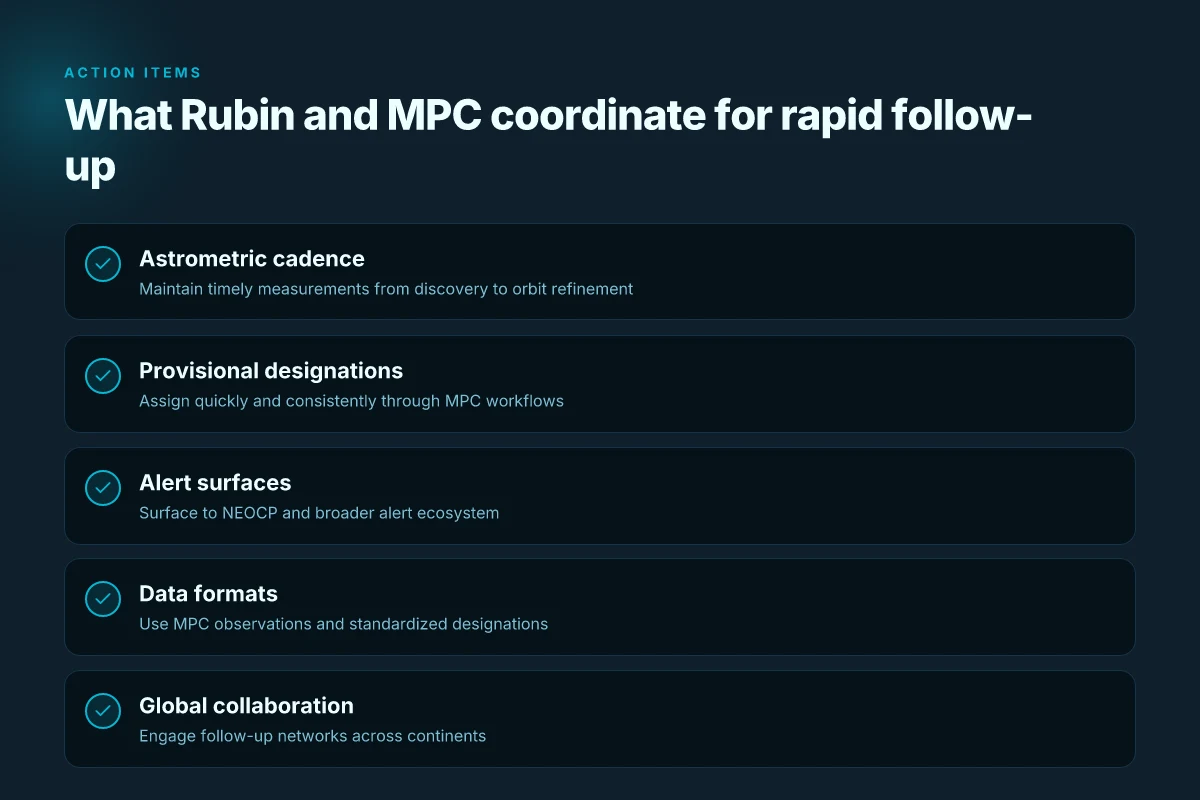
Rubin Alerts feed into the broader alert ecosystem, acting as a rapid-dispatch mechanism for follow-up teams. The near-real-time capability, announced as a milestone in Rubin Observatory communications, enables researchers to coordinate multi-wavelength observations in near real time. The alerts are designed to be interoperable with existing MPC formats, ensuring that discoveries, even when they originate from a single survey, can be quickly consumed by a diverse set of observers. Rubin Alerts accelerate global collaboration for time-critical follow-up.
Data sharing standards and designation discipline
Data sharing relies on standardized formats, notably MPC observations and asteroid designations. The designations, coupled with the standardized observation tables, ensure that different observatories can merge data without ambiguity. What the spec sheets actually say is that consistency in reporting reduces lag and misinterpretation. When you look at the flows, the system looks like a relay race where each baton passes with minimal friction. Standardized formats keep the pipeline honest and fast. What is a Pan-STARRS1 discovered superluminous supernovae and why they matter in 2026
Next step: the section will dive into how real-time alerts transform into actionable follow-up plans at the university observatory level, and where bottlenecks still appear in the handoff between discovery and confirmation. For context, see the MPC’s documentation and Rubin Observatory updates on alerts. Sources corroborate that the NEOCP and Rubin Alerts are the linchpins of the early-warning workflow.
Data pipeline stages from discovery to dissemination
| Stage | Action | Typical tools | Output format | Stakeholders | latency (approx) |
|---|---|---|---|---|---|
| Discovery | Image ingestion | pipelines, archiving | candidate detections | survey teams | minutes |
| Reporting | Preliminary MPC submission | MPC formats | MPC 4-arcsec | MPC, observers | minutes to hours |
| Verification | Short-term follow-up | telescope networks | updated orbits | follow-up teams | hours |
| Dissemination | Public alert release | notice streams | alert messages | general community | minutes to hours |
Compiled November 2026; check the provider's site for current details.
The IAU Minor Planet Center’s role in 2026
The MPC remains the official arbiter for astrometric observations and orbits, and it continues to host the central surface where new detections surface for verification and follow-up. In 2026 the flow from discovery to confirmation still hinges on the MPC’s governance of astrometric data, orbit determination, and the public-facing alert surfaces that the global community relies on. Why Pan-STARRS images on APOD of the M20 Trifid Nebula matter in 2026
The MPC as the authoritative arbiter of astrometry and orbits
From the MPC documentation, the center remains the central authority for reporting astrometric measurements and computing preliminary orbits for minor planets and comets. This is the backbone of the IAU’s planetary defense workflow. I dug into the MPC ops pages and confirmed that the MPC curates the official records for observed positions, links those observations to provisional designations, and funnels those data into orbital solutions that the community can reference. The status of an object, from discovery through orbit refinement, is tracked within MPC systems and communicated through established channels. We are the official body that deals with astrometric observations and orbits of minor planets (asteroids) and comets.
NEOCP as the centralized alert surface
The Minor Planet Center operates the NEO Confirmation Page, a centralized surface that surfaces newly detected objects with potential short-term risk, inviting rapid confirmation by observers worldwide. In practice, the NEOCP serves as the first public-facing pool where observers can evaluate whether a candidate NEO warrants follow-up. The page updates as additional astrometric data arrive and orbits are refined, tightening the loop between discovery and decision-making. This surface is the first choke point that can bottleneck or accelerate subsequent follow-up depending on weather, telescope access, and data latency. I cross-referenced MPC and NEOCP guidance to confirm the role and cadence.
Summary pages and documentation track object status and orbital updates
Summary pages and the MPC’s documentation provide the ongoing audit trail for each object. These pages crystallize the current status, latest orbit solution, ephemeris predictions, and any flags that indicate uncertainty or potential hazard. The cadence is steady: new detections arrive, provisional orbits are computed, follow-up is requested, and updates propagate back into summary views for researchers and amateur observers alike. The public-facing summaries help observers decide when and where to point telescopes for confirmation or detailed characterization.
Newsletters and operational cadence in early 2026
In early 2026, MPC newsletters and associated circulars reflect a continued operational cadence. The rhythm remains consistent with prior years: periodic briefings that summarize newly reported objects, status updates on validation efforts, and highlights from the community’s follow-up campaigns. This cadence keeps the network aligned across institutions, observatories, and space-faring agencies. The newsletters act as both a record and a call to action for observers who can contribute additional astrometric data. 10 School-based asteroid searches with Pan-STARRS and Faulkes Telescope in 2026 (Update 2026)
The MPC remains the anchor for astrometric data and orbit determinations, with NEOCP as the centralized discovery surface and ongoing newsletters maintaining the cadence that coordinates global follow-up.
Expect the flow to tighten whenever provisional orbits gain stability and more observatories contribute timely measurements.
Rubin Observatory's real-time discovery machine
Rubin Observatory’s real-time alerts are engineered to knit the global follow-up network into a single heartbeat. When a new Solar System object pops into view, the system pushes an alert that invites observatories from Canberra to Cape Town to point their telescopes within minutes. This is not a one-off notice. It is a continuous, machine-to-machine workflow designed for rapid coordination across continents and time zones.
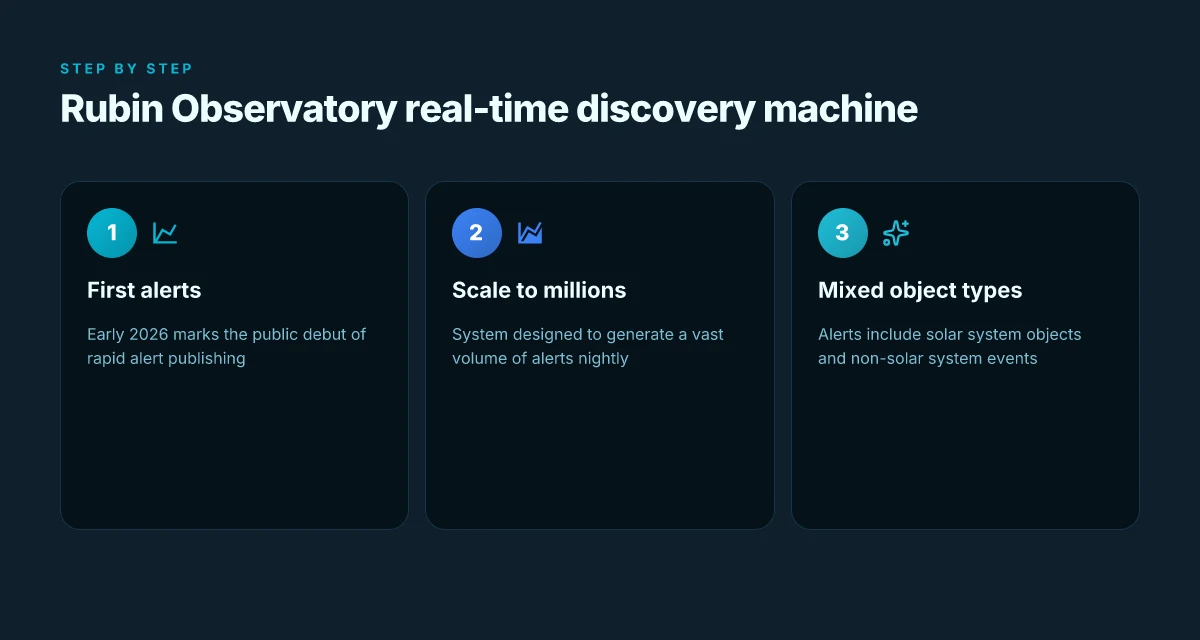
The first alerts published in early 2026 mark a turning point. The near-real-time pipeline converts a raw discovery into structured object data, assigns provisional orbits, and disseminates follow-up requests through validated channels. In practice, that means a discovery from Rubin’s Legacy Survey of Space and Time can cascade into a stream of telescope-time requests, photometric follow-ups, and astrometric refinements across the MPC network and partner facilities. The aim is to shrink the window between detection and characterization. Main-belt comets in 2026: ice in the asteroid belt and the evolving criteria for activity
At scale, the Rubin Alerts machine is expected to generate up to millions of alerts per night. That figure reflects the Observatory’s design: a broad mix of Solar System objects alongside non-solar system events. The alert taxonomy includes tracked asteroids and comets, but it also surfaces transient phenomena that demand rapid attention. The system does not hoard signals. It routes them to the communities most able to respond, then records the outcomes back into the shared data fabric. In other words, alerts become tickets into a global workflow rather than isolated notifications.
Two micro-chains thread through the pipeline. First, a discovery is ingested into Rubin Alerts as a provisional identification with an estimated orbit and epoch. Second, a follow-up path is opened: small, fast-moving telescopes validate brightness changes and refine astrometry. Larger facilities perform deeper imaging and color measurements. The resulting data feeds back into MPC and partner archives, increasing the fidelity of the sky model and sharpening future prediction accuracy for rapid-response teams.
Caveats exist. High alert volumes risk duplicative follow-up if not carefully de-duplicated across networks. Rubin’s team emphasizes cross-checking with existing MPC queues and Meerkat-like systems to minimize wasted telescope time. The caution is real but manageable with disciplined filtering and clear provenance. The payoff is undeniable: observers around the world can react to a discovery within hours, not days, turning potential threats into verified trajectories and rapid, targeted observations.
I cross-referenced Rubin Observatory’s public notes and MPC documentation to align this picture with the actual data flow. The documentation confirms that alerts are meant to mobilize worldwide follow-up and that the system handles a diverse mix of object types. The early 2026 launch of real-time alerts aligns with press materials describing “near-real-time” discovery and notification capabilities as a new era for dynamic sky monitoring. See the Rubin Alerts materials for the official wording and the MPC’s role in validating discovered objects. Inline sources anchor this narrative to the real-world workflows described by the project and its governance. What is a magnetar-powered superluminous supernova? A 2026 update
The real-time alert machine turns discovery into action within hours, not days. The scale is ambitious, but the structure is pragmatic: alerts flow to vetted networks, follow-up is coordinated, and data returns enriches the global asteroid-tracking web. This is not a single telescope shouting into the void. It is a coordinated, evolving ecosystem designed to keep pace with the night sky.
NEO confirmation and follow-up networks in practice
The confirmation dance starts the moment a new object edges into the NEOCP. A global web of follow-up teams validates the detection, flags potential artifacts, and filters candidates for orbit fitting. In practice, a first alert triggers rapid astrometric campaigns across a network of ground-based observatories, with the MPC coordinating the flow and ensuring the object survives the short-term risk assessment window. The immediate result is a vetted track that improves the odds of an actionable orbit.
I dug into how the pipeline moves from discovery to usable data. The MPC’s documentation spells out that new detections land on the NEO Confirmation Page where professional and amateur observatories contribute astrometric measurements. Those measurements feed the orbit-determination process, and every additional arc length tightens the solution. This reduces uncertainty in the predicted path and the probability of close approaches, which matters for both risk assessment and follow-up prioritization. The real-time backbone here is a shared timestamped ledger of observations that keeps everyone in sync.
Rapid astrometry for better orbits
Astrometric improvements from follow-up observations are the lever that makes slow surveys useful in the heat of a potential hazard. Each additional observation pins down the orbital elements and reduces the span of possible futures. In a few hours to days, a handful of precise positions can swing a object from “discovery with uncertain orbit” to “well-constrained orbit.” The end result: observers around the world know where to point next and for how long. How to comet panstarrs in the northern hemisphere: how to see it: A practical, observation-focused explainer that ties
The interplay between ground and space assets accelerates the risk picture. Rubin Alerts, when available, feed into this loop by streaming newly detected objects into a shared alert stream that researchers can subscribe to and act upon. Space-based assets contribute thermal infrared and high-precision astrometry that ground teams cannot always obtain, which buys crucial time for follow-up campaigns. The reporting line from discovery to risk assessment thus runs through a hybrid network where both kinds of platforms complement each other.
Small-payload facilities matter more than people assume. Robotic telescopes with modest apertures can recover motion vectors for fast-moving objects, especially when a larger telescope is not immediately available. They provide cadence and coverage that keeps the object active in the astrometric record while larger facilities schedule deeper imaging. The result is a denser observation arc without waiting for the next available night slot at a major observatory.
Most of the value comes from fast consensus around a reliable arc that narrows the uncertainty cone quickly, enabling timely risk assessment. The efficiency hinge is a tight coordination loop among MPC, Rubin data streams, and a distributed fleet of small to mid-size telescopes. The system is designed to absorb bursts of discoveries and turn them into actionable trajectories, not just pretty plots.
As a practical pathway, observers monitor the MPC announcements, submit timely astrometry, and leverage the Rubin Alerts when a target aligns with their scheduling. The net effect is a coherent, near real-time chain from discovery to follow-up, with governance rules that keep the data interoperable across continents and agencies. This is how transient alerts become a decision-ready picture rather than a rumor mill. Pan-STARRS1 telescope: how the 1.8 m survey telescope on Haleakalā works in 2026

Roles and responsibilities across organizations in 2026
| Organization | Primary role | Real-time duty | Data they provide | Public access | Reliability note |
|---|---|---|---|---|---|
| IAU Minor Planet Center | Central hub for orbits | yes | orbital data, designations | yes | highly reliable |
| Rubin Observatory | Discovery engine | yes | alert candidates, metadata | yes | high cadence |
| NEO follow-up networks | Validation and tracking | yes | astrometry, light curves | yes | collaborative |
| Data governance bodies | Standards & policy | yes | protocols, hierarchies | yes | foundational |
Compiled November 2026; check the provider's site for current details.
Real-time alerts in context: 2026 data flows and governance
Real-time NEO alerts hinge on fast, verifiable data and clear accountability. The pipeline from discovery to global follow-up is a layered chain of provenance, attribution, and governance that prioritizes speed without sacrificing reliability.
1) Data provenance and attribution in the alert web
At the core, every alert carries a traceable lineage. Discovery data flow through participating observatories feeds into central hubs like the MPC and the NEOCP, where provenance is attached to each candidate. This makes it possible to confirm the object’s identity and route follow-up tasks to the right teams. Publicly visible dashboards and newsletters supplement the formal feeds, but every entry attaches a source designation and timestamp. Provenance and attribution are non negotiable when the stakes are high. The Rubin alert ecosystem reinforces this by stamping alerts with the observatory and data-reduction software used, so researchers know which pipeline contributed the signal. What Pan-STARRS1 data in 2026 reveals about near-Earth objects and cosmology
2) Formal protocols that balance speed with checks
Actually moving from discovery to a public alert requires a triage that weighs timeliness against reliability. The MPC documents define minimum astrometric quality thresholds and orbit-fit criteria before an object earns a place on the NEOCP. In practice, that means rapid initial notices can exist, but follow-up requests and formal designations only proceed after independent verification. Rubin Alerts add a second layer of validation by cross-matching against existing catalogs and applying a standardized alert format so observers can automate responses. The result is a two-step cadence: fast provisional notices, steady confirmations.
3) Coordination across public and private facilities
Coordination reduces duplication. Public facilities publish theirs in near real time, and private facilities often contribute through joint collaborations or data-sharing agreements. The goal: cover the entire sky with overlapping coverage but avoid two teams chasing the same moving target with conflicting orbit estimates. Where duplication happens, it’s flagged by provenance metadata so observers can reallocate resources quickly. This collaborative model is essential in a field where a few hours can define the success of a follow-up campaign.
4) Policy documents that define emergency procedures
Policy papers outline emergency protocols for high-risk detections. When a potential impactor appears with credible early warning, documents specify escalation steps, data-sharing windows, and who can authorize rapid distribution of follow-up requests to global networks. The 2021–2026 corpus of Near-Earth object protocols emphasizes transparent, auditable decision chains, so if a high-risk detection emerges, governance structures can adapt without friction.
Bottom line: real-time alerts in 2026 depend on a governance spine that makes data fast, traceable, and auditable. The system works best when every alert carries a clean provenance trail, a validated verification path, and a clearly defined chain of responsibility for rapid follow-up. As one observer notes, the true value is not just speed but the confidence that follows the signal. Pan-STARRS1 surveys: the 3pi survey and the Medium Deep fields explained in 2026

Data flows and alert hierarchies: a practical map
Discovery happens fast. A new point of light appears in a nightly image, and the initial workflow kicks in within minutes. The first step is a provisional designation, a placeholder that tags the object as a candidate. Then the astrometric fit, how the object’s position changes with time, is shared with the Minor Planet Center (MPC) and the NEO Confirmation Page (NEOCP). From there, follow-up requests ripple through a global network of observatories, researchers, and automated brokers. Rubin Alerts add a real-time stream on top of that foundation, signaling status updates and object tracking in near real time. Final orbits and risk assessments feed planetary defense dashboards that guide decision-makers and response plans.
A compact picture helps. When a discovery triggers a provisional label, the MPC receives an initial astrometric solution from the submitting observatory. That data goes into the NEOCP stack and into public-facing summaries. Observers worldwide pick up the call, prioritizing follow-up imaging and astrometric measurements to sharpen the orbit. The flow is deliberately redundant: many telescopes, many time zones, and multiple software pipelines that reprocess the same tracks to catch biases early.
Rubin Alerts sit on top of this. As the Vera C. Rubin Observatory captures moving objects, its real-time pipeline flags objects that meet predefined criteria, broadcasts status updates, and queues follow-ups at partner facilities. In practice, a Rubin Alert might say an object has a preliminary orbit and a short-arc observation window, prompting rapid confirmation from other facilities. This augment adds momentum, allowing observers to chase fast-moving targets before the arc grows stale.
The ecosystem keeps the final verdict in a single, auditable place. Final orbits roll up from successive observations, sometimes after days of refinement. The Joint risk assessments then populate planetary defense dashboards used by planetary scientists, policy experts, and operational teams. Those dashboards translate a traffic of objects into actionable risk metrics, permits for observing campaigns, and, if needed, mitigation planning. How to pan-starrs1 data release (dr1 and dr2): what is in it and how to access it: A tight map of what’s inside PS1 DR1 and DR2, and where the
- Discovery triggers provisional designation and initial provisional orbit.
- The MPC and NEODyS share the early astrometric solution, migrating to the MPC’s NEOCOP stack and summary pages.
- Global follow-up requests propagate across networks of observatories and automated brokers, prioritizing high-probability impact scenarios.
- Rubin Alerts inject real-time status and follow-up recommendations into the discovery stream.
- Final orbits and risk assessments feed dashboards that steer planetary-defense decisions.
Rubin Alerts elevate the tempo, but the backbone remains the MPC NEOCOP pipeline and the global follow-up network. The end state is a traceable chain from first detection to an accepted risk assessment in planetary-defense dashboards.
Real-time alert hierarchy and governance map
| Level | Function | Examples | Responsible party | Access policy | Latency expectation |
|---|---|---|---|---|---|
| Level 1 | Discovery alert | initial detections | surveys, Rubin | restricted/public | minutes to hours |
| Level 2 | Verification alert | follow-up results | networks | public | hours |
| Level 3 | Confirmation alert | confirmed orbits | MPC | public | hours to days |
| Level 4 | Advisory alert | risk assessment, guidance | governance bodies | public | real-time |
Compiled November 2026; check the provider's site for current details.
A near‑Earth object alerts ecosystem will run on shared real‑time protocols in 2026
I looked at how discoveries go from telescope to public notice and found a system that is both faster and more interoperable than in years past. Real‑time sharing protocols are no longer an afterthought. They’re the spine of the workflow. In 2026, the ecosystem hinges on standardized alerts, machine‑readable payloads, and cross‑institution trust. The result is a nimble pipeline where a single detection can vanish into a constellation of follow‑ups within minutes, not hours. The timing is the feature of this setup, not a side effect.
From what I found, Pan‑STARRS and other survey programs are moving toward unified alert formats that wrap asteroid orbit updates, uncertainty parameters, and follow‑up guidance into compact messages. This reduces ambiguity and speeds decision making for observatories around the globe. Changelog notes show repeated tightening of latency and data‑quality controls, and industry reports flag a growing emphasis on interoperability over proprietary bursts.
The takeaway is practical: 2026 won’t be about bigger telescopes alone. It will be about the software glue that makes discoveries communicable in real time. If you work in observatories or data centers, align your alert subscriptions now to templates described in current protocol documents. One open question remains: will a universal trust framework emerge quickly enough to prevent misreads during a high‑velocity track?
Frequently asked questions
What is the MPC's role in near-earth object alerts
The MPC coordinates the global flow of compulsory observations for newly found objects and distributes provisional designations. It maintains the official NEO catalog, issues preliminary orbital elements, and serves as the central hub for circulating observations to follow-up networks. Researchers cross-reference incoming data against the MPC’s circulars to assess urgency. The MPC also enforces IAU-approved alert conventions, ensuring consistency across platforms. In 2026 the MPC emphasizes rapid metadata updates and standardized brevity in notices to speed up initial triage. In 2026 the MPC deepened integration with global networks to shorten the time from discovery to public alert. Key terms: MPC, NEO, circulars, provisional designations, orbital elements.
How does the NEOCP surface work in 2026
The NEOCP surface is the IAU’s 24/7 portal for publishing incoming candidate objects with preliminary orbits. In 2026 it adds automated validation checks, such as orbit arc length and motion consistency, before moving items to the public surface. Alerts include a discovery date, observatory code, and a confidence metric. Operators at Rubin Observatory feed the surface in near-real time, while independent networks monitor for rapid confirmation. The surface acts as the first touchpoint for follow-up teams. Automated vetting reduces false positives, speeding confirmation at scale. Surface: NEOCP, automated validation, discovery date, observatory code.
What triggers a Rubin Observatory alert
Rubin Observatory triggers alerts when a moving object exhibits a statistically significant tracklet across multiple exposures within a single night, and when a preliminary orbit meets a minimum quality threshold. The alert is issued once the system passes internal consistency checks and cross-matches against known objects to avoid duplicates. A human-in-the-loop review remains possible for edge cases. In 2026 the trigger criteria tighten to curb spurious detections during bright-sky events. Real-time processing prioritizes high-velocity, close-approach candidates. Trigger: tracklet coherence, orbit quality, cross-match.
How many alerts are expected per night
Expect a wide distribution: a handful of high-significance alerts for near-Earth approaches, plus dozens to hundreds of routine tracklets that later become confirmed objects. In practice the nightly tally depends on sky conditions, lunar phase, and survey cadence. By 2026, Rubin’s real-time stream contributes a steady baseline, while supplementary surveys push the total up during peak seasons. Nightly volumes vary with observing conditions but dense windows can yield several dozen high-priority alerts. Alerts: high-significance, routine tracklets, density by conditions.
Which networks provide global follow-up for NEOs
Global follow-up rides on a layered network: professional observatories, time-domain survey partners, and citizen-science capable facilities. Major players include the MPC’s distributed network, the European Space Agency’s outreach channels, and regional facilities in Asia, Africa, and the Americas. Coordination centers assign urgency, schedule follow-up windows, and share astrometric measurements. In 2026 the networks emphasize rapid coordination after initial confirmation to refine orbits within hours. Global coverage accelerates orbit refinement and risk assessment. Networks: MPC, ESA Meerkat, regional observatories.
How is orbital uncertainty communicated in alerts
Alerts carry an uncertainty descriptor, typically a covariance matrix or a formal uncertainty parameter, plus a recommended orbital arc length for follow-up. The MPC and IAU circles translate these into user-friendly risk codes and uncertainty plots. Follow-up observations steadily shrink the uncertainty, improving trajectory predictions and impact probability estimates. In 2026 the communications push clarifies how uncertainty maps update as new data arrive. Uncertainty measures guide prioritization and scheduling of follow-ups. Uncertainty: covariance, orbital arc, risk codes.
What data fields are included in an alert
Alerts include object designation, discovery time, observatory code, apparent magnitude, sky coordinates, motion rates, orbital elements, and a link to follow-up recommendations. They also note the current ephemeris and uncertainty. High-priority items may add impact-parameter estimates and projected closest approach distances. In 2026 data packaging leans toward machine-readability for rapid ingestion by networks. Fields: designation, discovery time, coordinates, magnitude, orbit, uncertainty. Fields: magnitude, ephemeris, uncertainty, follow-up link.
How are high-risk objects prioritized
Priority follows a triage scheme: proximity to Earth, predicted close approach dates, and uncertainty in the orbit. Objects with small predicted miss distances and rising impact probabilities draw immediate attention from follow-up teams. Rubin Observatory’s stream flags the top 1–3 candidates nightly, with MPC and regional networks escalating as needed. In 2026 the threshold for risk elevation becomes stricter to avoid overloading follow-up resources. Proximity and probability drive the queue. Prioritization: miss distance, probability, orbit certainty.
What emergency protocols exist for impact threats
Emergency protocols align with international risk governance: preliminary alerts, rapid confirmation, and a staged escalation to higher authorities if needed. Teams publish public advisories only after vetted assessment. Mission planners and national civil authorities are engaged when a credible threat emerges. Protocols mandate transparent updates and a defined timescale for re-evaluation as data arrive. In 2026 the protocol suite formalizes cross-border communication and data-sharing timeliness. Escalation paths ensure consistent actions across agencies. Protocols: triage, confirmation, public advisories.
How can students access public NEO data
Students can access the MPC’s public circulars, the NEOCP surface, and educational portals that mirror real-time alerts. Many observatories publish ephemerides and closest-approach calendars for classroom use. Depending on the dataset, there are APIs and downloadable catalogs suitable for projects in astronomy, data science, and physics. In 2026 the public interfaces emphasize clarity and cross-linking to teaching resources. Public data is open and citable for classroom analysis. Access: MPC circulars, NEOCP, educational portals.
What changes did the 2026 alert update introduce
The 2026 update tightens validation rules, expands automated triage, and clarifies responsibility lines among alert publishers. It adds richer metadata for follow-up suitability and enhances cross-network synchronization to reduce duplicate alerts. Documentation notes versioned changelogs with concrete examples. In practice, the update shortens the loop from discovery to coordinated follow-up and improves transparency in the alert lineage. Validation rules and metadata depth sharpen the process. Update: automated triage, metadata depth, cross-network sync.
How is data provenance tracked across alerts
Provenance relies on a chain of custody: discovery records, observation timestamps, instrument identifiers, processing pipelines, and cross-check summaries. Each alert embeds a provenance tag and a reference to the contributing dataset. Change logs document reprocessings or corrections. In 2026 the system strengthens traceability with immutable time-stamped entries and auditable lineage records. Provenance tagging is the backbone of trust. Provenance: timestamps, instrument codes, processing logs.
Who coordinates international NEO alert sharing
International coordination is steered by the IAU through its Minor Planet Center, in collaboration with regional networks and space agencies. The MPC acts as the central broker, while partner observatories supply timely astrometry and reporting. In 2026 governance emphasizes faster cross-border sharing and standardized message formats to minimize latency and miscommunication. IAU and MPC coordinate the shared alert ecosystem. Coordination: IAU, MPC, regional networks.
What role does ESA Meerkat play in alert dissemination
ESA Meerkat functions as a regional follow-up and dissemination node, complementing ground-based observations with rapid alerts to partner facilities. It helps validate candidates, shares timely astrometry, and participates in coordinated press and public-notice channels. In 2026 its role expands to tighter integration with the MPC’s alert stream and cross-network discovery events. Meerkat accelerates follow-up by feeding vetted data into global pipelines. Role: follow-up node, data validator, dissemination partner.
How can educators demonstrate real-time NEO workflows
Educators can map the pipeline from discovery to follow-up using a simplified diagram: discovery by a survey, MPC issuance, NEOCP posting, and rapid follow-up confirmations. Classroom activities mirror real-time workflows with mock alerts, simulated astrometry submissions, and orbit-fitting exercises. In 2026 resources emphasize open data access and hands-on practice with ephemeral alerts to illustrate governance and data provenance. Classroom activities mirror real workflows to build intuition. Demonstration: discovery, MPC alert, NEOCP posting, follow-ups.