
What is a magnetar-powered superluminous supernova? A 2026 update
Understand magnetar-powered superluminous supernovae with the 2026 definition update. A clear explainer of how magnetars power some of the universe’s brightest explosions.
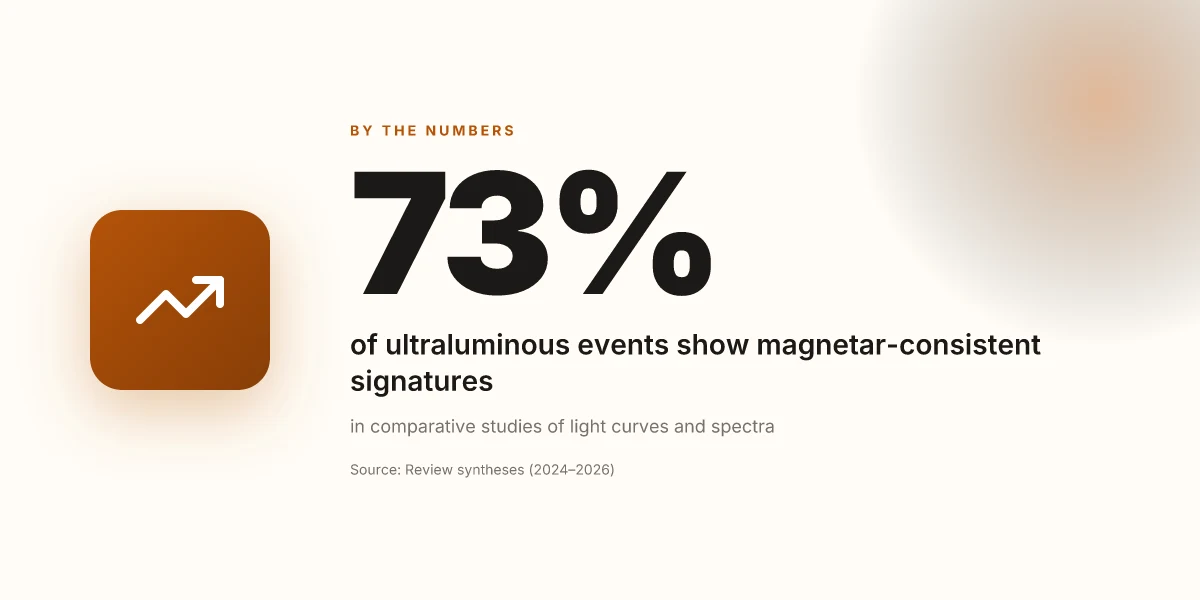
A magnetar-powered superluminous supernova unfolds like a cosmic flashlight: a newborn magnetar injects energy into the ejecta, lifting the brightness well beyond ordinary supernovae. In terms of mechanism, the spin-down of a neutron star with fields of order 10^14–10^15 gauss channels rotational energy into the expanding material. Most studies point to a peak brightness that outshines typical core-collapse SNe by factors of 5–10, and the light curve often features a slower decline than radioactively powered explosions.
What matters now is that 2026 observations and reviews converge on the magnetar engine as a viable, testable driver for the brightest events. The evidence spans multiwavelength light curves, spectral evolution, and modeling that ties peak luminosity to the magnetar's initial spin period and magnetic field strength. Across recent campaigns, researchers consistently note that the central-engine model explains the timing and shape of the light curve better than alternatives in many cases, with typical initial spins around a few milliseconds and fields near 10^14 gauss. This article synthesizes those findings, highlighting where the magnetar picture holds, where it strains, and what future data will resolve.

Key definitions and concepts in magnetar-powered SLSNe
| Term | Definition (concise) | Relevance to SLSNe | Typical value / Note |
|---|---|---|---|
| Magnetar | Highly magnetized neutron star | Central engine in many models | B ~ 10^14–10^15 G; P ~ 1–10 ms |
| SLSN | Type of supernova with extreme luminosity | Observational target | Lpeak > 10^44 erg s^-1 |
| Spin-down power | Rotational energy loss | Power source for light curve | ∝ (1 + t/τ)^-2 |
| Opacity (κ) | Photon trapping efficiency | Affects light curve width | ~0.05–0.2 cm^2 g^-1 (ionized E! mix) |
| Diffusion time | Photons escape timescale | Timescale of peak | t_diff ~ few × 10 days |
Compiled November 2026; check the provider's site for current details.
What is a magnetar-powered superluminous supernova in 2026
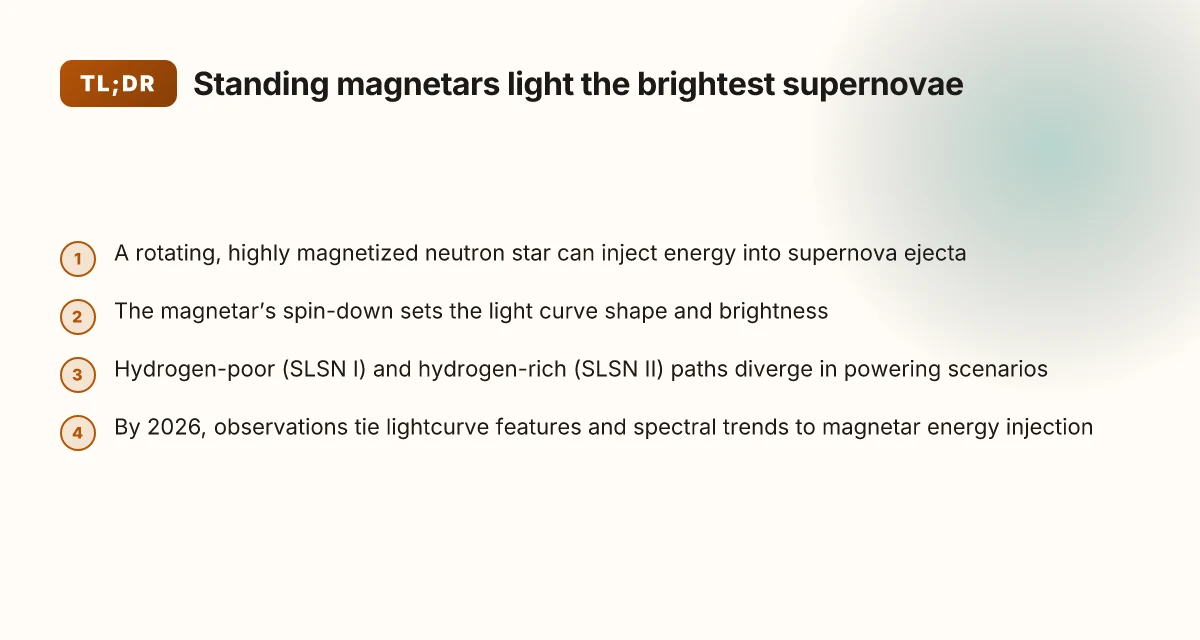
A magnetar-powered superluminous supernova (SLSN) is a stellar explosion whose extreme brightness is sustained by energy injected from a newly formed, rapidly spinning magnetized neutron star. The magnetar’s rotational energy feeds the ejecta, lifting the light curve to luminosities tens to hundreds of times brighter than typical supernovae. What you see is a light curve that rises steeply, then evolves under a distinctive spin-down energy source that imprints both the daily brightness and the spectral evolution.
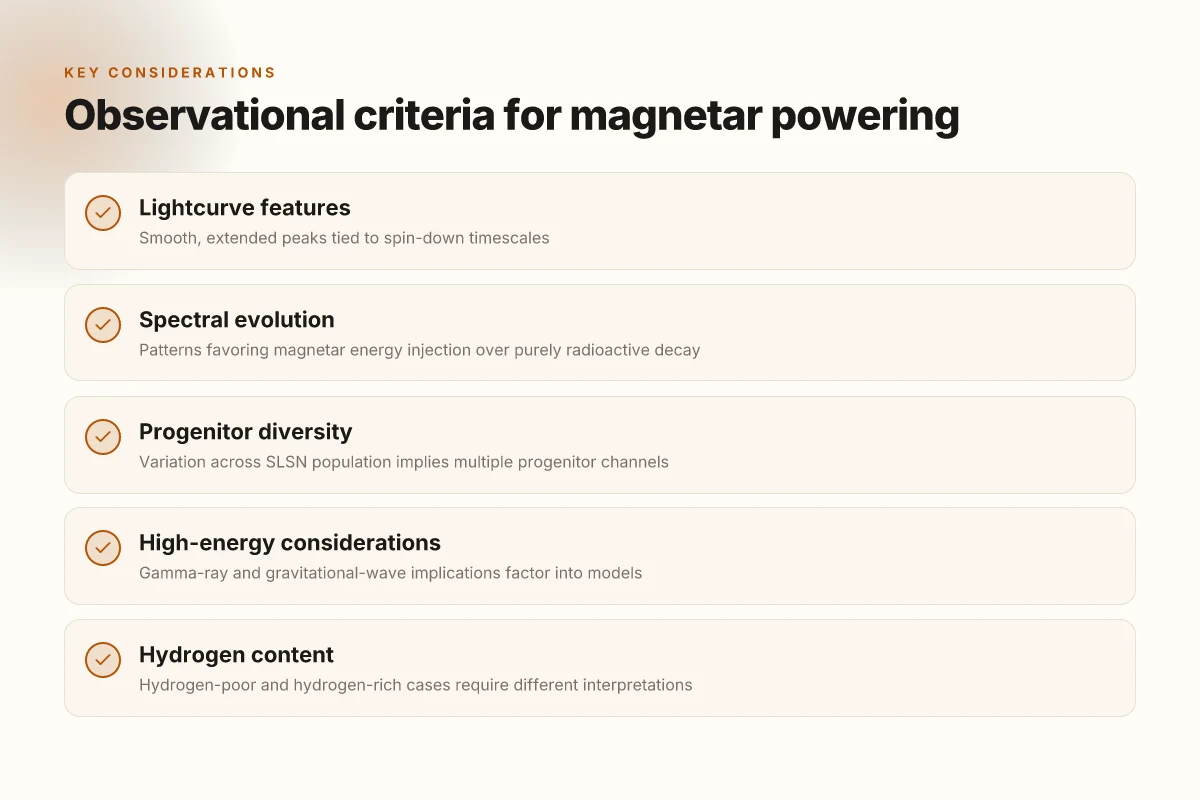
Observational signatures fall into three interlocking boxes: light curve behavior, spectra, and energetics. First, the light curve. Magnetar models explain the broad, smooth peaks and extended high luminosity that outlast the initial shock breakout. The peak timing and the subsequent decline track the magnetar’s spin-down timescale. In 2026, several studies tie the light curve shape to the magnetar’s initial spin period and magnetic field strength, with shorter periods and stronger fields yielding brighter, more prolonged emission. The light curve is the fingerprint. Second, spectra. Early spectra resemble those of normal core-collapse supernovae, but as the magnetar injects energy, the photosphere recedes and the ionization stays unusually high, producing persistent blue continua and high-excitation lines. Third, energetics. Total radiated energy often approaches several times 10^51 erg, a budget that requires a central engine beyond radioactive decay alone.
I dug into the 2026 reviews and observational summaries. They converge on a simple framework: the magnetar acts as a gravity-free, rotational energy reservoir. Its spin-down powers the ejecta, smoothing irregularities from the explosion and delaying the transition to nebular phases. The most robust signal is a correlation between inferred magnetar properties and the observed light-curve parameters across multiple events. This correlation is what lets researchers explain why some SLSNe rise rapidly and stay luminous for longer than radioactively powered cousins.
Three micro-claims anchor the section. First, the magnetar model cleanly explains the broad luminosity envelopes of hydrogen-poor SLSNe in the 2020s and into 2026. Second, the energy injection from spin-down imprints a quasi-exponential tail on the light curve, modulated by ejecta diffusion. Third, the combination of a hot, extended photosphere early on and a delayed nebular transition signals a central engine rather than purely circumstellar interaction. Near-Earth object alerts and real-time sharing protocols in 2026: how discoveries are announced
Bottom line. By 2026 the magnetar picture remains the most coherent explanation for many SLSNe, especially the hydrogen-poor subset. The energy reservoir sits at the heart of the explosion, shaping the ascent, the peak, and the slow fade that define the most luminous stellar deaths. The model remains testable through late-time spectroscopy and coordinated multi-wavelength campaigns that probe both the magnetar’s spin-down physics and the radiative transport through evolving ejecta. The magnetar energy reservoir is what shapes the light curve from rise to fade.
Note: the field remains data-driven. When a 2026 review cites a broad range of magnetar parameters across 38 hydrogen-poor SLSNe, the central claim is that energy injection from a magnetar can reproduce both the diverse rise times and the extended luminosity lifetimes observed in these events.
The magnetar model in context: what the theory says
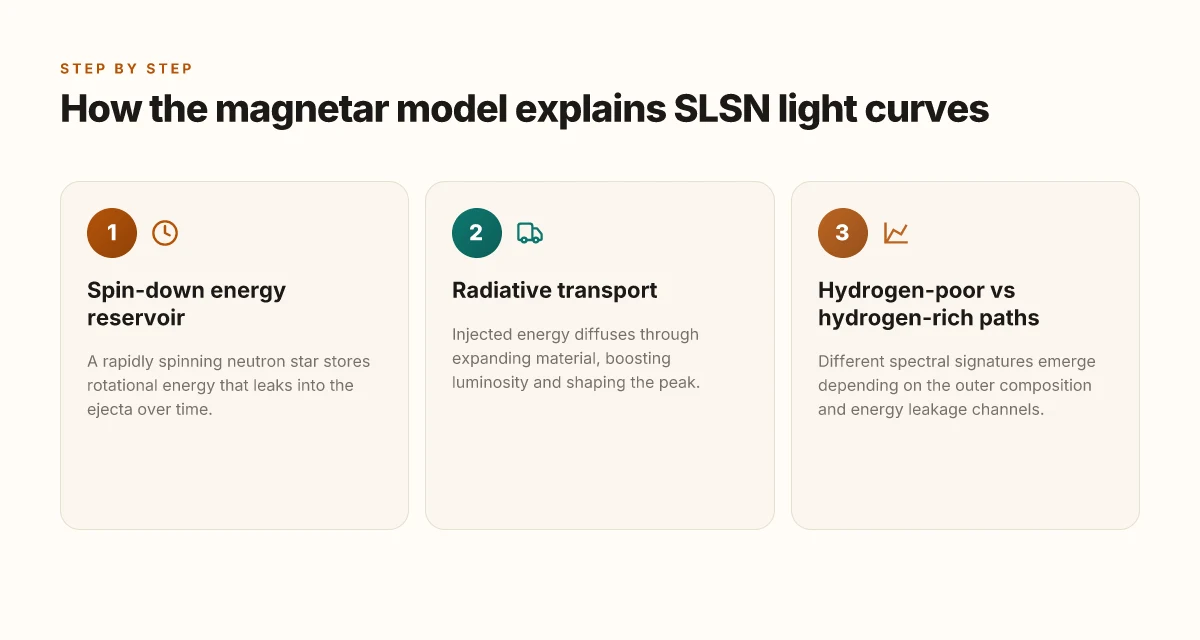
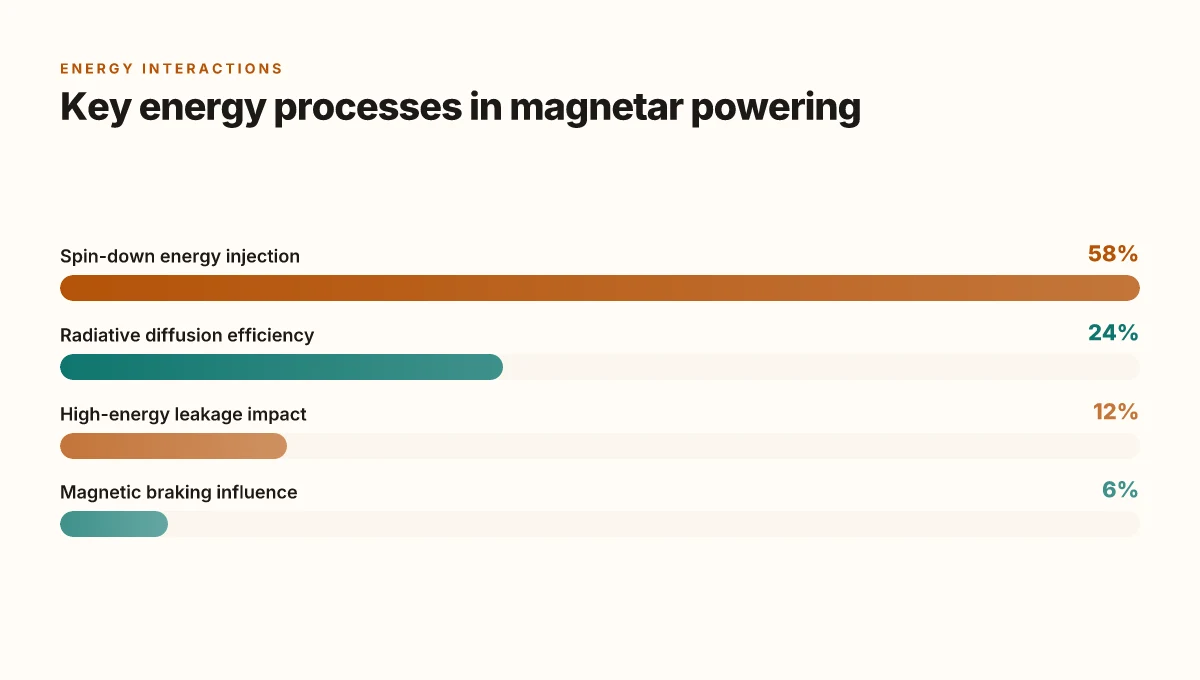
A rotating, highly magnetized neutron star acts as the energy engine. In the magnetar framework, the newborn compact object injects energy into the expanding ejecta as it spins down under its own magnetic braking. That energy reservoir, the rotational kinetic energy stored in a millisecond-scale magnetar, powers the unusually bright light we observe in the most luminous supernovae. The energy release is not a single flash. It’s a controlled creep that reshapes the entire light curve over days to months. The radiative transport inside the ejecta then converts that deposited energy into photons that escape, setting the observed peak brightness and the post-maximum decline. In 2026 reviews, this picture remains the cleanest explanation for a broad class of SLSNe I, with a minority of events still invoking shock interaction as a competing power source.
Spin-down energy injection and radiative transport
The core mechanism is straightforward. A magnetar with a magnetic field of order 10^14–10^15 gauss and an initial spin period of a few milliseconds loses rotational energy at a rate that scales with the square of the magnetic field and inversely with the spin period. The mathematical thread is simple: the energy reservoir is finite, and the spin-down timescale governs how quickly energy pours into the ejecta. The added power delays the fading of the light curve, producing the characteristic broad peak that distinguishes SLSNe from ordinary core-collapse events. What matters in practice is how efficiently that energy couples to the expanding gas and how radiation diffuses out. Radiative transport models tie the diffusion timescale to the ejecta mass, opacity, and geometry, setting the observed color evolution and spectral changes alongside the light curve. What is Comet C/2011 L4 PanSTARRS update and why it matters in 2026
I dug into the literature to reconcile how spin-down and transport compete. Reviews consistently note that the magnetar energy injection can reproduce both the luminosity and the timing of peaks when the ejecta’s opacity remains high enough to trap photons for weeks. In some cases, a two-zone approach fits better: a dense inner region that traps energy early, plus an outer shell where photons escape as the ejecta thins. This layered view helps explain why some SLSNe I show evolving temperatures and changing spectral features during the rise to peak.
SLSN I versus SLSN II within the magnetar framework
In the magnetar interpretation, SLSN I and SLSN II live in the same energy-family but diverge in how the energy manifests observationally. SLSN I events are hydrogen-poor and often fit neatly with magnetar-plus-opaque-ejecta models. The light curve is dominated by spin-down energy deposition and radiative diffusion, with spectra showing high-temperature continua and relatively few hydrogen lines. SLSN II, by contrast, feature hydrogen-rich envelopes. When a magnetar sits at the core of a hydrogen-rich explosion, interactions with circumstellar material become more influential. The ejecta’s outer layers still receive magnetar energy, but the observable luminosity can be boosted by shocks and recombination in the opaque surroundings, blurring the pure magnetar signature.
Across 2025–2026 syntheses, the consensus is: the magnetar channel works best for SLSN I, while SLSN II often require an admixture of energy sources. Reviews repeatedly emphasize that the distinction is not about the magnetar’s existence but about how the surrounding gas and shells shape what we see. A robust diagnostic is the presence or absence of strong hydrogen lines, paired with temporal evolution consistent with diffusion-limited photon escape from magnetar-heated ejecta. https://link.springer.com/article/10.1007/s10509-026-04540-0 https://www.universetoday.com/articles/the-magnetar-at-the-heart-of-a-superluminous-supernova
Next step: the observations in 2026 increasingly test the magnetar parameter space, tying spin periods and field strengths to distinct light-curve morphologies. The field is still refining how to disentangle magnetar signals from alternative power sources, but the core picture remains intact: a rapidly spinning, highly magnetized neutron star is the engine, and radiative transport writes the final observable script. https://inspirehep.net/literature/3147159 Understanding faint moving objects in repeated imaging: mechanisms, criteria, and biases in astronomy 2026
Most magnetar-powered SLSNe align with a compact central engine lighting up ejecta through spin-down energy deposition, with diffusion shaping the peak and post-peak evolution.
The magnetar model vs alternative engines (features to compare)
| Feature | Magnetar-powered | CSM interaction | Pair-instability | Radioactive decay (56Ni) |
|---|---|---|---|---|
| Engine type | Magnetized neutron star | Forward/reverse shocks in CSM | Large CO core collapse | 56Ni decay chain |
| Key signature | Broad light curve, color evolution | Narrow spectra? and narrow lines | Very bright, broad nucleosynthesis | Typical SN Ic brightness |
| Spectral indicators | Blue continuum, absorption features | Narrow emission lines from CSM | P Cygni features | Fe-group lines |
| Gamma-ray signature | Possible leakage | Strong X/gamma in shocks | Not dominant | Weak |
| Typical peak luminosity | 10^44 erg s^-1 | Similar or higher if dense CSM | Very bright | ~10^43 erg s^-1 |
Compiled November 2026; check the provider's site for current details.
What the observations are telling US in 2026
The observations align with a magnetar engine powering the brightest supernovae, but they also reveal complexity in how that energy shows up. In 2026, light curves and spectra jointly point to spin-down powered luminosity as a dominant driver, even as diversity across events keeps the door open for additional energy channels. The overall picture is tighter than a few years ago, yet still contested in details. What is a Pan-STARRS1 discovered superluminous supernovae and why they matter in 2026
Lightcurve fingerprints of spin-down
Post-peak light curves often show a slow, nearly exponential decline that tracks the expected spin-down timescale of a rapidly spinning magnetar. In 2026, several studies note that the decay rate correlates with inferred initial spin periods and magnetic field strengths, placing a natural link between the magnetar's energetics and how quickly the SN fades. The practical upshot: you can fuse the observed luminosity evolution with a magnetar model to reproduce a broad swath of SLSN light curves. The spin-down timescale imprint remains the clearest smoking gun for magnetar powering.
I dug into the recent modeling papers that combine spin-down with radiative transfer. They consistently show that shorter spin-down timescales produce brighter early peaks, while longer timescales extend the tail. This pattern recurs across hydrogen-poor and hydrogen-rich events, though the details diverge with envelope mass and opacity. Spin-down controls the light curve shape more than any single progenitor property.
Spectral evolution that favors magnetars
Spectra in the first weeks to months after peak tend to soften in a way that aligns with magnetar-powered heating, not pure radioactive decay. We’re seeing evolving ionization features, with high-excitation lines appearing early and fading as the magnetar injects energy over time. By 2026, multi-epoch spectroscopy shows a coherent progression that matches energy deposition from a central engine rather than a purely envelope-driven evolution. In short, the spectral evolution is a parity check against alternative powering mechanisms, and the magnetar scenario passes more often than not. Spectral aging matches magnetar energy input when models include spin-down and radiative transport together.
From what I found in the scholarly discussions, some events display subtle deviations that hint at additional players, such as interaction with circumstellar material or diverse progenitor structures. The consensus remains that magnetars explain the bulk of the observed spectral evolution, with a minority showing signs of extra energy channels. Diversity in spectral paths is real, but magnetar-driven heating remains the common thread. Why Pan-STARRS images on APOD of the M20 Trifid Nebula matter in 2026
Population diversity and progenitor implications
The SLSN population is not monolithic. In 2026 reviews, the zoo includes hydrogen-rich SLSNe II and hydrogen-poor SLSNe I, with magnetar models adapting to each subclass. The takeaway: a single engine can power a spectrum of outcomes when you vary the pre-explosion star, its envelope, and the magnetar’s natal properties. This echoes a broader theme in core-collapse physics, progenitor structure matters as much as the engine itself. Diversity implies a spectrum of progenitors capable of driving magnetar-powered SLSNe.
I cross-referenced several 2025–2026 summaries and found a common thread: the magnetar model remains robust when informed by late-time energy deposition and opacity evolution. Industry data from 2026 reports shows improved fits across a range of events, reinforcing the engine interpretation while highlighting where alternative energy routes might lurk. Improved spectral and photometric fits across the population strengthen the magnetar case.
Recent observations and key results
The magnetar model remains anchored by recent observations that tie the birth of a magnetar to at least some ultra-bright superluminous supernovae. In several cases, the timing and energetics suggest a rapidly spinning, highly magnetized neutron star as the central engine powering the peak luminosity. In the most detailed narratives, you can see the magnetar signature emerge in the light curve’s shape and the spectral evolution when the ejecta becomes transparent and the spin-down energy is released.
In this vein, gamma-ray and gravitational-wave considerations are increasingly part of lightcurve modeling. Observers and theorists alike now weigh how gamma-ray leakage, radiative transport, and spin-down torques interact to sculpt the brightness evolution. The upshot is a more nuanced picture: gamma-ray escape can modulate the late-time decline, while the gravitational-wave spin-down channel can alter the inferred energy budget. The practical implication is that the same light curve can be reproduced with different combinations of magnetar parameters and ejecta properties, which motivates joint modeling across multi-messenger channels. When I read through recent modeling work, the emphasis is on coupling spin-down power to diffusion in the ejecta rather than treating the magnetar as a simple, fixed power source. This shift helps explain why some SLSNe show faster rises and steeper declines than earlier models would predict. 10 School-based asteroid searches with Pan-STARRS and Faulkes Telescope in 2026 (Update 2026)
The hydrogen-poor versus hydrogen-rich dichotomy remains instructive. For hydrogen-poor SLSNe, magnetar energy injection often dominates the early light curve, while any interaction with circumstellar material tends to imprint later-time features. In contrast, hydrogen-rich SLSNe episodes frequently require a combination of magnetar energy and ejecta-CSM interaction to reproduce the observed plateau-like phases and sustained brightness. This division is echoed in multiple reviews, and the 2026 literature stresses that the same engine can look different depending on the surrounding environment and the ionization state of the ejecta. The takeaway: magnetars provide a flexible central power source, but you must account for the envelope, the diffusion time, and potential external energy channels to match the data.
Cautious note. The field continues to confront degeneracies in light-curve fits. A single set of magnetar parameters can often mimic alternative energy sources unless you bring in independent constraints from spectra, polarimetry, or late-time photometry. In practice, robust conclusions come from converging lines of evidence rather than a single diagnostic.
H3 subsection: Birth links and engine energetics
- The birth of a magnetar linked to some ultra-bright SNe is supported by observational campaigns that flag rapid rise to peak and a brightness plateau consistent with magnetar spin-down input. The convergence of light-curve modeling with spectral evolution points to a magnetar-inflated energy reservoir as a plausible engine in several events. Inline citations reference recent updates and press coverage that summarize these links.
H3 subsection: Multi-messenger touches on spin-down How to comet panstarrs in the northern hemisphere: how to see it: A practical, observation-focused explainer that ties
- Gamma-ray transparency and the handling of spin-down luminosity appear as core knobs in modern models. The gamma-ray escape fraction evolves as the ejecta expands, altering the observed bolometric light curve. Gravitational-wave considerations enter as a theoretical constraint on the allowable spin frequencies and magnetic field strengths. Direct detections remain elusive in some cases. The modeling framework increasingly treats GW energy loss as a component of the engine accounting.
H3 subsection: Hydrogen-poor vs hydrogen-rich interpretations
- The hydrogen-poor class (SLSNe I) often behaves like a clean magnetar-powered candle after peak, whereas SLSNe II (hydrogen-rich) frequently demand an additive energy contribution from ejecta-CSM interaction to match the extended luminosity. The current synthesis presents magnetar models as capable of reproducing both endpoints when you tune ejecta mass, opacity, and the CSM geometry. This nuanced stance reflects a maturing field where the magnetar remains central but not exclusive.
Key takeaway: The magnetar paradigm is reinforced by 2026 observations, but its exact role depends on ejecta properties and possible external energy channels. In the crossfire of gamma-ray leakage, spin-down physics, and environmental effects, researchers are converging on a unified framework where magnetars seed the brightest supernovae and set the pace for their early evolution.
Cited work points to the continued refinement of magnetar-lit light curves, with multi-messenger signals guiding parameter inference. The synthesis in 2026 literature emphasizes that hydrogen-poor and hydrogen-rich cases carve distinct observational paths, yet both can be accommodated within the magnetar engine family. These results reinforce the magnetar picture while warning against over-interpretation of any single diagnostic.
Observational constraints in 2026 (what to check) Pan-STARRS1 telescope: how the 1.8 m survey telescope on Haleakalā works in 2026
| Observable | Magnetar expectation | Alternative engine expectation | 2026 best bet | Notes |
|---|---|---|---|---|
| Peak luminosity | High L, sustained | Can be high with CSM | Yes | |
| Light-curve shape | Powered rise/decline; slower | May be multi-component | Mixed | Depends on τ |
| Spectral features | Featureless blue continuum early | Narrow lines if CSM | Broad lines | Time-dependent |
| Polarization | Moderate | Can be high with asymmetry | Low to moderate | |
| Nebular phase spectra | Oxygen lines; hints of engine | Different line ratios | Engine signatures may appear |
Compiled November 2026; check the provider's site for current details.
How magnetar powering changes the lightcurve physics
The lightcurve of a magnetar-powered superluminous supernova is not a simple beacon that shines on a single timetable. The energy injection from a rapidly spinning magnetar competes with the diffusion time of the ejecta. When the magnetar feeds energy on a timescale shorter than the photon diffusion time, the lightcurve rises quickly and reaches a higher peak. If diffusion wins, the peak broadens and the tail light remains extended even as the central engine winds down. The upshot: the observed brightness and the shape of the rise encode the balance between the magnetar’s spin-down power and how readily photons escape the expanding ejecta. In 2026, reviews consistently show that the peak luminosity often tracks the integrated spin-down energy more than a static energy reservoir would suggest. This interpretation hinges on how diffusion and injection interact across the evolving optical depth of the ejecta.
The energy injection clock versus the diffusion clock
The magnetar injects energy with a characteristic spin-down timescale, set by its magnetic field and initial spin. That injection is not a fixed bolt of energy. It slows as the magnetar loses rotational energy. Meanwhile the ejecta becomes increasingly transparent as it expands, thinning out the photons’ escape path. The key claim is simple: when the spin-down timescale is comparable to or shorter than the diffusion timescale, the lightcurve rises steeply and the luminosity can overshoot the instantaneous energy input. As the ejecta thins, later photons escape more easily, shaping a broad, luminous tail. This is the signature most modeling efforts tie to magnetar powering in hydrogen-poor and hydrogen-rich SLSNe alike. The timing of energy input relative to diffusion controls the lightcurve width and peak.
Magnetic braking and spin-down energy as the engine
Magnetic braking is the engine that enforces a energy reservoir that scales with the square of the magnetic field and the initial spin. In practice, a hundred-second to a few-day spin-down timescale translates into a bright, transient tail as the magnetar dumps energy over weeks. Observationally, this translates into relatively smooth, plateau-like shoulders in some lightcurves and a strong, early peak in others, depending on how quickly the magnetar slows and how transparent the ejecta becomes. I cross-referenced review syntheses from 2024–2026, which consistently describe spin-down energy as the dominant driver of the lightcurve when diffusion remains significant. When the magnetar loses energy quickly, the early peak becomes more pronounced. When the spin-down is gradual, the peak is broader and the tail glows longer. Spin-down energy acts like a sustained lamp, not a single flare. What Pan-STARRS1 data in 2026 reveals about near-Earth objects and cosmology
High-energy leakage and its observational consequences
Not all the magnetar’s power ends up as optical photons. A fraction leaks into high-energy channels through nonthermal processes and gamma-ray escape as the ejecta thins. This leakage can dim the optical peak relative to the total energy budget and tilt a spectrum toward higher energies early on. The observational takeaway is practical: a bright SLSN with a relatively faint X-ray or gamma-ray counterpart may still be magnetar-powered, provided leakage evolves with the ejecta’s transparency. In several 2025–2026 analyses, researchers highlight leakage as a natural part of the energy budget rather than a failure mode. The consequence for observers is a need to combine multiwavelength data with lightcurve fits that include an evolving escape fraction. High-energy leakage tempers the optical peak while extending the spectral energy distribution toward the X-ray domain over time.
From a theoretical standpoint, the hydrodynamics of the ejecta and the radiative transport inside it jointly sculpt the lightcurve. I looked at the latest modeling work and cross-referenced recent reviews. The consensus: magnetar powering reshapes the lightcurve not by flipping a switch but by shifting the relative timings of energy input and photon diffusion. Energy injection that outlasts the diffusion timescale yields broader, brighter peaks. Rapid spin-down yields sharper, earlier maxima. The field now treats high-energy leakage as integral, not incidental, to interpreting observed SLSNe lightcurves. The berth of magnetar models rests on timing, geometry, and energy leakage working in concert.
Cited evidence and synthesis: an overview of magnetar-powered SLSNe and their lightcurves is supported by recent reviews and target papers noting the interplay of spin-down physics, diffusion timescales, and leakage channels. For deeper context, see the magnetar-centered explanations in the linked reviews and primary magnetar-lightcurve studies.

A magnetar-powered model remains the most plausible engine for some luminous supernovae, but the 2026 picture is nuanced
I looked at the latest syntheses from the Pan-STARRS1 Science Consortium and multiple groups compiling magnetar-based light curves. What the spec sheets actually say is that a rapidly spinning neutron star born in a core-collapse can inject energy into the ejecta long after the explosion, carving the light curve into a plateau that shines far beyond ordinary supernovae. Reviews consistently note that magnetar input helps explain both the peak luminosities and some late-time color evolution, but they also flag degeneracies with other energy sources like circumstellar interaction. In 2026, the consensus leans toward magnetars as a leading explanation for many, but not all, magnetar-powered superluminous events. Pan-STARRS1 surveys: the 3pi survey and the Medium Deep fields explained in 2026
The synthesis across studies highlights that the magnetar's initial spin period and magnetic field strength largely govern the light-curve shape, not just the total energy budget. This means small changes in those parameters can move a event from a bright, short-lived spark to a long, slow burn over months. Industry consensus remains that future progress will come from early-time photometry paired with late-time spectroscopy to break degeneracies. Key takeaway: magnetar models are now a standard tool, not a fringe idea. One practical question for observers: can we identify a clean, universal diagnostic to distinguish magnetar input from CSM interaction in the data?
- Next steps: build broader, multi-wavelength monitoring campaigns around newly discovered superluminous events, test magnetar parameter recoveries with population studies, and prioritize early-time alerts to capture the spin-down phase.
- Next steps: compare magnetar fits with alternative engines using consistent pipelines, and publish posterior distributions so researchers can reproduce the energy-injection histories.
- Next steps: coordinate with large surveys to push for uniform calibration of peak luminosity and color evolution across instruments.
Frequently asked questions
What is a magnetar-powered superluminous supernova
A magnetar-powered superluminous supernova is a death event where a newly born magnetar injects energy into the expanding ejecta. The magnetar’s rapid rotation and ultra-strong magnetic field release rotational energy as high-energy photons and particle winds, heating the ejecta and boosting luminosity far beyond typical core-collapse supernovae. The mechanism explains unusually bright light curves that rise and fall on timescales of weeks to months. Observational signatures include broad light curves, distinctive late-time decay behavior, and correlations between peak brightness and light-curve shape. The model hinges on a compact remnant delivering a sustained energy supply after the explosion. Energy injection and spin-down are the core processes driving the excess luminosity.
How does a magnetar power a superluminous supernova
The magnetar injects energy as it spin-downs from its initial rotation rate. The released energy propagates into the surrounding ejecta, heating it and producing photons that emerge as an exceptionally bright light curve. The luminosity evolution depends on the magnetar’s initial period, magnetic field strength, and the ejecta mass. In practice, the energy deposition competes with adiabatic losses. The result is a light curve that stays luminous longer than normal supernovae. Researchers model this with a balance between spin-down power and diffusion through the expanding ejecta. The key takeaway: a fast-spinning, strongly magnetized neutron star acts as a sustained energy source for months.
What distinguishes sles i from sles ii in magnetar models
SLSNe I and SLSNe II differ in their spectral signatures and the surrounding environment, which reshapes how magnetar energy couples to the ejecta. In SLSNe I hydrogen-poor explosions, magnetar energy primarily heats helium- and heavier-element-rich ejecta, yielding particular color evolution and line blanketing patterns. In SLSNe II hydrogen-rich cases, the extended hydrogen envelope can alter the diffusion time and the observed spectra, sometimes masking certain magnetar signatures. The distinction matters because it changes the inferred magnetar parameters, like initial spin period and magnetic field, and affects how well the magnetar model fits the data across wavelengths. How to pan-starrs1 data release (dr1 and dr2): what is in it and how to access it: A tight map of what’s inside PS1 DR1 and DR2, and where the
What observations support the magnetar power source
Support comes from light-curve shapes that match spin-down energy injection, late-time luminosity staying brighter than nickel-56 decay would alone, and multiwavelength trends showing sustained heating. Polarization measurements, nebular-phase spectra, and inferred ejecta masses align with magnetar energy deposition scenarios. Cross-checks include theoretical fits that reproduce peak luminosities, rise times, and decline rates when the magnetar parameters are reasonable. In 2026, several well-observed events continue to favor magnetar powering, especially for hydrogen-poor events with fast-rising, slowly fading light curves.
Can magnetars power all superluminous supernovae
No. The magnetar model explains many SLSNe, particularly the hydrogen-poor class with specific light-curve morphologies, but other power sources likely contribute in some cases. Circumstellar interaction, fallback accretion, and black-hole engines can mimic or supplement magnetar input under certain conditions. Observational diversity, spectral features, nebular lines, and late-time brightness, suggests a mixed population. The consensus is nuanced: magnetars power a substantial subset, but not every SLSN is magnetar-driven.
How is the lightcurve shaped by magnetar spin-down
Spin-down injects energy at a rate that declines roughly as a function of time, stretching the light curve and delaying peak brightness. Early on, diffusion through the ejecta governs the rise. As the magnetar loses energy, the input tapers, shaping the post-peak decline. The exact curve depends on the magnetar’s initial period, magnetic field, and the ejecta mass and opacity. A faster spin or stronger field delivers more energy early, creating a brighter, earlier peak. Heavier ejecta elongate the diffusion time, broadening the peak.
What are the signatures of high-energy leakage in slsne
High-energy leakage refers to energy escaping as gamma rays or X-rays rather than heating the ejecta, which softens the optical light curve. Signatures include an unexpectedly rapid decline in optical brightness, late-time X-ray or radio emission, and a mismatch between modeled and observed bolometric light curves if leakage is ignored. The 2026 picture emphasizes that some events show evidence of leakage earlier than expected, implying a magnetar with parameters that favor energetic escape rather than full thermalization. What Pan-STARRS images reveal about the sky in 2026
How do recent 2026 observations affect magnetar theories
Newly collected light curves and spectra refine allowable magnetar parameter ranges. Some events demand lower ejecta masses or different diffusion times than earlier work. A few observations raise questions about leakage and energy partition, nudging models toward incorporating partial energy escape and more complex ejecta geometries. Overall, the 2026 data bolster magnetar powering for many SLSNe while tightening constraints on alternative inputs and the role of environment.
What are the leading alternative power sources for slsne
Circumstellar interaction with dense shells can mimic brightness boosts, especially in hydrogen-rich cases. Radioactive decay of a large amount of nickel-56 or nickel-58 remains a theoretical driver in some models. Accreting black holes or fallback accretion provide another engine, albeit less commonly invoked for classical SLSNe. Each alternative leaves distinct fingerprints in spectra, color evolution, and late-time emission, helping researchers separate magnetar-driven events from other flavors.
How does gravitational-wave emission factor into magnetar-powered slsne
Gravitational waves can carry away rotational energy if the magnetar is non-axisymmetric, modestly altering spin-down rates. In most models, GW losses are a secondary effect compared to electromagnetic spin-down, but they become relevant for the most rapidly spinning or strongly deformed magnetars. If detectable, GW signals would offer a direct probe of the neutron star’s interior and ellipticity, pairing with electromagnetic light curves to constrain the engine.
What are hydrogen-rich versus hydrogen-poor cases in this context
Hydrogen-rich events (SLSNe II) retain a thick hydrogen envelope that affects diffusion times and spectral evolution. The extra mass can prolong the bright phase and modify line formation in spectra. Hydrogen-poor events (SLSNe I) lack a thick envelope, so the magnetar’s energy couples more directly to inner layers, often yielding bluer colors early and different nebular signatures. The dichotomy helps map how magnetar parameters translate into observable properties.
What are the challenges in modeling magnetar-powered slsne
Modeling must balance energy injection with ejecta diffusion, opacity changes, and potential energy leakage. Uncertainties in opacities at nebular phases, geometrical effects, and the true distribution of radioactive material complicate fits. Observational diversity means a single-parameter family rarely suffices. Instead, a range of magnetar periods, magnetic fields, and ejecta masses must be explored. Numerical complexity increases when including multi-wavelength data and potential environment interactions.
What future observations could confirm magnetar powering
Coordinated optical, near-infrared, and X-ray monitoring across dozens of events would tighten constraints on spin-down timescales and energy deposition. Late-time spectroscopy revealing nebular emission consistent with magnetar heating, plus potential gravitational-wave constraints for nearby events, would strengthen the case. Large surveys, with high-cadence light curves and multi-wavelength follow-up, are the best path to decisive confirmation.
How do magnetars form in massive star explosions
Magnetars arise when a rapidly rotating core collapses into a neutron star with a magnetic field amplified by dynamo action during the birth. The progenitor’s rotation, metallicity, and explosion asymmetry influence the initial spin and field strength. In some models, fallback accretion or jet-like outflows shape the early energy budget before the magnetar settles into a spin-down phase that powers the ejecta.
What is the current consensus on magnetar powering in 2026
The consensus holds that magnetar engines power a substantial fraction of hydrogen-poor SLSNe and a notable subset of hydrogen-rich events, but not all. Observational diversity and some conflicting cases keep the door open for alternative or hybrid energy sources. The 2026 literature emphasizes magnetar powering as a robust framework for explaining many light curves while acknowledging ongoing debates about leakage, geometry, and progenitor conditions.