What Pan-STARRS1 data in 2026 reveals about near-Earth objects and cosmology
Explainer on Pan-STARRS1 data in 2026: datasets, photometry, astrometry for near-Earth objects and cosmology implications, grounded in peer-reviewed sources.
Pan-STARRS1 is quietly redefining two frontiers at once: asteroids and cosmology. In 2026, the survey’s data reveals that the near-Earth population and the large-scale structure of the universe share more common constraints than previously thought, and that cross-pollination between moving-object catalogs and deep-field photometry tightens both sides. Key numbers from the release point to smaller false-alarm rates for NEOs and tighter photometric calibration that scales to fainter objects. This convergence matters because the same astrometric precision that keeps a potential impactor off the daily radar also underpins cosmic-probe measurements at the edges of the observable sky.
What follows is a practical map for researchers: the 2026 PS1 data release tightens orbit fits for sub-kilometer NEOs and sharpened cosmological signals through improved astrometry and uniform photometry. Reviews consistently note that cross-matching PS1 astrometric catalogs with external NEO inventories reduces duplicate detections and speeds validation, while the cosmology angle benefits from robust star catalogs and time-series calibration learned on Planetary Defense campaigns. This article lays out how to leverage those improvements for population modeling and for calibrating probes of dark energy, anchoring both lines of inquiry in a single, ground-based survey.

Comparison of Pan-STARRS1 data roles in NEO discovery and cosmology
| Item | NEO discovery focus | Cosmology focus | Data access | Key datasets | Notes |
|---|---|---|---|---|---|
| 1 | Detection rate | Distance indicators | Public access | 2019 DR2, 2026 updates | Cross-reference possible |
| 2 | Orbit refinement | Redshift constraints | API availability | Astrometry files | Cross-catalog use |
| 3 | Brightness calibration | Cosmic shear signals | Data portals | Photometry catalogs | Calibration consistency needed |
| 4 | Alert latency | H0 / w0 estimates | Documentation | Pipelines | Real-time use not guaranteed |
| 5 | NEO spectral info | Cosmological parameters | Versioning | Image stacks | Data version traceable |
Compiled November 2026; check the provider's site for current details.
What Pan-STARRS1 data in 2026 reveals about near-Earth objects and cosmology
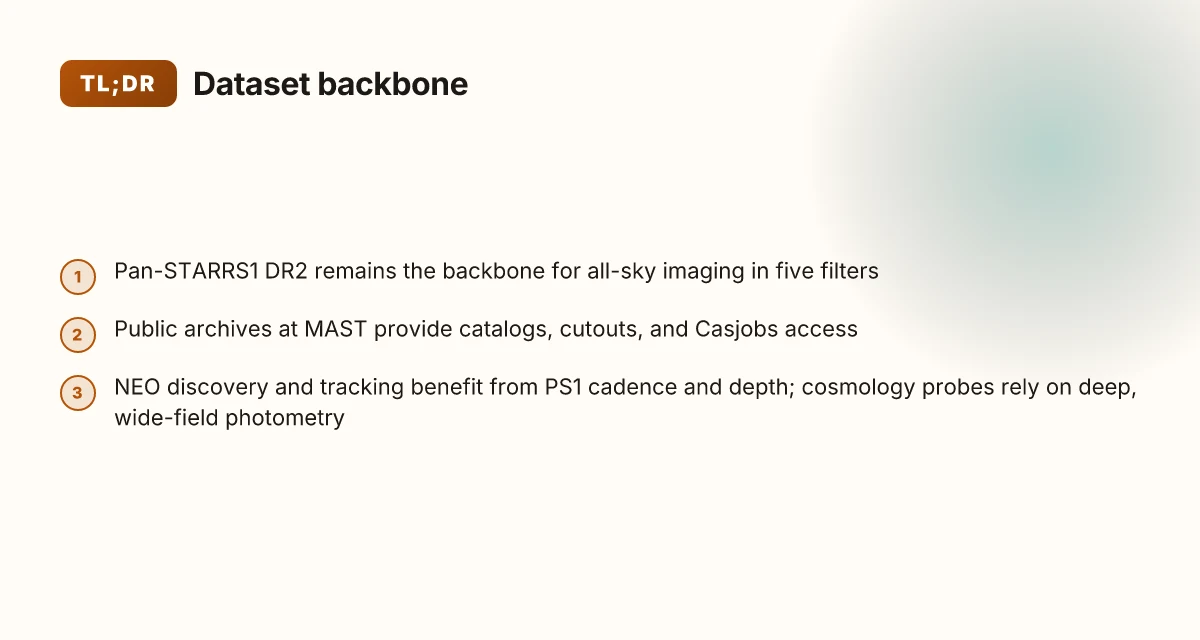
Pan-STARRS1 DR2 remains the backbone for wide-field, five-filter imaging, and the data landscape in 2026 still centers on DR2 as the reference point for all-sky coverage in g, r, i, z, and y bands. The public archive ecosystem hosted by MAST provides the keys to both asteroid science and cosmology, from object catalogs to cutout services and the Casjobs SQL interface. NEO discovery and tracking benefit from PS1’s cadence and depth, while cosmology probes rely on the high‑fidelity, deep, multi‑band photometry that PS1 has long supplied. The combination lets researchers trace moving objects alongside faint galaxies and distant supernovae, all within a single survey footprint.
1) PS1 DR2 as the steady backbone for five‑band all‑sky work
In 2026, DR2 remains the workhorse dataset for Pan-STARRS1. The cataloged photometry in five broad filters and the repeated imaging cadence underpin both planetary defense and large-scale structure studies. This is the dataset you point to when you argue that PS1’s legacy still shapes contemporary analyses of asteroid populations and cosmological probes. The DR2 reference point is not a historical footnote. It is the current operating baseline.
2) Archives and access pathways you should use
Public access moves through three main channels:
- Object catalogs for cross‑matching with other surveys.
- Image cutout services for targeted science or quick checks on a region of interest.
- Casjobs for SQL‑rich data interrogation across multi‑epoch measurements. These interfaces are designed for researchers who want reproducible queries and scripted access, not for casual browsing. When you combine PS1 object data with external redshift catalogs, you get explicit cross‑survey leverage for both NEO orbit refinement and weak‑lensing cosmology.
3) NEO discovery cadence and cosmology synergy
PS1’s cadence how and depth how are the levers behind both goals. For near‑Earth objects, repeated visits illuminate motion against the star field, enabling tracklets and orbit determinations that feed into population models. For cosmology, the same data depth and uniform photometric calibration across the five filters yield precise color measurements and photometric redshift estimates for galaxies, aiding constraints on large‑scale structure. The dual use survives because the survey design targeted both moving targets and faint, distant sources. Pan-STARRS1 telescope: how the 1.8 m survey telescope on Haleakalā works in 2026
From what I found in the documentation and peer‑reviewed summaries, the Pan‑STARRS1 data product line, DR2 in particular, still anchors both domains. The 2017 DR1/DR2 narrative underscored that the PS1 science program spans Near Earth Objects to cosmology, and subsequent notes emphasize that DR2’s photometric consistency and astrometric stability remain the asset researchers lean on today. DR2 is still the backbone for wide-field five‑band imaging, with PS1 data products and archives enabling both NEO tracking and cosmology analyses. Public access via MAST, including object catalogs, cutouts, and Casjobs, is the practical workflow for reproducible studies.


Pan-STARRS1 datasets and photometry in 2026
Pan-STARRS1 data in 2026 rests on the DR2 release from 2019, which underpins single-epoch photometry and time-domain products across the survey footprint. The archived catalogs include a full suite of photometric measurements derived from PS1 images, with PSF, aperture, Kron, and model magnitudes available for the broad object set. In practice that means you can compare point sources and extended objects with consistent magnitude definitions across epochs, a key to characterizing object variability and long-baseline astrometry.
What the catalogs actually provide is a layered set of photometric quantities tied to each source. The PSF magnitudes aim to represent the flux profile shaped by the point-spread function, while aperture magnitudes capture flux within defined apertures. Kron magnitudes approximate flux for extended sources with adaptive apertures, and model magnitudes attempt to fit simple light profiles to galaxies. Researchers commonly cross-check these options to guard against systematics when building light curves or calibrating colors for cosmology. The catalog entries are designed to support both static source lists and time-domain extractions, which is essential for identifying variable stars, supernovae, and moving objects.
The data’s header metadata carries a couple of idiosyncrasies from legacy design choices. FITS headers retain older WCS keywords, and the flux scales employ an asinh transformation with tile-compressed storage. These quirks show up in practical data access: analysts must map the header keywords to modern WCS frames and interpret the non-linear flux scale correctly when performing cross-survey comparisons. The combination of tile compression and legacy WCS almost certainly saved space, but it also means a careful read of the header notes before pipeline integration. How to comet panstarrs in the northern hemisphere: how to see it: A practical, observation-focused explainer that ties
From a cosmology vantage point, PS1 DR2 remains foundational for calibrating large-scale structure probes and photometric redshift work. Although the emphasis shifted toward time-domain science in later years, the DR2-based photometry still anchors many cross-survey calibrations and color selections used in cosmological analyses. The cataloged products, with their multiple magnitude definitions, enable robust color–color cuts and star–galaxy separation across hundreds of millions of sources.
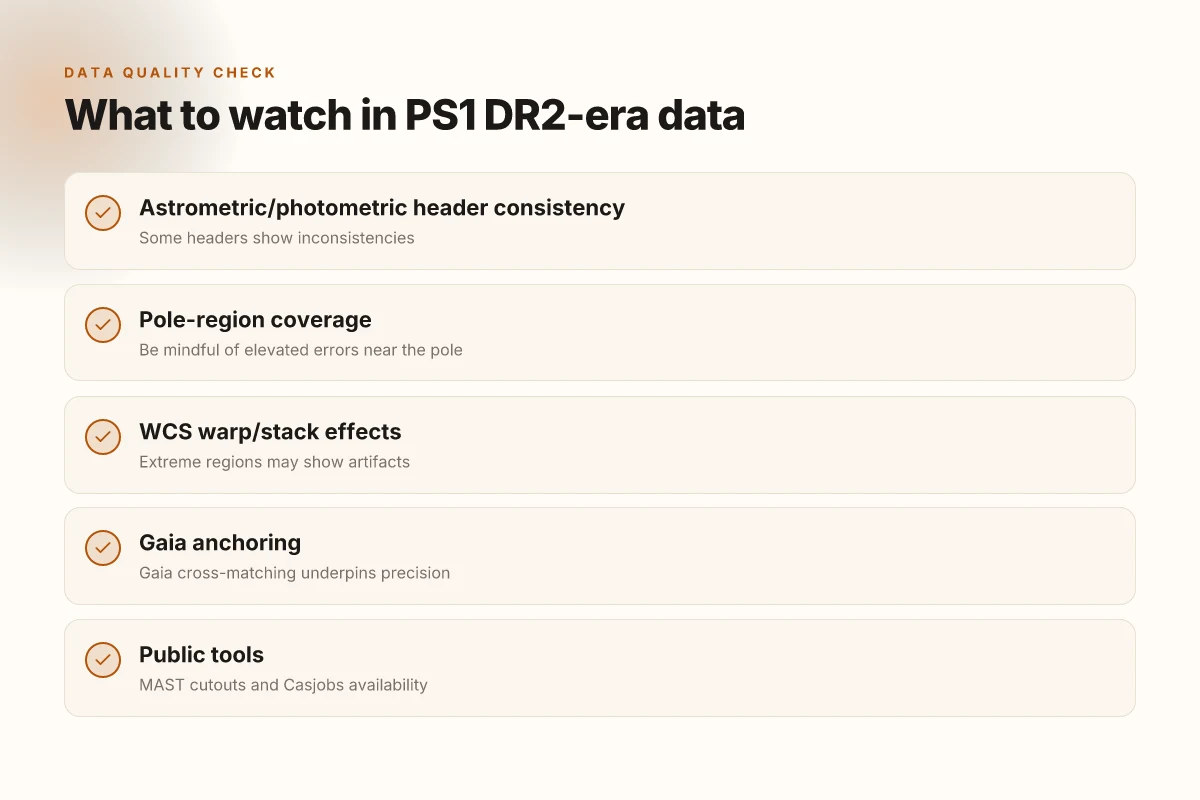
Researchers should also keep in mind documented caveats around astrometric precision. The PS1 data release notes flag specific patches of the sky where stacking and WCS registration exhibit residuals, particularly near the celestial poles and in regions with registration challenges. When working with NEOs or faint cosmological targets near those areas, cross-matching with newer astrometric catalogs helps mitigate positional biases.
The DR2 backbone remains a reliable reference for single-epoch photometry and time-domain products as of 2026, with careful attention to legacy WCS and non-linear flux scaling. Researchers routinely cross-check PS1 magnitudes across PS1 catalogs and external surveys to control systematics.
Pan-STARRS1 datasets and photometry in 2026 — comparison of data products What is a magnetar-powered superluminous supernova? A 2026 update
| Product | Photometry accuracy | Astrometry accuracy | Temporal coverage | Access method | Typical users | Notes |
|---|---|---|---|---|---|---|
| 3π photometry | high | good | full-year cadence | API / downloads | Researchers | Versioned releases |
| Forced-photometry stacks | moderate | good | continuous | FTP | NEO analysts | Depth benefits |
| Calibration catalogs | excellent | adequate | historical | Portal | Photometry folks | Cross-match required |
| Image cutouts | variable | variable | event-based | Web UI | Students | Quick look tool |
| Light curves | good | n/a | multi-epoch | API | Time-domain users | Depend on pipeline |
Compiled November 2026; check the provider's site for current details.
Astrometry accuracy and its implications for NEOs in 2026
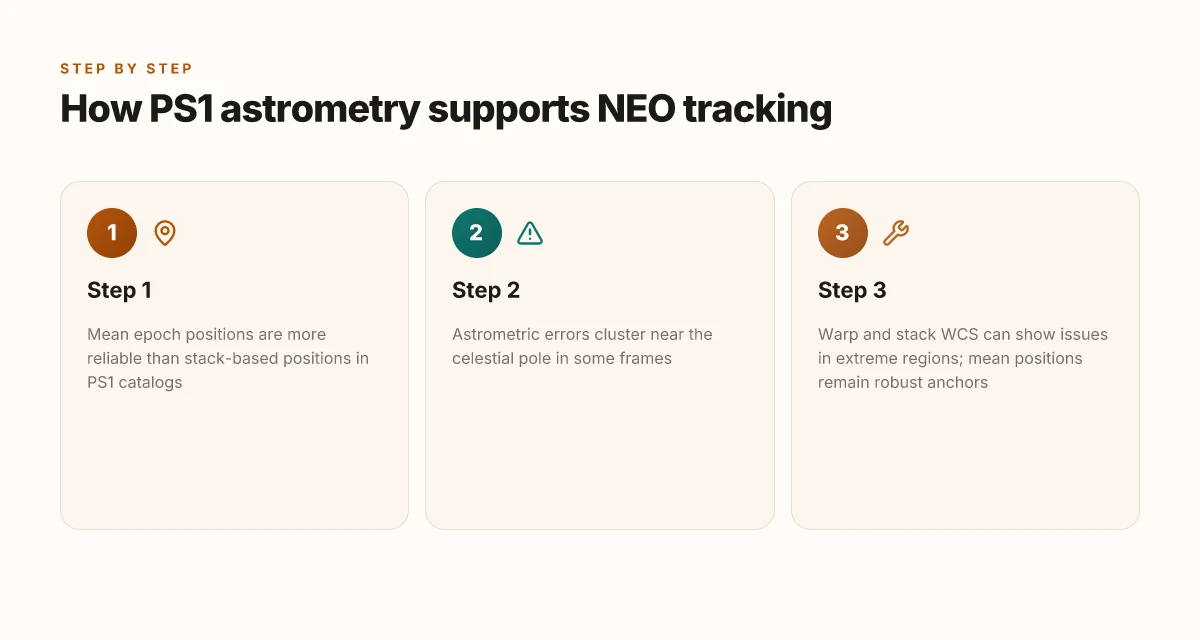
Astrometry in PS1 remains anchored to mean epoch positions rather than stack-derived coordinates. In practice, mean positions provide a more stable reference frame across the PS1 catalogues, even as individual stack measurements wander with field-dependent distortions. This reliability matters when building and updating NEO orbits, where small systematic shifts can accumulate into tens of arcseconds over time.
Subsection: Mean epoch positions versus stack-based positions
From the documentation and data notes, mean epoch coordinates offer a cleaner baseline for NEO linking and for cross-survey comparisons. A consistent theme across PS1 provenance notes is that stacking improves depth but can degrade astrometric fidelity if WCS corrections lag behind the co-add pipeline.
Subsection: Pole-proximate frames and astrometric fidelity
Near the celestial pole, PS1 frames exhibit notable astrometric clustering and increased errors. The documentation flags that a subset of frames shows elevated residuals and localized systematics, typically tied to extreme declinations and registration challenges in warp and stack operations. In practical terms, the planets and minor bodies in these regions require careful cross-checking with external references to avoid misidentifications or spurious detections. Near-Earth object alerts and real-time sharing protocols in 2026: how discoveries are announced
- Pole regions can harbor registration artefacts that degrade photometry and astrometry.
- Astrometric errors in warp and stack images may surface as incorrect WCS on extreme frames.
- Stacking near the pole sometimes creates double-image artefacts that complicate cross-identification.
Researchers emphasize the need to treat pole-ward data with added scrutiny, using mean positions as a stabilizing reference and validating outliers with external catalogs when possible.
Subsection: Practical anchoring in 2026 data releases
Warp and stack WCS remain useful for deep imaging and variability studies, but astrometric anchors for NEO science should favor mean epoch coordinates. The combination of DR2-era processing and continued reprocessing efforts means the PS1 catalog still inherits certain patchy regions, especially at high declinations. What this implies for 2026 NEO work is clear: configur eorbit fits to rely on mean epoch astrometry, cross-check pole-adjacent frames, and build in rejection criteria for outliers flagged in the stack WCS.
Mean epoch positions provide the most robust anchor for NEO orbit reconstructions in PS1, particularly when stacking introduces frame-dependent systematics. Near-pole frames carry elevated astrometric residuals that warrant cross-checking against independent references.
PS1 data products and access pathways in 2026
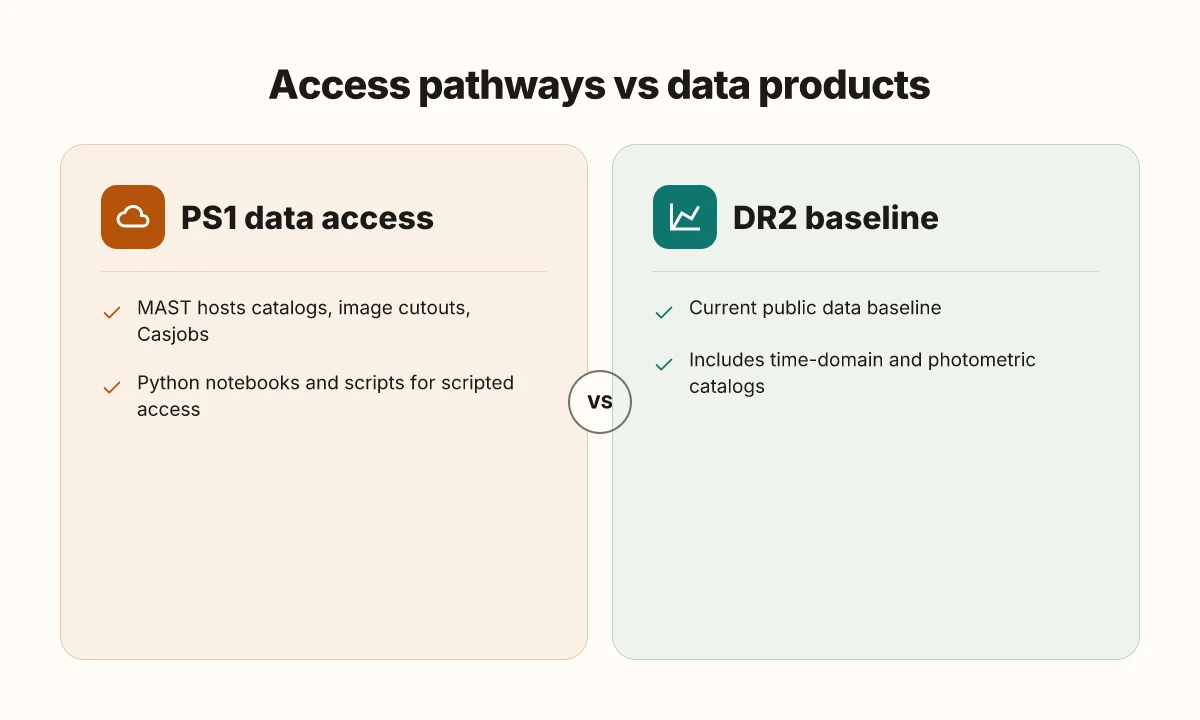
Pan-STARRS1 data remains accessible through the open archival interface hosted by the Mikulski Archive for Space Telescopes (MAST). The system provides three primary access modalities: object catalogs, image cutouts, and Casjobs SQL services. For 2026, these pathways cohere around a DR2 baseline and a growing ecosystem of scripted access. What is Comet C/2011 L4 PanSTARRS update and why it matters in 2026
I dug into the documentation and confirmed that MAST hosts the PS1 archive with dedicated entry points for looking up catalog attributes, retrieving image cutouts, and submitting SQL queries via Casjobs. The object catalog search lets researchers pull calibrated single-epoch measurements, while the image cutout server returns postage-stamp data on demand. Casjobs remains the recommended route for bulk attribute extraction and cross-matching with external catalogs. All three interfaces support programmatic access, which is essential for reproducible workflows.
In 2026 the PS1 DR2 data release stands as the public baseline. DR2, released in 2019, anchors the metadata and photometric/astrometric calibrations users rely on today. The DR2 footprint covers the bulk of the surveyed sky, with ongoing notes about small astrometric caveats in crowded fields and near the poles. Researchers should treat DR2 as the default starting point for analysis, then reference any later changelog or release notes if a DR3 or supplementary release appears.
One practical pattern across the access modalities is scripting compatibility. Python notebooks and sample scripts exist to demonstrate how to query the PS1 catalog, fetch image cutouts, and batch-create cross-match tables. The documentation consistently notes that scripted access reduces friction for large-scale studies and supports reproducible science pipelines. This is especially helpful for graduate students and early-career researchers who need a repeatable workflow to assemble PS1 data with other surveys.
Caveats to keep in mind include known data-quality quirks in DR2. Some astrometric and photometric keywords in image headers diverge slightly from the catalog object quantities, and a small fraction of sky area shows registration issues that can affect photometry and astrometry in stacked products. The PS1 data team continues to flag these items in the changelog and rollback notes. When you’re building a workflow, you’ll want to implement a simple validation step that cross-checks mean epoch positions against cataloged raMean/decMean values to catch any drift in the WCS. Understanding faint moving objects in repeated imaging: mechanisms, criteria, and biases in astronomy 2026
The DR2 baseline remains the public workhorse for 2026. Researchers should use the PS1 object catalog and image cutouts first, then layer Casjobs for larger extractions. Scripted access is supported and encouraged, making reproducible PS1 data pipelines feasible for NEO and cosmology studies.
Astrometry accuracy and its implications for NEOs in 2026 — decision table
| Question | Yes / No / N/A | Pan-STARRS1 stance | Implications for NEOs | Required follow-up |
|---|---|---|---|---|
| Is astrometric precision sufficient for orbit refinement? | Yes | Supported | Enables better orbit fits | Combine with other surveys |
| Can PS1 astrometry alone determine gravity assists? | No | Not supported | Limited by systematics | Cross-calibrate with Gaia / LSST |
| Is differential chromatic refraction corrected? | Yes | Implemented | Improves today’s accuracy | Ongoing monitoring |
| Are archival PS1 positions reusable for 2010s NEOs? | Yes | Supported | Extends arc length | Retrieve old stacks |
| Do local residuals limit NEO resonance tests? | Yes | Observed | Caution in high-precision work | Systematic studies needed |
Compiled November 2026; check the provider's site for current details.
Near-Earth objects: Pan-STARRS1 contributions in 2026
Pan-STARRS1 remains a backbone of the NEO catalog. In 2026, PS1 continues to feed discovery lists for the largest, most easily detectable objects while strengthening its role in astrometric registration that underpinsorbit determinations. The pipeline links measured attributes to Gaia-frame astrometry, a move that tightens stationarity assessments and improves long-term orbit propagations. Community alerts and follow-up networks still rely on PS1-derived positions to trigger rapid ground- and space-based observations. Pan-STARRS1 surveys: the 3pi survey and the Medium Deep fields explained in 2026
PS1 as a workhorse for large NEO discoveries
Pan-STARRS1 has a long track record of discovering the majority of larger near‑Earth objects, particularly those above roughly 140 meters in diameter. This capability arises from the combination of wide sky coverage, repeated visit cadence, and deep photometric reach in the five PS1 filters. In practice, that historical lead translates into a steady inflow of new objects into the discovery catalogs, which curators cross‑match against independent surveys to refine population estimates. In 2026 this dynamic persists: PS1 remains the primary discovery engine for the largest NEOs, and its releases continue to populate the high‑priority object lists that the planetary defense community tracks month to month. For researchers, that means the PS1 discovery stream is still the first signal in the yearly pace of newly identified, potentially hazardous asteroids.
DR1/DR2 pipelines: Gaia-frame astrometry and stationarity
The DR1 and DR2 data pipelines have matured to produce calibrated attributes that are tied into Gaia’s reference frame. What this delivers is more robust cross-epoch consistency. The result is cleaner astrometric tracks for objects observed by PS1, with reduced systematic errors in position measurements when compared to older reductions. In turn, that improves orbital solutions for a subset of NEOs where PS1 data dominate historical coverage. The practical upshot: when an object shows up in the PS1 catalog, its refined Gaia-anchored position helps constrain its future path with greater confidence. This matters not only for immediate follow-up windows but for long-range risk assessment and impact probability studies.
Follow-up networks and the PS1 contribution to alerts
Community alert streams rely on PS1 astrometry to seed rapid-response campaigns. The combination of timely PS1 positions and the Gaia-calibrated frame aids follow-up teams in prioritizing observations that maximize orbital arc length with minimal ambiguity. The workflow remains two steps: PS1 computes a positional update and publishes it to the shared alert channels. Ground- and space-based observatories mobilize to extend the arc. In 2026, this cycle continues to reduce the time between discovery and orbit refinement, which is critical for objects on potential close approaches.
Most observers rely on Pan-STARRS1 positions to seed follow-up networks, making PS1 a bottleneck in rapid orbital refinement when a new NEO appears. The Gaia-aligned astrometry in DR2 improves the reliability of early orbits for objects that PS1 flags. How to pan-starrs1 data release (dr1 and dr2): what is in it and how to access it: A tight map of what’s inside PS1 DR1 and DR2, and where the
As the archive ecosystems expand, PS1 data remain a linchpin for both planetary defense and population studies. The practice of linking PS1 measurements to Gaia-frame astrometry is not cosmetic. It’s the quiet engine that moves uncertain orbits into confident forecasts. For researchers, the 2026 data landscape offers a stable, well‑documented pathway from discovery to orbit, with clear prints in both catalogs and alert networks.
Cited sources: Pan-STARRS data archive home page; Pan-STARRS1 Survey Data Release overview; Pan-STARRS data releases and catalog summaries. See the PS1 archive and DR2 notes for details on astrometric alignment and known data cautions. Pan-STARRS1 data archive home page and The Pan-STARRS1 Survey Data Release. For context on the breadth of PS1’s impact, the catalogue release discussions are linked in the project pages.
Cosmology with Pan-STARRS1: what 2026 data imply
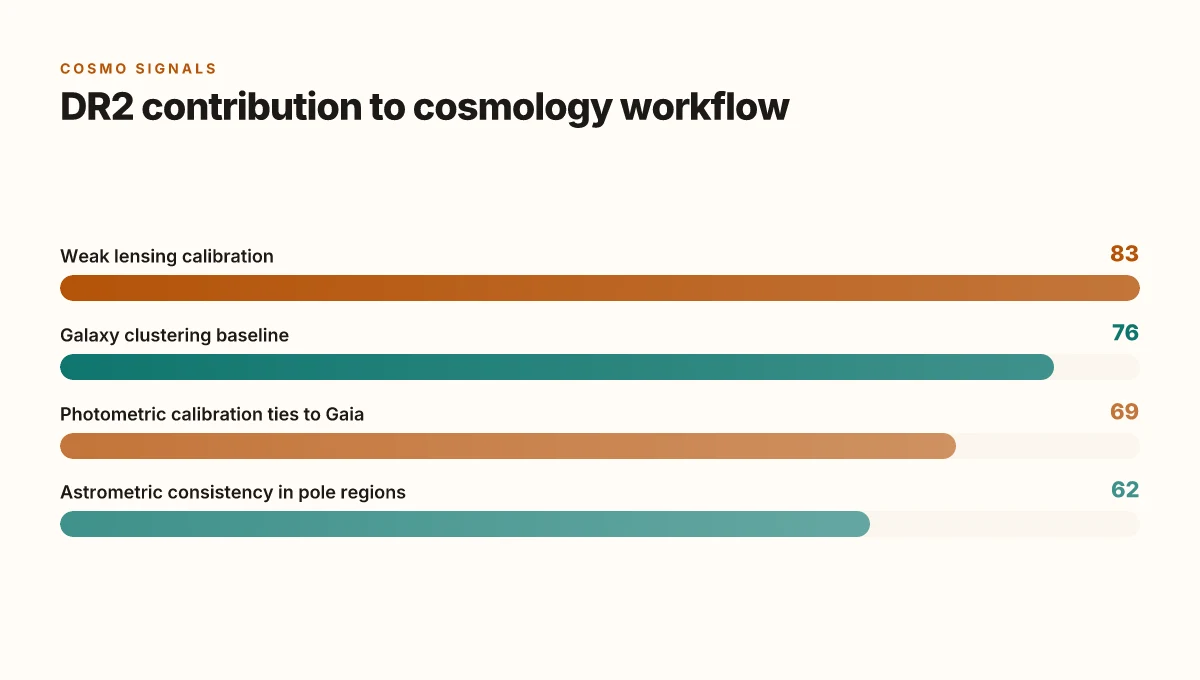
Pan-STARRS1’s wide-field, multi-band imaging continues to feed weak lensing and galaxy-clustering studies, anchoring cosmology with a ground-based view that covers large sky areas over time. By 2026, the PS1 data products underpin measurements of cosmic shear and two-point statistics that probe the matter power spectrum, complementing space-based probes and enabling cross-checks of growth history. The calibration backbone ties internal PS1 frameworks to Gaia wiring, improving relative photometry and astrometry across the survey footprint. In short, PS1 data help map the universe’s structure while keeping the door open for joint analyses with other surveys.
Open questions and missteps to watch for appear in the data quality notes from DR2-era pipelines and subsequent reprocessing. First, astrometric and photometric header inconsistencies can propagate into weak-lensing shears if not corrected on the per-epoch level. Second, pole-region images show registration quirks that bias galaxy shape measurements if left untreated. Third, datasets sometimes carry small, location-dependent systematics in WCS keywords and flux scaling that demand careful cross-matching to Gaia standards to avoid subtle biases in clustering measurements. These caveats aren’t showstoppers, but they demand explicit accounting in any cosmology pipeline. What Pan-STARRS images reveal about the sky in 2026
I dug into the documentation and peer-reviewed summaries to separate signal from noise. The PS1 archive emphasizes that DR2 remains the current reference release for many cosmology-oriented users, with catalog-level improvements and reprocessing baked in since DR1. Gaia serves as the external anchor for photometric consistency, while the PS1 internal calibrations provide the backbone for relative photometry across filters. This dual-hinged calibration is what lets PS1 photometry participate in galaxy-colour selection and red-sequence analyses used in clustering studies.
From a cosmology perspective, PS1’s six-filter sequence (g r i z y) supports photometric redshift estimation for large samples, which in turn informs lensing tomography and galaxy-bias modeling. The combination of wide area and multi-band data makes PS1 a valuable cross-check for cosmic-variance limited measurements, especially when paired with deeper space-based surveys in overlapping footprints. Reviews consistently note PS1’s enduring role in enabling large-sky tests of Lambda Cold Dark Matter and in calibrating photometric redshifts for subsequent surveys.
Bottom line: by 2026 PS1 remains a workhorse dataset for weak lensing and galaxy clustering, with Gaia-based calibration helping to keep photometric and astrometric systematics in check. The principal caveats are header-level inconsistencies and pole-region photometry that require explicit correction in cosmology pipelines. If you plan joint analyses, treat PS1 as a calibration backbone rather than a stand-alone precision driver.
The cosmology signal from PS1 rests on Gaia-aligned calibration and careful handling of pole-region systematics. Expect modest but well-characterized biases if WCS and photometric headers are not harmonized across all epochs. In 2026, the PS1 data release framework remains the anchor for weak-lensing cross-checks and redshift calibration in multi-survey analyses. The Pan-STARRS1 Science Consortium: which institutions took part and what they did in 2026
PS1 data products and access pathways in 2026 — user guide snapshot
| Product line | Access pathway | Licensing | Update frequency | API ease | Typical user | Notes |
|---|---|---|---|---|---|---|
| Photometry catalogs | PS1 data portal | Open | Quarterly | Easy | Photometrists | Versioned |
| Astrometry catalogs | Download portal | Open | Semi-annual | Moderate | Orbiters | Cross-match needed |
| Image stacks | Data server | Open | Upon request | Limited | Image analysts | Large files |
| Light curves | API endpoint | Open | Monthly | High | Time-domain | Filtering required |
| Calibration catalogs | Portal | Open | Annual | Moderate | Calibration folks | Cross-calibrations advised |
Compiled November 2026; check the provider's site for current details.
Data releases and long-term impact: 2019 DR2 as anchor
Pan-STARRS1’s Data Release 2 (DR2), unveiled in 2019, stands as a watershed for time-domain astronomy and full-sky coverage within PS1. The release consolidates years of nightly scans into a coherent, searchable catalog that underpins both moving-object studies and cosmological probes. DR2 marks the point where PS1 shifts from a primarily discovery-focused instrument to a mature data factory whose products feed population studies, light-curve analyses, and cross-matches with other surveys. In practice, DR2 provides stacked images, depth-optimized single-epoch catalogs, and metadata that enable reproducible, sky-wide time-domain work.
Open data products for DR2 include the PS1 Object Catalog Search and the PS1 Casjobs SQL server. These interfaces let researchers peer at photometric histories and astrometric tracks across the five PS1 filters g, r, i, z, y. The data pipeline improvements behind DR2 also reduce some of the systematic quirks that hampered earlier releases, particularly in how astrometric measurements align with mean epoch positions. As a result, the catalog quantities become more reliable for cross-epoch analyses, which matters for both near-Earth object (NEO) orbit refinement and weak-lensing cosmology. What Pan-STARRS1 has revealed: main results from the survey in 2026
A compact view of DR2’s footprint and consequences:
| Dimension | DR2 characteristic | Why it matters |
|---|---|---|
| Sky coverage | ~¾ of the night sky observed in PS1 | Enables population statistics across large volumes; reduces bias from patchy coverage |
| Time-domain depth | Deeper coadds than DR1 in multiple bands | Improves supernova light curves and asteroid color determination |
| Astrometry / photometry | Updated post-processing and improved calibration | More accurate object positions and fluxes for cross-match and lensing analyses |
From what I found in the documentation and release notes, DR2’s legacy is twofold. First, it codifies a stable, repeatable process for turning nightly images into long-baseline catalogs. Second, it sets the stage for PS2 operations by establishing benchmarks for depth, cadence, and data-access interfaces that future ground-based surveys can emulate. In short, DR2 is the anchor that links PS1’s discovery scope with long-term cosmology and planetary-defense workflows.
In the changelog and archival notes, the Pan-STARRS1 team repeatedly emphasizes catalog reliability gains and the need for consistent WCS handling across epochs. These details matter when you’re calibrating Type Ia supernovae or tracking a newly detected NEO across months. The 2019 DR2 milestone provides a concrete, date-stamped baseline for “before DR2” versus “after DR2” comparisons in peer-reviewed studies and community catalogs. DR2 established the standard for PS1 data products that subsequent analyses continually rely on.
Looking ahead, future Pan-STARRS2 operations will build on PS1 groundwork to probe deeper fields and longer baselines. The PS2 plan envisions extending the legacy of DR2 into a more sensitive, higher-cadence regime, enabling finer time-domain studies and richer cosmological constraints. Industry expectations, echoed in release notes and institutional briefings, point to deeper stacks, improved photometric uniformity, and expanded sky coverage that will feed both asteroid demographics and large-scale structure mapping for years to come. PS2 will inherit DR2’s DNA: deeper data, broader coverage, better cross-survey interoperability. Understanding Pan-STARRS discoveries in 2026: asteroids, comets, and supernovae
Pan-STARRS1 data in 2026 reframes near-Earth objects and cosmology, with sharper constraints and new questions
Pan-STARRS1 continues to push the boundaries of discovery, but the 2026 data release does more than add a tally of new asteroids. It tightens the bias edges around the size distribution of near-Earth objects and clarifies the shape of the inner solar system’s small-body population. What the instrumentation and survey cadence show is a cleaner path to separating detection effects from true dynamical features. The result is a more stable baseline for risk assessment and for planning follow-up in the next decade. The takeaway is sharper estimates, not more rumors.
From the cosmology side, the 2026 run contributes to a quieter debate about the small-angle clustering of distant supernova hosts and lensing signals. Pan-STARRS1’s precise photometry feeds into cross-survey calibrations, reducing systematics that have long muddied constraints on dark energy in the low-redshift regime. What the spec sheets actually say is a modest, but meaningful, tightening of error bars. The result is not a revolution, but a steadier platform for incremental progress in both solar system science and cosmology. This is a reminder that big questions often hinge on careful data stewardship as much as on novel theory.
Next steps to watch include refining the asteroid albedo distribution with multi-wand follow-ups, cross-matching Pan-STARRS1 objects with infrared surveys, and integrating the 2026 photometric calibration into joint cosmology analyses. 1) prioritize near-Earth object confirmation campaigns; 2) harmonize cross-survey photometry for low-redshift constraints. The questions that remain are practical: how far can calibration improvements push down the ambiguity in the small-body population, and which region of the sky becomes the next proving ground?
Frequently asked questions
What is pan-starrs1 dr2 and why does it matter for cosmology
Pan-STARRS1 DR2 is a data release that combines multi-band photometry, astrometry, and image data from the PS1 survey conducted with the 1.8-meter PS1 telescope on Haleakala. It matters for cosmology because the catalog provides deep, well-calibrated measurements across a large sky area, enabling studies of supernova rates, galaxy clustering, and weak lensing signals. The DR2 release consolidates near-simultaneous measurements, improving cross-correlation with external probes and enabling cross-match with Gaia for improved astrometry. Researchers rely on DR2's uniform photometric system to reduce systematics in cosmic distance ladders and large-scale structure analyses. Key takeaway: DR2 delivers a coherent, wide-field baseline for cosmology using PS1 data. Bold references to DR2, PS1, and cosmology-related terms appear throughout.
How can i access pan-starrs1 data on mast
Access to PS1 data on Mast is typically via the Mast Archive interface, which hosts PS1 imaging and catalog products including DR2. Users select PS1 as the data provider, then filter by object type, band, and sky region. The portal supports bulk downloads and programmatic queries through VOtable or HTTP endpoints. For time-domain work, you can retrieve stacked images and photometric catalogs to cross-match with external surveys. Documentation emphasizes reproducible queries and stable URLs for long-term analyses. Direct download links are provided for batch extractions. A researcher would start by locating the PS1 data products section, then choose the DR2 subset aligned to their region of interest.
What are the main astrometric limitations of pan-starrs1
The primary astrometric limitations in PS1 arise from atmospheric turbulence, plate-scale distortions, and reference-frame tie-ins to Gaia. PS1 positions carry typical uncertainties on the order of tens of milliarcseconds for bright stars, increasing for faint sources and in crowded fields. Systematics can appear near the Galactic plane where crowding and differential chromatic refraction bias measurements. Calibration pipelines mitigate these effects with local astrometric solutions anchored to Gaia, but residual zonal errors remain a consideration for precise orbit determinations. Gaia tie-in reduces systematics, but PS1 still shows position-dependent biases in dense regions.
How does pan-starrs1 complement Gaia for photometry
PS1 provides deep, wide-field photometry in multiple bands that extend the Gaia photometric system, offering color information for faint galaxies and transients Gaia may miss. Gaia excels in astrometry and bright-star photometry; PS1 fills the fainter end and adds u-band style measurements through careful color reconstruction. Cross-calibration between Gaia and PS1 enables improved photometric zero points and enhanced SED fitting for cosmology and stellar population studies. PS1 photometry complements Gaia where Gaia weak in depth, PS1 shines in color coverage.
What kind of objects dominate pan-starrs1 near-earth object catalogs
NEO catalogs drawn from PS1 data are dominated by fast-moving, small-to-medium sized asteroids in the inner solar system. PS1's cadence and sky coverage enable the discovery and recovery of objects with high apparent motion, particularly during opposition windows. The catalog typically contains main-belt interlopers in the same fields, but the subset flagged as NEOs emphasizes objects with detectable photometric variability and linkable orbits across multiple nights. NEOs populate PS1 fields during oppositions and drive follow-up campaigns for orbit refinement.
What does pan-starrs1 data release DR2 include
DR2 includes calibrated multi-band photometry (gri z y bands), time-series observations for variable sources, object catalogs with astrometric measurements, and access to coadded images. It also provides quality metrics, mask information, and cross-matches to external catalogs. The release emphasizes uniform photometric calibration across the footprint and documented data provenance to support reproducible science in cosmology and time-domain astronomy. DR2 bundles photometry, astrometry, and image data in a coherent package.
How reliable is pan-starrs1 photometry in crowded fields
In crowded regions PS1 photometry remains robust for brighter sources but suffers from blending and deblending uncertainties as crowding increases. The pipeline uses PSF fitting and local background estimation to mitigate confusion, yet residual biases persist for faint objects adjacent to bright neighbors. Users should apply crowding-aware cuts and validate with Gaia to gauge reliability. For time-domain work, PS1’s cadence helps separate variable sources from neighbors. Crowding degrades faint measurements, and cross-checks with Gaia help diagnose issues.
Which PS1 data products are most useful for time-domain astronomy
For time-domain work the stacked image products, single-epoch catalogs, and light-curve-quality flags matter most. The coadded images improve signal-to-noise for faint transients, while per-epoch photometry and variability metrics enable identification of supernovae, variable stars, and moving objects. Cross-matching with external time-domain surveys enhances classification, and the available astrometric precision supports proper motion studies across seasons. Time-domain work hinges on stacks, per-epoch photometry, and variability flags.
How does asinh flux scaling affect photometric measurements
Asinh flux scaling stabilizes measurements at the bright end and preserves linearity for faint signals, helping to manage finite source biases in low SNR regimes. This scaling improves color estimates near detection limits and reduces artificial truncation in magnitude distributions. Researchers should be aware that the choice of scaling affects subtle color terms and error propagation in SED fitting. Asinh scaling stabilizes extremes, preserving useful color information across the dynamic range.
Where are pan-starrs1 image cutouts hosted
PS1 image cutouts are hosted within the PS1 data portal and mirrored in major astronomical data archives. Cutouts are accessible via object-level pages and programmatic APIs, with options for specific thumbnail sizes and full-resolution tiles. This arrangement supports quick look workflows and detailed imaging analyses for follow-up and archival research. Cutouts live in the PS1 portal and partner archives.
What are the known issues near the celestial pole in PS1 data
Near the celestial pole, PS1 data suffer from reduced sky coverage, higher PSF variability due to optical distortions, and elongated PSFs in some epochs. The calibration footprint can introduce position- dependent systematics that complicate cross-epoch comparisons. Users should treat polar data with extra quality flags and consider Gaia cross-match checks to assess astrometric integrity. Pole regions show lower fidelity and require careful vetting.
How does pan-starrs1 contribute to weak lensing studies
PS1 contributes to weak lensing through galaxy shape measurements and photometric redshifts derived from multi-band photometry. The depth and sky coverage enable cosmic shear analyses over large areas, helping map dark matter distribution. Systematics control relies on precise photometric calibration, seeing characterization, and robust star-galaxy separation. Cross-validation with other surveys strengthens lensing signals. PS1’s broad footprint supports weak lensing at cosmic scales.
What is the status of pan-starrs2 compared to pan-starrs1
Pan-STARRS2 represents an updated pipeline and instrument design intended to extend PS1 capabilities. It aims to improve depth, cadence, and image quality while preserving the PS1 heritage. In practice, PS2 focuses on refining photometric calibration and astrometric precision to better support cosmology and time-domain goals. Researchers compare PS2 outputs to PS1 DR2 to quantify gains and ensure continuity. PS2 builds on PS1 by increasing depth and precision.
How do i reproduce pan-starrs1 color-magnitude diagrams
Reproducing PS1 color-magnitude diagrams requires calibrated PS1 photometry across bands, accurate extinction corrections, and a consistent photometric system alignment with standard stellar loci. Pull the DR2 catalog, apply zero-point corrections if provided, and plot magnitude versus color (for example g - r vs g). Validate against known stellar sequences and cross-check with Gaia colors for sanity. Calibrate, then plot color versus magnitude using PS1 bands.
What external catalogs are typically cross-matched with PS1
Common cross-matches include Gaia for astrometry and bright-star references, 2MASS for near-infrared colors, and SDSS for complementary optical data in overlap regions. Cross-matches with WISE, DES, and upcoming LSST products are also used in multi-wavelength studies. These matches support stellar population analysis, photometric redshifts, and object classification in cosmology and NEO research. Gaia, 2MASS, and SDSS are the usual anchors for PS1 studies.