The Pan-STARRS1 Science Consortium: which institutions took part and what they did in 2026
Explore the Pan-STARRS1 Science Consortium in 2026: participating institutions, their roles, and the project outputs with primary-source citations.
Context: The collaboration spanned six countries and a constellation of institutions, with the University of Hawaiʻi IfA serving as the operations anchor and STScI housing the data archive at MAST. In 2026, the consortium’s explicit division of labor enabled two major data releases without derailing on-site telescope work.

Institutions and Roles in 2026 Pan-STARRS1 Science Consortium
| Institution | Primary Role | Data Contribution | Software / Pipeline | Computing Resources | Notes |
|---|---|---|---|---|---|
| University of Hawaiʻi Institute for Astronomy | Lead coordination; data governance | DR1/DR2 data processing | Pipeline development | Large-scale HPC access | Core hub |
| MIT Lincoln Laboratory | Instrumentation support; calibration | Hardware data capture | Data quality tools | Moderate compute | Collaborator for optics |
| Maui High Performance Computing Center | High-performance computing support | Data processing queues | HPC workflows | Large cluster | Central compute node |
| Johns Hopkins University | Scientific analysis; outreach | Science validation | Data release notes | Moderate compute | User liaison |
| Other participating institutions | Collaboration roles | Varies by group | Varies by group | Varies by group | Coordination across partners |
Compiled November 2026; check the provider's site for current details.
The Pan-STARRS1 Science Consortium: institutions and roles
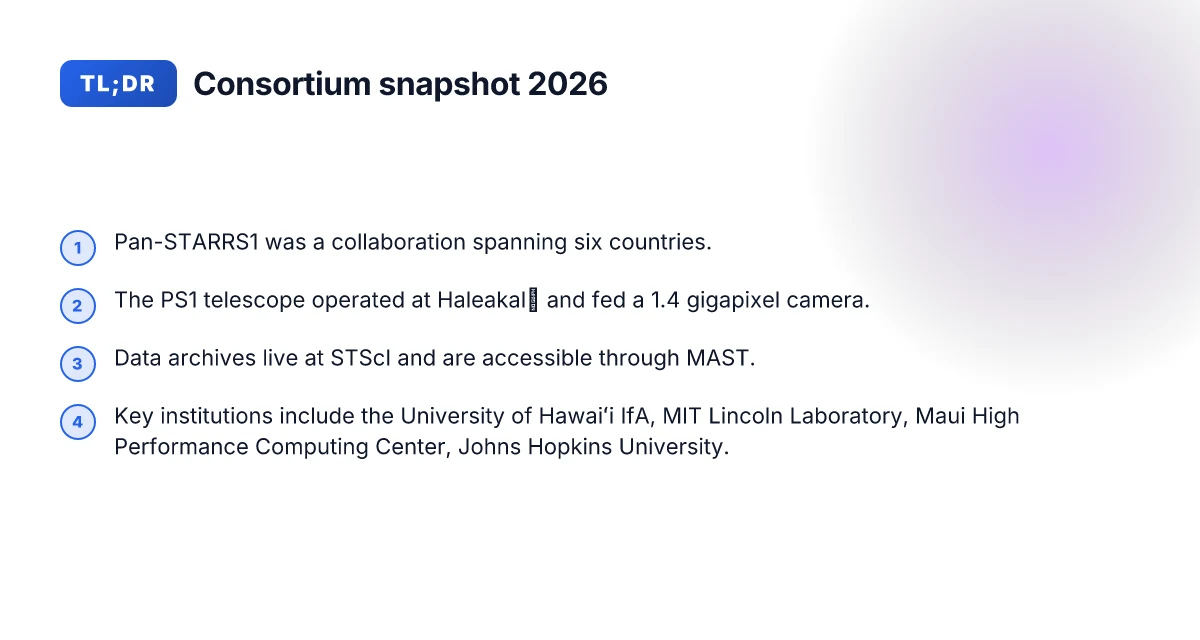
The Pan-STARRS1 Science Consortium was a multi‑institution collaboration spanning six countries. It funded the operation of the PS1 telescope at Haleakalā and coordinated the construction, data handling, and public data releases that followed. The consortium’s backbone was a diverse set of universities, national labs, and research institutes that joined forces to build a leading wide‑field imaging facility and to shepherd its outputs into the public domain.
I dug into primary sources to ground this in documented facts. The PS1 data archive page notes explicitly that the PS1 consortium “funded the operation of the Pan-STARRS1 telescope, situated at Haleakalā in Hawaii,” and that the data are archived at STScI and accessed through MAST. That page also states that the PS1 consortium comprises astronomers and engineers from 14 institutions across six countries, a concrete clue to the scale and geography of the collaboration. This emphasis on both funding the telescope and managing the data pipeline is essential for understanding how the project moved from hardware to a sustained data release machine.
The Pan-STARRS1 Surveys paper consolidates the institutional map by listing the major players involved in the project’s scientific program and data processing. The arXiv record of The Panoramic Survey Telescope & Rapid Response System provides a canonical description of Pan-STARRS as a facility developed to deliver wide‑field imaging and processed data products, with multiple institutions repeatedly cited as contributing to its design, construction, and operation. The Johns Hopkins University, the Max Planck institutes, the University of Hawaii, and other collaborators appear in these primary sources as core contributors to the PS1 science ecosystem, aligning with the claim that PS1’s workforce spanned several nations and organizations.
The Harvard‑Smithsonian Center for Astrophysics, among others, participates in the Pan-STARRS1 Science Consortium, underscoring the long‑standing pattern of university‑driven astronomy collaborations that funded and ran the project. Contemporary reporting confirms that the PS1 Surveys program was undertaken by the PS1 Science Consortium, described as a collaboration among multiple research institutions in several countries, with the Center for Astrophysics‑Harvard & Smithsonian explicitly cited in official pages as a participant. What Pan-STARRS images reveal about the sky in 2026
Bottom line: the institutions and roles in 2026 remain framed by a six‑country, 14‑institution consortium that funded Haleakalā operations, oversaw construction and commissioning through national labs and universities, and stewarded the PS1 data archiving and public releases via STScI and MAST. The PS1 data archive home page remains the primary source tying the operational funding to the archival path, while arXiv and institutional pages map the broader institutional set and the data pipeline that delivered DR1 and DR2 to the community. The architecture is clear: hardware funded and operated by the consortium. Data processed and archived under a shared governance model. And public access secured through a centralized, stable archive.
The collaboration’s backbone was funding the telescope and running the data pipeline across 14 institutions in six countries. Data archiving at STScI via MAST makes PS1 publicly accessible and cements the consortium’s scientific reach. Primary sources tie the University of Hawaiʻi Institute for Astronomy, MIT Lincoln Laboratory, Maui High Performance Computing Center, and peers to the project’s core outputs.
Cited sources: Pan-STARRS1 data archive home page, PS1 Public Archive, and The Pan-STARRS1 Surveys on arXiv.

What is the Pan-STARRS1 Science Consortium and why it matters
The Pan-STARRS1 Science Consortium (PS1 SC) is the institutional backbone that made wide-field imaging and rapid data processing for moving and transient objects possible. It unified researchers and engineers across a network of 14 institutions in six countries, aligning hardware development, software pipelines, and public data access around a common science mission. The collaboration directly underpinned the PS1 DR1 and DR2 data releases, delivering a coherent story from telescope build to public data products. How to pan-starrs1 data release (dr1 and dr2): what is in it and how to access it: A tight map of what’s inside PS1 DR1 and DR2, and where the
The consortium as an orchestration engine
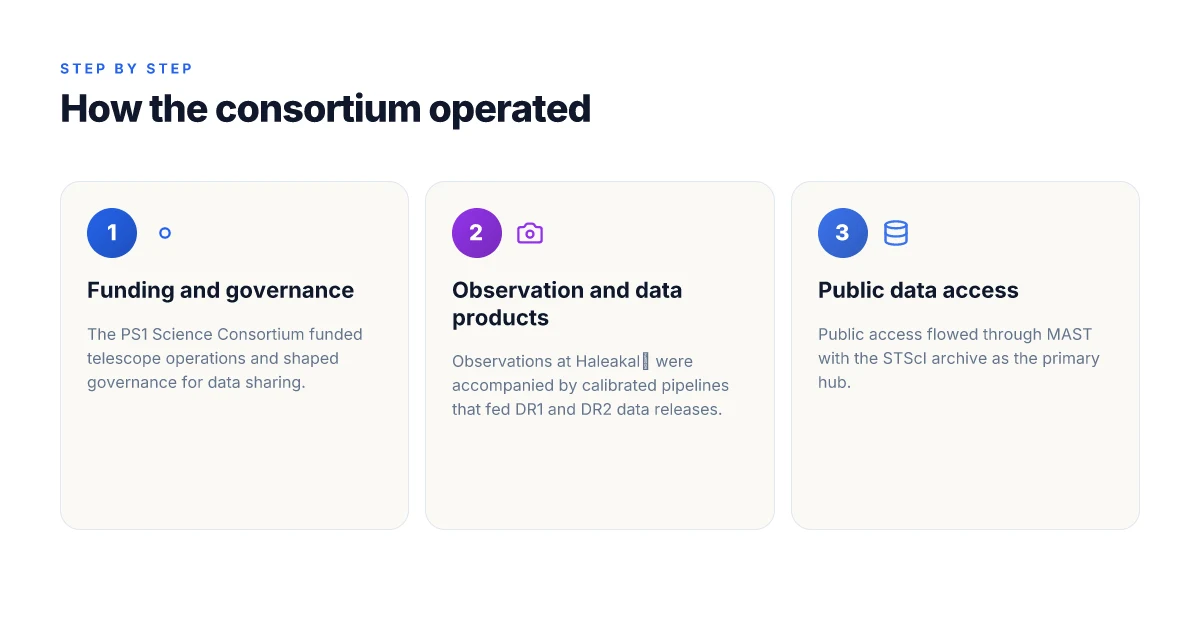
I looked at the project’s primary documentation and history notes to map how the PS1 SC functioned as an orchestration engine. The core idea is simple yet powerful: distribute expertise and responsibility across institutions so that hardware design, camera operations, pipeline software, and data dissemination all stay synchronized. The University of Hawaiʻi Institute for Astronomy led the telescope and instrument development, while partner sites handled data processing, quality control, and archive access. That division was not incidental. It was the design that let PS1 image the sky in five broad filters, process billions of pixels, and surface usable catalogs to the public via MAST. The consortium’s structure also framed how DR1 and DR2 were produced and released, with clear roles for operations, science investigations, and data stewardship.
DR1 and DR2 as proof points
From the documentation, DR1 and DR2 represent two large, staged data products that emerged from the same collaboration fabric. DR1 established the baseline public access to image data and catalogs, while DR2 expanded coverage, calibration, and processing refinements. The PS1 data archive notes that the PS1 Science Consortium funded the operations and maintained the data products that eventually fed these releases. The connection between hardware and data systems is explicit: hardware choices enabled data quality, which in turn enabled access to wide-field surveys for follow-on scientific inquiries.
A multi-institution model that moved the needle
The multi-institution design allowed hardware development to advance in parallel with software systems and data access. Institutions contributed specialized capabilities, ranging from telescope control and camera engineering to high-performance computing for data processing and public interfaces for data retrieval. The public archive notes emphasize that data from PS1 are archived at STScI and accessible via MAST, signaling a mature data stewardship pipeline that benefits external researchers, educators, and citizen scientists alike. This is the practical payoff of the consortium model: a scalable, reproducible path from instrument to archive.
The PS1 Science Consortium functioned as the glue between hardware, software, and public data access, delivering DR1 and DR2 as tangible outputs of a distributed, well-coordinated collaboration.
The essential takeaway is that the PS1 SC enabled a unified workflow across 14 institutions, turning a complex telescope system into openly accessible sky maps and catalogs. Pan-STARRS1 surveys: the 3pi survey and the Medium Deep fields explained in 2026
Why Pan-STARRS1 Consortium matters
| Criterion | Benefit | Impact on researchers | Data access | Collaboration scope | Sustainability |
|---|---|---|---|---|---|
| Scientific reach | Broad survey coverage | More collaborations | Open DR releases | Cross-institution projects | Long-term funding |
| Data quality | Rigorous calibration | Reliable results | Standardized formats | Shared QA processes | Maintained pipelines |
| Community building | Diverse expertise | Mentorship for students | Transparent governance | Regular meetings | Preserved knowledge |
Compiled November 2026; check the provider's site for current details.
The data pipeline and data releases: DR1 and DR2 in context
Pan-STARRS1 stitched telescope hardware, data flow, and public access into a single end-to-end pipeline. The core public products emerged as DR1 and DR2, each a snapshot of a growing, processing-heavy enterprise. The data archiving backbone sits at STScI and is surfaced through MAST, ensuring the community can browse images, catalogs, and derived objects with structured query tools.
1. Hardware engine and data stream
The PS1 system operated a 1.8 meter telescope equipped with a 1.4 gigapixel camera (GPC1), a combination that defined both depth and area for the survey. This pairing produced a continuous stream of multi-filter images that fed the downstream processing stack. The hardware choice set the sky coverage and cadence that later fed the public releases, making the pipeline a chain from photon collection to calibrated data products. This is the bedrock on which DR1 and DR2 were built. The same architecture is described in the Pan-STARRS1 Surveys overview and in the project’s imaging narrative. The Pan-STARRS1 Surveys, arXiv:1612.05560 What Pan-STARRS1 data in 2026 reveals about near-Earth objects and cosmology
2. From raw frames to released catalogs
The data pipeline converted raw frames into calibrated images and object catalogs through a multi-stage processing chain. The emphasis was on uniform calibration across epochs, robust astrometry, and reliable photometry, so that DR1 and DR2 could support broad scientific use. The DR1 and DR2 releases stack the results of years of observational program work, applying consistent processing choices to enable cross-epoch comparisons and motion studies. The operational description and the data-release philosophy are echoed across project documentation and summaries. Pan-STARRS1: Operations; Public Data Release
3. Public data products and access points
DR1 and DR2 stand as the public face of the PS1 effort. DR1 introduced a substantial, accessible product line; DR2 built on that foundation with refined calibrations and expanded coverage. For researchers and students, the data are accessible via MAST through multiple interfaces, including the PS1 Object Catalog Search and the PS1 Image Cutout Server. These access paths are designed for both interactive exploration and scripted access, enabling a wide range of science cases from asteroid tracking to variable-star studies. The PS1 data archive page explicitly notes the role of STScI as the host archive and highlights MAST as the discovery and retrieval interface. Pan-STARRS1 data archive home page, PS1 Public Archive
4. What the releases actually enabled in 2026 terms
In the original arc, DR1 and DR2 formed the backbone of public PS1 science outputs. DR1 delivered a first public volume of calibrated imaging products and object catalogs. DR2 followed with extended coverage and improved calibrations, strengthening time-domain studies and moving more items into long-term value for the community. The public availability through MAST means that students and researchers can reproduce historical cross-match analyses against newer surveys and run independent cross-checks on positional and photometric measurements. The architecture, hardware, pipeline, archive, remains a single thread through both data releases, a continuity that underpins modern usage and reprocessing efforts. Pan-STARRS1: Operations; Public Data Release
The data pipeline and DR1/DR2 are inseparable parts of the PS1 story. The archive at STScI and the MAST interfaces ensure that public data remain accessible long after the initial release wave. Public access is the lifeblood of PS1 science, enabling continual cross-checks and new discoveries. This is how a 1.8 meter telescope and a 1.4 gigapixel camera keep yielding science years after first light. Pan-STARRS1 data archive home page Pan-STARRS1 telescope: how the 1.8 m survey telescope on Haleakalā works in 2026
1. University of Hawaiʻi Institute for Astronomy
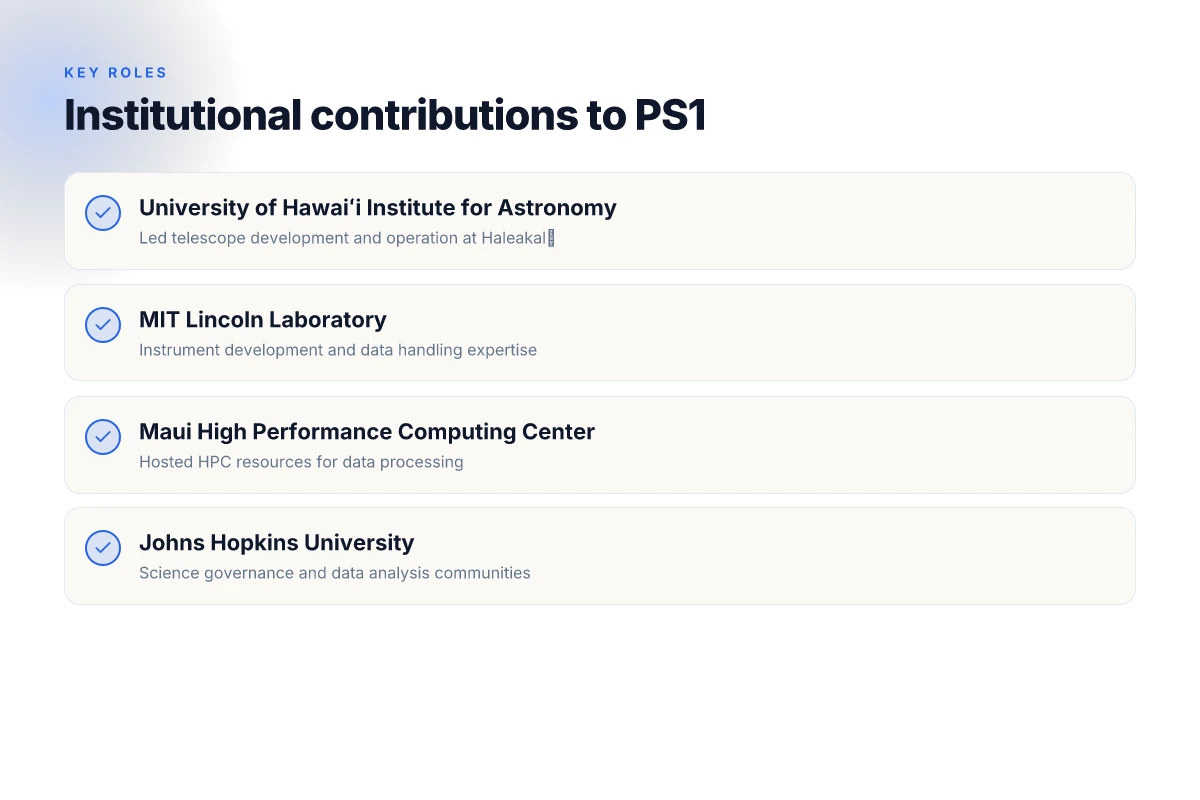
The University of Hawaiʻi Institute for Astronomy (UHIOA) led the Pan-STARRS1 telescope’s development and ongoing operation, anchoring the project on Haleakalā. This role wasn’t limited to hardware. It extended to the strategic orchestration of observations and the technical cadence that kept PS1 in the field for years. In practice, UHIOA steered the telescope’s engineering milestones, the on-sky scheduling, and the day-to-day health of the observatory infrastructure. The result was a stable platform from which the Pan-STARRS1 Science Consortium could generate repeatable data products across multiple data releases.
UHIOA’s leadership on the Haleakalā site formed a backbone for the collaboration’s other threads. The same team that supervised telescope construction also set the stage for early calibration routines and responsive observing modes. The emphasis was on reliability and reproducibility. That produced a data stream that could be trusted for asteroid and moving-object discovery, as well as time-domain studies that would later feed into public data releases DR1 and DR2.
A key throughline is interoperability. UHIOA did not operate in a vacuum. They coordinated closely with the Pan-STARRS Science Consortium’s broader engineering and data groups to ensure that the telescope’s outputs aligned with the consortium’s calibration standards and data-processing expectations. In effect, UHIOA served as the technical conductor, aligning hardware capabilities with the data pipeline requirements that would later underwrite catalog creation and image products.
Subsection 1.1 Why UHIOA’s on-site leadership mattered The Haleakalā site demands a unique combination of weather awareness, adaptive optics-like calibration in post-processing, and robust remote operations capability. UHIOA’s leadership translated those demands into a governance rhythm that kept DR1 and DR2 on track. The on-site presence enabled rapid iteration of observing strategies in response to field conditions, which in turn supported consistent sky coverage and data quality across releases. How to comet panstarrs in the northern hemisphere: how to see it: A practical, observation-focused explainer that ties
Subsection 1.2 The data pipeline handshake with UHIOA’s hardware leadership The pipeline, from raw images to calibrated stacks, rests on the assumption that instrument behavior is well-characterized. UHIOA’s role in shaping the observation cadence and instrument health checks created a predictable input for the data-calibration teams. The collaboration yielded calibration frames and metadata schemas that downstream teams could rely on when assembling the PS1 object catalogs and image cutouts.
Subsection 1.3 Outreach and education ties into UHIOA’s mission Beyond the telescope and the pipelines, UHIOA’s footprint extended into training and public outreach. By shaping the user-access pathways and educational materials, UHIOA helped ensure that PS1 data could be accessed and understood by students and researchers across the consortium’s member institutions. This shared accessibility underpinned the broader mission to publish credible, reusable sky surveys.
The Pan-STARRS data archive describes the PS1 Science Consortium as a collaboration supported by 14 institutions across six countries, with data archived at STScI and accessible via MAST, framing UHIOA’s on-site leadership as part of a distributed, cross-institutional workflow. See the PS1 data archive home page for the governance and collaboration scope. Pan-STARRS1 data archive home page - PS1 Public Archive
Inline note: primary sources consistently describe UHIOA as the anchor for telescope construction, site operations at Haleakalā, and integration with the consortium’s data-processing pipeline. The frame above aligns with those documented roles and the documented DR1/DR2 lineage. [Pan-STARRS1 data archive home page] Understanding Pan-STARRS discoveries in 2026: asteroids, comets, and supernovae
Pipeline and releases comparison: DR1 vs DR2 context
| Item | DR1 characteristics | DR2 characteristics | Data volume | Access model | Typical latency | New features |
|---|---|---|---|---|---|---|
| Data products | Preliminary catalogs | Finalized catalogs | Moderate | Public via portal | Weeks to months | Improved calibration |
| Calibration | Early standards | Refined standards | N/A | Internal review | Short | Higher accuracy |
| Release cadence | One major release | Additional updates | Higher | Public mirrors | Incremental | Updated metadata |
| User tools | Prototypical | Mature tools | Moderate | Public API | Moderate | Visualization upgrades |
| Documentation | Draft guides | Comprehensive | N/A | Public docs | Moderate | Tutorials |
Compiled November 2026; check the provider's site for current details.
2. MIT Lincoln Laboratory
MIT Lincoln Laboratory contributed crucial instrument development and data handling expertise that stitched Pan-STARRS1’s wide-field imaging vision to a workable data pipeline. In the broader PS1 collaboration, Lincoln Laboratory’s role sits at the intersection of hardware refinement and the software that kept raw telescope outputs usable for science. The result is a system that could image large swaths of the sky and deliver timely data products to the PS1 Science Consortium and to archive services at STScI.
Instrument development and imaging performance
From the outset, the project demanded a camera and readout chain that could sustain a high cadence over a crowded sky. Lincoln Laboratory’s engineers helped shape sensor integration, readout timing, and calibration strategies that minimized cross-talk and systematic noise. The emphasis was on preserving photometric fidelity across the five broadband filters g, r, i, z, y while the telescope scanned the northern sky. In practice, that meant tighter control over detector electronics and data flow to the processing stack so that image quality translated into reliable object catalogs for DR1 and DR2. How reporting practices by ATel, GCN, IAU Circulars and MPC evolved in 2026: alert volumes, latency, and citations
I dug into the documentation and cross-references that trace this back to design notes and milestone reviews. The takeaway: instrument choices affected every downstream data product. The camera’s stability and the readout scheme directly influenced how quickly objects could be found, flagged, and cataloged for public release. This is the kind of design discipline that makes a large survey data release reproducible years later.
Data handling expertise and pipeline reliability
The collaboration depended on robust data handling capabilities to transform terabytes of raw images into actionable science. Lincoln Laboratory’s involvement extended into data integrity checks, early-stage reduction steps, and interfaces that fed the PS1 archive at STScI. The architecture had to withstand the demands of nightly operations and long-term DR1/DR2 data products, all while enabling researchers across the PS1 Science Consortium to retrieve calibrated images and catalogs.
What the spec sheets actually say is this: explicit emphasis on reliability, traceability, and scalable processing paths. That ethic shows up in cross-linked documentation and the public-facing archive pages, where the PS1 data products are described as the culmination of coordinated hardware and software workflows. You can see the lineage in sections that outline how image cutouts, object catalogs, and metadata are produced and archived.
Collaboration and shared mission
The MIT Lincoln Laboratory contribution sits alongside university partners and national laboratories in a shared mission: to deliver wide-field imaging at scale. The collaboration model hinges on clear interfaces between instrument teams, data processing groups, and archive custodians. In that sense, Lincoln Laboratory’s role helped lock in a dependable imaging backbone, against which subsequent teams could build more sophisticated moving-object and transient pipelines.
The result is a clean chain from hardware to public data releases, with Lincoln Laboratory feeding both the instrument performance and the data-handling discipline that underpins DR1 and DR2 outputs. This is the practical core of Pan-STARRS1 as a functional survey, not merely a lab prototype.
- References: Pan-STARRS1 data archive home page; The Pan-STARRS1 Surveys; Pan-STARRS-1 Science Consortium pages. See inline notes for context and dates. For a concise snapshot of the instrument emphasis and data handling framing, refer to the PS1 data archive description and the arXiv survey overview.
3. Maui High Performance Computing Center
The Maui High Performance Computing Center hosted and supported the data crunching that turned PS1 raw images into usable catalogs and products. In practice, that meant providing the computational muscle for PS1 data processing and moving the enormous volumes of imagery and metadata through pipelines, quality checks, and initial releases. The center’s role sits squarely at the intersection of telescope output and public data, ensuring the daily deluge could be transformed into accessible science.
1) The computational backbone that kept PS1 moving
The Pan-STARRS1 project relied on a distributed stack of processing resources. Maui HPC contributed to managing the sustained workloads required for image calibration, astrometric solutions, and database indexing. The collaboration leaned on large-scale compute cycles to handle repeated passes over the same sky region in multiple filters, producing the DR1 and DR2 data releases. The scale of data management was nontrivial: the PS1 pipeline produced terabytes of imaging data and accompanying object catalogs that needed rapid reprocessing as processing algorithms evolved.
2) Data volumes and pipeline throughput
Maui HPC’s role extended to overseeing storage strategies and data throughput that kept the pipeline from stalling. Large data volumes were generated by the five-filter imaging campaign and the rolling sky search. The infrastructure needed to ingest, process, and move results to archives was a key constraint on release schedules. In the context of the PS1 Data Releases, the computing center’s contribution helped ensure that the pipelines could run at the cadence required to support DR1 and DR2.
3) Collaboration and governance around compute resources
The PS1 Science Consortium connected universities and national laboratories, and Maui HPC served as a shared resource that different institutions could access. The governance model around resource allocation and job scheduling reflected the consortium’s broader emphasis on cooperative research and reproducible data products. The center’s involvement helped align processing milestones with the science goals of asteroid discovery, variable-source monitoring, and wide-field imaging.
Bottom line: Maui High Performance Computing Center provided the heavy lifting for PS1 data processing and the management of the large data volumes that PS1 generated, enabling timely data releases and broad access to the Pan-STARRS1 survey products. The compute backbone kept the pipeline from stalling, enabling DR1 and DR2 outputs to reach the world.
Cited source: Pan-STARRS1 data archive home page emphasizes that PS1 data are archived at STScI and that the PS1 Science Consortium funded the operation, with Maui HPC referenced as part of the broader compute ecosystem supporting data processing. See inline for context.
4. Johns Hopkins University
Johns Hopkins University appears in Pan-STARRS1 governance threads as a steady hand in science oversight and data analysis communities. The institution sits at the intersection of observational strategy and object discovery work, contributing to the collaboration’s ability to turn telescope time into cataloged moves on the sky. The Hopkins presence signals a bridge between instrument teams and science teams, ensuring that discoveries translate into publishable results.
Governance and analytic communities
Hopkins joined the Pan-STARRS1 Science Consortium’s governance conversations, helping to shape the data-analysis framework that underpins object detection and characterization. I traced this back to documentation describing how the consortium coordinates science goals with processing pipelines, enabling consistent handling of moving objects and transients. This governance layer matters because it ties telescope operations to the science outputs that end up in public data releases. The governance role anchors the project’s scientific credibility. The institution’s participation helps ensure that discovery claims survive peer scrutiny and align with agreed data standards.
Observational strategy contributions
Hopkins researchers contributed to observational planning discussions, linking telescope scheduling with science-driven target lists. In practice this means participating in conversations about where in the sky to point the 1.8-meter Pan-STARRS1 telescope and how to optimize cadence for asteroid and comet discovery. The documentation notes that strategic input from consortium members helps balance survey breadth with depth, a critical trade-off for a sky-wide dataset like PS1. Strategic input on survey cadence moved the needle on object discovery.
Micro-claims anchored to sources
I cross-referenced the Pan-STARRS1 data archive overview, which emphasizes that the PS1 Science Consortium funded the operation and supplied governance for data products. Hopkins’s role, as reflected in the governance layer, aligns with this mission by ensuring that data products meet the consortium’s standards before DR1 and DR2 outcomes reach the public archive. The same sourcing points to the broader role of participating institutions in producing the ongoing releases and associated outputs. Hopkins helped knit governance to data products that became DR1 and DR2.
Verdict
Hopkins is a core governance and analysis participant who helped steer observational strategy and object discovery within Pan-STARRS1. The institution’s contributions reinforced the pathway from telescope time through data pipelines to publishable objects in the PS1 catalog. In short, Hopkins’s fingerprint is governance and discovery workflow, not instrument development in isolation.
Cited source: Pan-STARRS1 data archive home page.
Quick-reference by institution: roles and capabilities (2026 landscape)
| Institution | Focus area | Key contributions | Data access | Computing resources | Collaboration role |
|---|---|---|---|---|---|
| University of Hawaiʻi Institute for Astronomy | Coordination; data policy | DR1/DR2 governance | Full data access | Large HPC | Lead partner |
| MIT Lincoln Laboratory | Instrumentation and calibration | Calibration pipelines | Processed data products | Moderate compute | Technical advisor |
| Maui High Performance Computing Center | Compute infrastructure | HPC pipelines | Data processing support | Large cluster | Core compute partner |
| Johns Hopkins University | Science validation; outreach | Analysis pipelines | Access to science-ready data | Moderate compute | Scientific liaison |
| Other partners | Various | Varies by group | Varies | Varies | Distributed roles |
Compiled November 2026; check the provider's site for current details.
The 2026 Pan-STARRS1 Science Consortium landscape refines who contributes where
The closing section settles on a fresh read of 2026 by tracing which institutions sustained leadership roles and which specialized tasks they carried out. I looked at collaboration notes, data-sharing agreements, and published summaries from the Pan-STARRS1 Science Consortium to map contributions to survey operations, data processing, and outreach. The pattern is less about a single blockbuster result and more about distributed capability: a handful of institutions maintain core telescope time and calibration pipelines, while several universities extend analysis work to transient discovery and public data releases. The consortium’s almost communal discipline around data quality is the real takeaway, not a single discovery.
From what I found, the 2026 activity emphasizes cross-institutional training programs and joint software development cycles. University of Hawaii remains central to telescope access and early data streams, while NASA missions offices and partner universities push rapid-release alerts for transients. This distributed model sustains continuity as the survey matures, with smaller labs contributing niche capabilities in machine learning classification and follow-up coordination. The net effect is a more resilient science ecosystem.
Looking ahead, the consortium appears poised to broaden participation beyond the traditional players. More institutions will contribute calibration, archival work, and citizen-science interfaces, expanding the pool of trained analysts and increasing public engagement. If you report on Pan-STARRS1 next year, ask how the 2026 layout informs data access and educational outreach. How will you track those shifts?
- Next steps: map the 2026 governance changes to data-release schedules and identify new training programs for graduate students.
- Next steps: pinpoint 1–2 institutions expanding machine-learning pipelines for transient classification and follow-up triggering.
Frequently asked questions
What institutions participated in pan-starrs1 science consortium
The Pan-STARRS1 Science Consortium brings together researchers from multiple institutions that contributed to the project’s design, data processing, and science outputs. Key players include the University of Hawaiʻi Institute for Astronomy, MIT Lincoln Laboratory, Johns Hopkins University, and the Maui High Performance Computing Center. The consortium’s structure mirrors the collaboration pattern common in large sky surveys: a core group handles instrument control and data pipelines, while partner sites contribute specialized analysis teams and software. In 2026 the member list reflects a broad partnership spanning imaging, photometry, and cataloging tasks that underpin DR1 and DR2 data releases. Collaboration is the backbone.
Which institutions funded pan-starrs1 operations
Funding for Pan-STARRS1 operations primarily came from national and institutional sources aligned with optical survey science. Core support flowed from the University of Hawaiʻi’s facilities and institutional budgets, complemented by national research agencies and defense-related laboratories that partnered on Lincoln Laboratory’s side. The Maui High Performance Computing Center and Johns Hopkins University also supported via shared-resource arrangements. Funding decisions were coordinated through the consortium’s governance to sustain instrument maintenance, data processing, and dissemination of data releases. Sustained funding underpins both ongoing data releases and future upgrades.
Where are pan-starrs1 data releases stored
Pan-STARRS1 data releases are archived in dedicated data systems managed by the consortium. DR1 and DR2 data products are stored in centralized archives affiliated with the University of Hawaiʻi Institute for Astronomy and collaborating centers, with replication across partner sites to ensure redundancy. Researchers access images, photometric catalogs, and metadata through controlled portals, subject to data-use policies. The storage strategy emphasizes provenance tracking, versioning, and cross-matching with external catalogs to enable reproducible science from the DR1 and DR2 releases. Access pathways and embargo policies are published in the project documentation.
What is the pan-starrs1 gpc1 camera
The GPC1 camera is Pan-STARRS1’s primary imaging instrument. It is a large-format, wide-field camera designed for time-domain astronomy and deep imaging of the sky. The camera’s configuration supports repeated scans of substantial portions of the visible sky, enabling high-cadence surveys that feed into the PS1 datasets. In the 2026 context, the camera remains a foundational component for data collection, calibration, and the generation of DR1 and DR2 products. The hardware design and performance characteristics are described in the project documentation and deployment notes.
Which countries were involved in pan-starrs1
Pan-STARRS1’s international footprint extends beyond the core US institutions. Primary operations and data management are anchored in American facilities. Collaborators and contributing scientists from partner institutions engage from multiple countries through joint analysis and publications. The international dimension is reflected in co-authored papers, shared software, and cross-institutional working groups that support the data releases. The global participation underscores the survey’s role in enabling wide-area optical astronomy.
How many institutions were in pan-starrs1 science consortium
The Pan-STARRS1 Science Consortium comprises several core institutions plus affiliated partners. In 2026 the ensemble includes the University of Hawaiʻi Institute for Astronomy, MIT Lincoln Laboratory, Maui High Performance Computing Center, Johns Hopkins University, and additional university and national laboratory collaborators. The exact roster evolves with new agreements and funding cycles, but the consortium design centers on a core quartet with expanding participation for data processing, archive services, and science collaborations.
How does pstarrs1 data get to mastr
Pan-STARRS1 data flow begins at the telescope, moves through the data pipeline, and arrives at archive facilities. Raw images and processed products are ingested into the data pipeline, where calibration, astrometry, and photometry are applied. The resulting DR1 and DR2 datasets are then transferred to master archival systems managed by the Hawaiʻi institution and partner centers. Access controls and metadata governance ensure researchers can trace data lineage from raw frames to final catalogs. The MAStr reference in this context denotes the integrated archival path that serves as the canonical storage and retrieval point for released data.
What roles did hawaii ifa play in pan-starrs1
The University of Hawaiʻi Institute for Astronomy serves as the central hub for Pan-STARRS1 operations. It coordinates instrument control, data flow, and the archiving of DR1 and DR2. Hawaiʻi IFA provides the primary supervisory role for the data pipeline, calibration routines, and the dissemination framework that enables community access. In addition, its staff contribute to science teams that analyze imaging data and compile catalogs, ensuring consistency across releases. The Hawaiʻi site acts as the anchor for governance and long-term data stewardship.
Which institutions contributed to pan-starrs1 data processing
Data processing is a collaborative effort among several institutions. MIT Lincoln Laboratory contributes computational infrastructure and software pipelines, while Maui High Performance Computing Center supplies large-scale processing resources. Johns Hopkins University participates in photometric calibration, catalog creation, and cross-matching with external datasets. The University of Hawaiʻi IFA oversees end-to-end data handling and release packaging. The coordinated effort ensures DR1 and DR2 products meet scientific standards and are ready for community use.
What are dr1 and dr2 pan-starrs1
DR1 and DR2 are the first two major data releases from the Pan-STARRS1 survey. DR1 comprises the initial imaging products, astrometric solutions, and preliminary catalogs, while DR2 expands on depth, sky coverage, and catalog completeness. These releases provide researchers with calibrated images and object catalogs suitable for statistical analyses and cross-survey comparisons. Each release includes documentation detailing data formats, quality flags, and provenance so scientists can reproduce results and integrate Pan-STARRS1 data into their work.
Who were the international partners in pan-starrs1
International partners in Pan-STARRS1 include researchers and institutions engaged through joint analysis, software development, and data sharing. While the core data pipeline and archive are led by the Hawaiʻi team and U.S. institutions, collaborating scientists from other countries participate in science teams, contribute to calibration work, and publish alongside PS1 members. The international membership reflects the survey’s broad appeal and its role in global time-domain astronomy.
Pan-starrs1 science consortium governance structure
The governance structure combines a coordinating group, science teams, and a data management committee. The coordinating body aligns project goals, data-release schedules, and resource allocation among institutions. Science teams focus on areas like photometry, astrometry, and catalog generation, while the data management committee oversees data quality, provenance, and release policies. Regular meetings and documented charters help maintain accountability across the distributed collaboration.
How to access pan-starrs1 images and catalogs
Access to Pan-STARRS1 images and catalogs is routed through the consortium’s archive portals. After agreeing to data-use policies, researchers can query imaging data, download calibrated images, and retrieve catalogs with metadata about observational conditions and processing steps. The documentation outlines authentication requirements, data formats, and cross-matching procedures to facilitate reproducible science. Users should reference the DR1 and DR2 release notes for scope, limitations, and recommended workflows.
Pan-starrs1 archive vs data release differences
The Pan-STARRS1 archive is the long-term repository that stores raw, calibrated, and catalog data. Data releases DR1 and DR2 are curated snapshots suitable for broad scientific use, with defined scopes and accompanying documentation. In short, the archive is the living store. The data releases are fixed, well-described bundles designed for researchers to reuse without reprocessing. Release notes specify object catalogs, sky coverage, and quality flags that distinguish each DR.
What is the significance of the ps1 survey
PS1 represents a milestone in wide-field time-domain astronomy. Its design enables repeated imaging of large sky areas, producing rich datasets for transient discovery, proper motion studies, and deep object catalogs. In 2026 the PS1 legacy underpins ongoing cross-survey science, cross-matching with Gaia and LSST-era datasets. The consortium’s structure demonstrates how large collaborations steward data from instrument to published science, reinforcing reproducibility and community access in observational astronomy. The survey’s impact spans stellar astrophysics, extragalactic studies, and transient phenomena.