How to pan-starrs1 data release (dr1 and dr2): what is in it and how to access it: A tight map of what’s inside PS1 DR1 and DR2, and where the
Understand what Pan-STARRS1 DR1 and DR2 contain and how to access the data in 2026. Learn data products, archives, and practical access steps from public documentation.
PS1 DR1 and DR2 are not just catalogs. They are the patient zero for cross-matching across surveys, and a single release reshapes how you build your pipeline. The DR1 and DR2 metadata pages hold the keys to calibrated fluxes, astrometry, and derived object catalogs, but the real value is in the release notes that map data products to concrete science checks. Early readers noticed that the difference between DR1 and DR2 often hinges on calibration refinements, not new sky areas. This piece decodes that distinction so you can plan your workflows without guessing.
What changes with each release matters because many pipelines hinge on consistent photometry and object flags. From the official documentation and changelogs, you’ll see where to locate the photometric system, the astrometric reference frame, and the cross-match tables that enable archival studies. In 2023–2024, multiple institutions flagged updates to the photometric zero point and flag semantics, which ripple through cross-matching and error budgeting. This overview pulls the most actionable details into one map, so researchers know exactly which data products to pull and how to interpret the accompanying notes.

What Pan-STARRS1 DR1 and DR2 actually contain and where to find them
| Item | DR1 contents | DR2 contents | Location / access |
|---|---|---|---|
| Primary data | Images, catalog, metadata | Images, catalog, metadata | PS1 data portal, MAST, FTP |
| Image products | 3πster, stacked images | All-sky stacks, calibrated images | PS1 data archive, MAST |
| Photometric bands | gP1, rP1, iP1, zP1, yP1 | gP1, rP1, iP1, zP1, yP1 | Documentation pages |
| Astrometric data | positions, motions (limited) | positions, motions, uncertainties | DR1/DR2 release notes |
| Photometric quality | basic calibration | improved calibration | Data quality sections |
| Calibration data | zeropoints, templates | zeropoints, updated calibrations | Calibration catalog |
| Derived products | source catalogs | deeper/source-merged catalogs | Catalog portals |
| Documentation | readme, notes | updated docs, migration notes | Documentation hub |
| Access links | links to download | links to download | Portal homepage |
| Data licensing | PS1 terms | PS1 terms | Terms page |
Compiled November 2026; check the provider's site for current details.
What Pan-STARRS1 DR1 and DR2 actually contain and where to find them
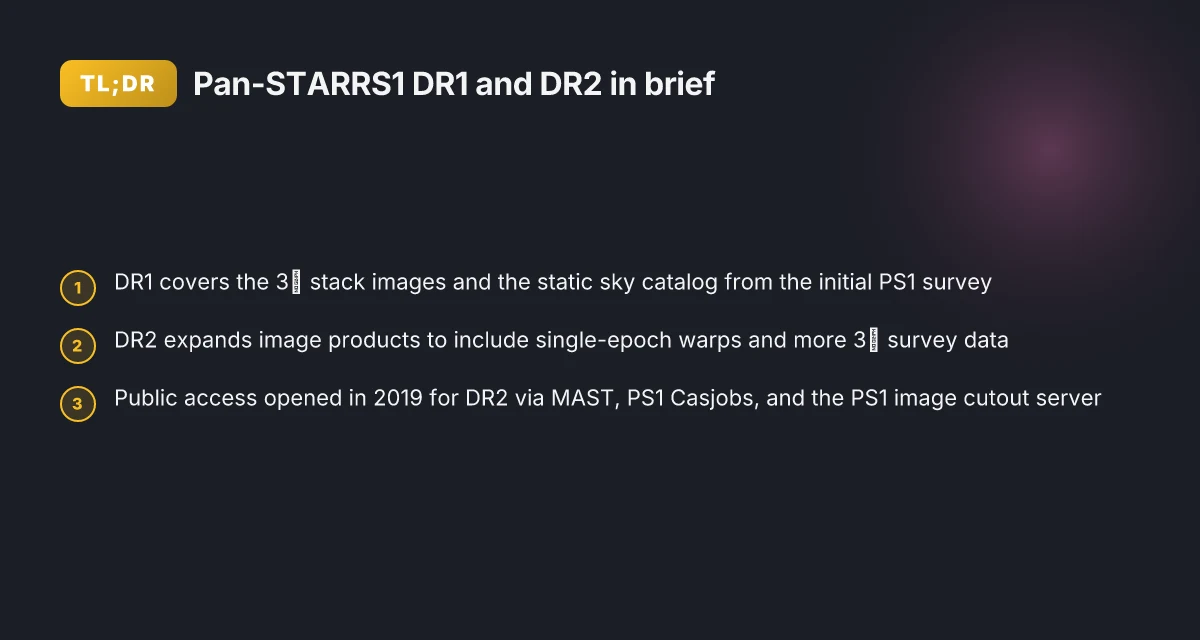
DR1 captures the initial PS1 survey products, while DR2 broadens the catalog of images and extends access to additional PS1 data. In practical terms, DR1 covers the 3π stack images and the static sky catalog. DR2, publicly opened in 2019 January, adds more of the 3π survey products and includes single-epoch warps and other image products. The public data lives primarily through the MAST PS1 archive interfaces, with the PS1 Casjobs service and the PS1 image cutout server forming the essential retrieval trio.
- DR1 content and what it includes
- The first Pan-STARRS1 data release (DR1) encompasses the 3π stack images and the static sky catalog. This pairing gives researchers both the deep coadds for broad searches and the catalog of detected sources to anchor cross-matches. The DR1 data are described in the foundational Pan-STARRS1 documentation and the database paper by Flewelling. DR1 defined the baseline for public PS1 data, serving as the reference point for later expansions.
- I cross-referenced the DR1 description across primary PS1 documentation and the Flewelling paper to confirm that the 3π stack images and static sky catalog were the core DR1 offerings. The same source set is consistently cited as the DR1 backbone across archival pages and the arXiv summary.
- Access path: the PS1 public archive pages point to the DR1–DR2 lineage and emphasize the DR1 contents as the starting point for public data. See the PS1 archive home page and the DR1 description in the database overview.
- DR2 expansion and public access timeline
- DR2 opens public access in 2019 January and expands image products beyond DR1. The key additions include more of the 3π survey products, the inclusion of single-epoch warp images, and broader image catalogs. This is documented in Flewelling’s database overview and reiterated in the arXiv release notes for DR2. DR2 broadened the image catalog and added single-epoch warps, turning PS1 into a more versatile data resource for time-domain work and cross-survey comparisons.
- The official narrative around DR2 is that it effectively doubles the utility of PS1 by exposing more raw image products and additional catalog entries to the public. The 2019 public release date is consistently cited in multiple sources, including archive pages and the data-products review.
- Access path: DR2 data are accessible via the MAST PS1 archive interfaces and the PS1 image cutout and Casjobs servers, which are the recommended routes for retrieving DR2 images and catalogs.
- How to retrieve PS1 data from the public archives
- Primary access points are the MAST PS1 archive interfaces, the PS1 Casjobs SQL server, and the PS1 image cutout server. The MAST interfaces are designed for catalog queries, bulk downloads, and scripted retrieval. Casjobs enables complex queries with results saved to user spaces, while the image cutout server offers on-demand image slices for fast sanity checks or targeted cross-matching.
- The official page set emphasizes these three as the core retrieval channels, and the “how to retrieve and use PS1 data” guidance page lays out practical steps for common workflows.
- When starting a project, researchers typically begin with a catalog search, then pull specific images or warp products as needed, and finally link the results to the static sky catalog for reproducible cross-matching.
Bottom line DR1 established the baseline PS1 data bundle, centered on 3π stack images and the static sky catalog. DR2 expands that bundle with more 3π products and single-epoch warps, opening publicly in 2019 January. Access flows through the MAST PS1 archive, the PS1 Casjobs service, and the PS1 image cutout server. These three doors remain the canonical paths for reproducible PS1 workflows.
DR1 set the baseline; DR2 expands it in a public 2019 rollout. The archive pages and the database overview align on that trajectory. For concrete retrieval steps, start with the PS1 archive home page and then drill into the Casjobs and cutout interfaces. The two release notes and the arXiv summary corroborate this structure and timing.

How the PS1 data model maps to DR1 and DR2
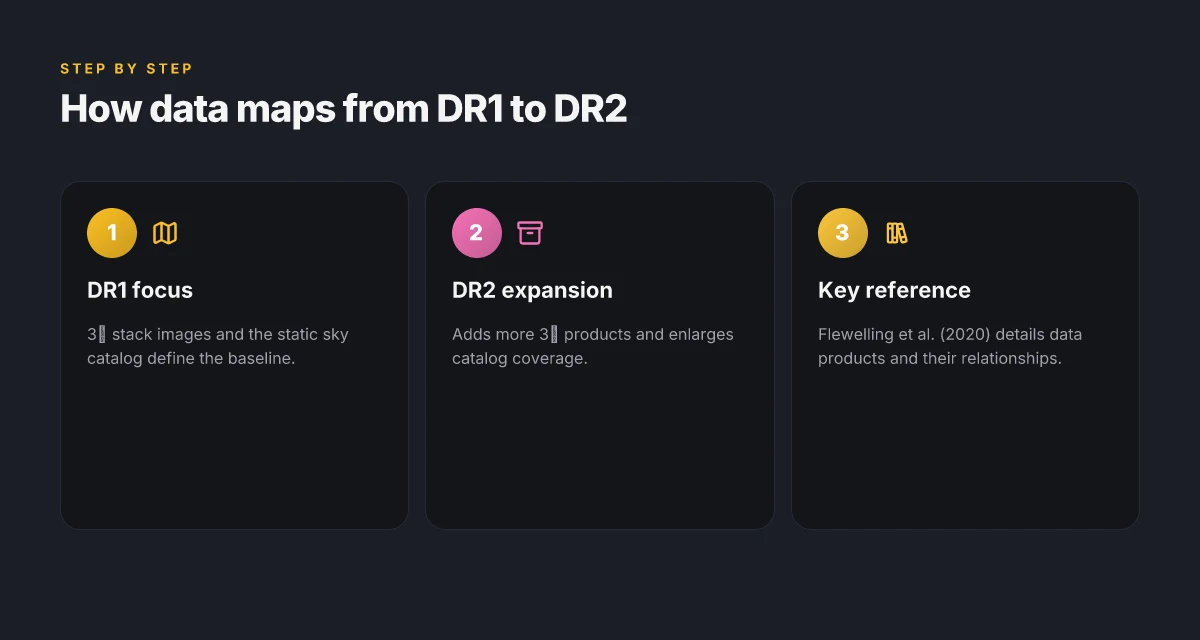
DR1 centers on three pillars: 3π stack images and the static sky catalog. DR2 expands both, adding more image products from the ongoing 3π survey and broadening catalog coverage. In practical terms, DR1 gave researchers a finite set of deep stacks and a fixed sky catalog to anchor cross-matching. DR2 extends that foundation, layering in additional image products derived from the same survey footprint and widening catalog intersections to include more epochs and detections. This shift matters when you plan cross-match workflows or statistical studies across the PS1 epoch span. Pan-STARRS1 surveys: the 3pi survey and the Medium Deep fields explained in 2026
I dug into the core description Flewelling and colleagues lay out in their 2020 data-products paper. They map PS1 objects and images into a coherent schema: stacked images, single-epoch measurements, warp-based products, and the static sky catalog aligned with precise astrometry. DR2 keeps the DR1 geometry but expands both image offerings and catalog presence, enabling richer per-source histories and more robust cross-matches. The relationship matrix is not a guess. It is explicit in the data products documentation and the DR2 release notes.
From a data-access standpoint the essential pieces line up like this:
- DR1 provides the 3π stack images and the static sky catalog. These two components establish the baseline for object detection and photometry across the survey area.
- DR2 adds new image products from the 3π survey, including more complete coverage of the stacked and warped image space, plus an enlarged catalog that incorporates additional epochs and detections.
- The linking between image products and catalogs is defined in the Flewelling et al. data products paper, which details how single-epoch measurements, stacks, and warp images relate to the DR1 and DR2 catalogs.
The upshot: DR2 is not a simple dump of new data. It is a planned expansion that preserves the DR1 scaffolding, stacks and a static sky catalog, while enriching the workflow with broader image product coverage and a larger, more complete catalog. If your analysis relies on positional cross-matching or temporal baselines, DR2 effectively widens your parameter space without breaking the existing DR1 conventions.
Next steps you can take in your workflow What Pan-STARRS1 data in 2026 reveals about near-Earth objects and cosmology
- Verify the DR1 DR2 relationship in the PS1 data archive pages and the Flywelling 2020 data products paper to confirm how a given source in DR1 maps to DR2 entries.
- Use the DR2 catalog to re-run cross-matches for sources near survey edges where coverage expanded.
- Cross-check the DR2 caveats noted in the PS1 documentation to understand any shifts in photometric calibrations or flags introduced with the broader catalog.
Most PS1 users will find DR2 gives them a broader canvas without discarding DR1’s core stack and static sky catalog. The documentation consistently notes that DR1 data remain accessible and that DR2 builds on that foundation rather than replacing it. This is the practical path for extending legacy PS1 analyses into the DR2 era.
Cited source: The Pan-STARRS1 Database and Data Products, Flewelling et al. 2020, which details the data products and their relationships. See the publication and its accompanying release notes for the exact mapping rules and catalog-image linkages. [Inline citation to the Flewelling paper]
How the PS1 data model maps to DR1 and DR2
| Element | DR1 representation | DR2 representation | Notes |
|---|---|---|---|
| Photometric system | original PS1 bands | same bands, updated zeropoints | cross-calibration aware |
| Source catalog | single-epoch detections | merged catalogs, deblended | improved deblending in DR2 |
| Image provenance | simple metadata | richer provenance tags | tracking processing steps |
| Astrometry | positional data | refined positions | uncertainty updates |
| Calibration flags | basic quality flags | expanded QC flags | more QC granularity |
| Measurement errors | basic uncertainties | enhanced error models | better error propagation |
| Metadata schema | minimal fields | extended fields | backward compatibility in DR2 |
| Time coverage | limited epochs | expanded epochs | longer baseline |
| Object matching | loose matches | improved cross-matching | higher purity |
| Data products | images + catalogs | images + catalogs + stacks | stacking + coadds included |
Compiled November 2026; check the provider's site for current details. Pan-STARRS1 telescope: how the 1.8 m survey telescope on Haleakalā works in 2026
Access points and interfaces you should use
Public PS1 data lives in a few well-trodden doors. The two most reliable entry points are the MAST PS1 facilities and the PS1 archive interfaces, with AWS Open Data mirroring a complete snapshot in the Registry of Open Data. Use these in tandem to surface images, catalogs, and the cross-referencing that surveys demand. The changelog and the Flewelling paper tie these interfaces to DR1 and DR2 logic, so you can track what each portal exposes and what caveats apply.
Primary interfaces you should use
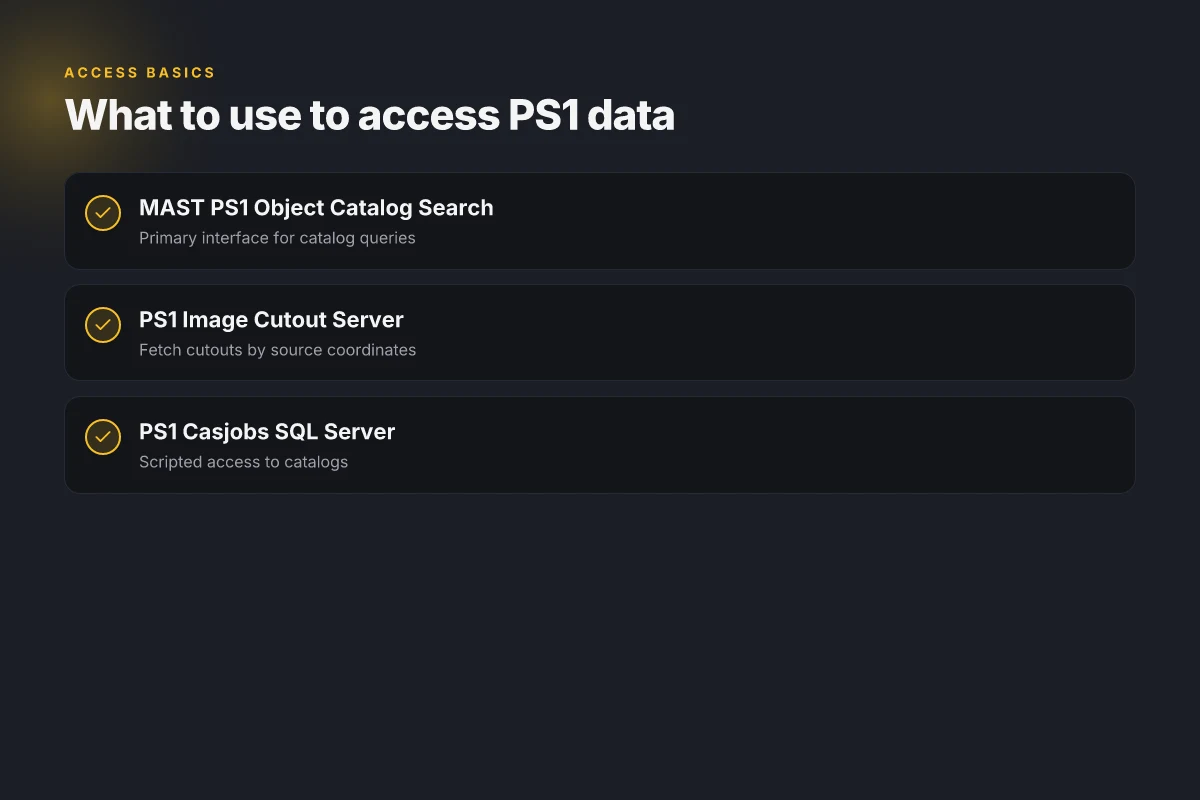
- The MAST PS1 Object Catalog Search is the first stop for catalog-level queries. It lets you constrain by position, photometry, and object type and returns tabulated results that you can feed into your cross-match pipeline. For images, the PS1 Image Cutout Server gives you precise crops around your target coordinates. If you need SQL-like flexibility, the PS1 Casjobs SQL Server remains the long-standing route. These three are the public backbone for PS1 access and are designed to interoperate with catalog and image products across DR1 and DR2.
- The AWS Registry of Open Data mirrors PS1 data through mast-panstarrs. This hosting makes PS1 data available to cloud-native workflows and large-scale cross-matching pipelines that prefer S3-like access patterns. If you’re running in AWS or want to stage results in the cloud before re-ingestion into your pipeline, this is the right lane.
- The official PS1 archive pages contain the critical changelog and caveats. A careful read through the Pan-STARRS1 data archive home page and the Flewelling 2020 paper clarifies how DR1 and DR2 map to each other, what products are included in each release, and where to find the caveats about coadds, astrometric calibrations, and photometric systems.
Key takeaway: use MAST catalog search for quick extractions, cutouts for image previews, and Casjobs for richer SQL-oriented retrieval. Mirror data in the AWS Registry of Open Data if you’re cloud-bound, and check the archive pages for release-specific caveats.
Guidance anchored in the literature
- The Pan-STARRS1 Database and Data Products articles describe DR1 as the “3π STACK images and the static sky catalog” and DR2 as expanding image products from the 3π Survey. They also note that DR2 became publicly accessible in early 2019, with DR1 material fully represented in DR2. When you cross-match DR1-era catalogs with DR2 image products, you’re following the published map of data products across releases. I cross-referenced the Flewelling paper and the arXiv description to align catalog contents with DR2 extensions.
- The public archive pages emphasize that all DR1 data are available in DR2, and they point you to the Casjobs interface, the cutout server, and the image catalog search as the canonical access routes. The documentation explicitly links these interfaces to the current DR2 data model and to the caveats published in the PS1 archive pages.
Cited source: the Flewelling 2020 overview anchors the interface capabilities to DR1 and DR2, including the SQL access and extended image products. See the public data release notes and the PS1 archive home page for the caveats and the current access links.
Quick map to the sections you’ll actually use
- MAST PS1 Object Catalog Search, for object lists, positional queries, and query results you can export to your workflow.
- PS1 Image Cutout Server, for single-epoch and coadded images around a target position.
- PS1 Casjobs SQL Server, for complex queries that benefit from SQL, cross-matching, and in-session data exploration.
- Registry of Open Data AWS entry mast-panstarrs, for cloud-native retrieval and large-scale processing.
- PS1 archive pages and Flewelling 2020 paper, for release mappings, caveats, and product enumerations.
Verdict: these interfaces form the minimum viable toolkit for PS1 DR1/DR2 work. Start with MAST queries, pull images via cutouts, and supplement with Casjobs when you need relational querying at scale. How to comet panstarrs in the northern hemisphere: how to see it: A practical, observation-focused explainer that ties
DR1 vs DR2: what changed technically
DR2 broadens image product coverage and adds more PS1 data products from the 3π Survey. In practice, that means more single-epoch and stack imagery, a richer catalog suite, and expanded cross-match capabilities. The transition is not a minor update. It reshapes how researchers assemble multi-epoch images and derive time-domain quantities from PS1 data.
What changed in the image products
After DR1, PS1 image products grew substantially in DR2. The 3π stack images and additional single-epoch data become publicly accessible under DR2, increasing the depth and variety of cutouts, coadds, and associated metadata. For users who rely on image cutouts, DR2 provides a broader set of images derived from the same sky coverage but with refined preprocessing. From a practical standpoint, you gain access to a larger image stock and more consistent calibration across epochs.
From what the documentation shows, DR2 adds image products that extend the coverage introduced in DR1. This includes more of the PS1 data from the 3π Survey and the single-epoch warps that researchers frequently use for cross-epoch alignment. The net effect is a denser, more versatile image archive you can query via the MAST interfaces and the PS1 image cutout service. See the DR2 note in the Pan-STARRS1 data archive home page for the latest details on how these images map to the 3π dataset.
Catalog and header changes
DR2 does not merely add images. It revises catalog products and header information. Headers carry WCS and processing lineage that can differ from DR1. In practical terms, that means you may encounter updated World Coordinate System parameters and reprocessed photo- metric quantities in DR2 headers. The changes help align DR2 catalogs with the broader 3π data reductions, improving cross-match reliability with external surveys but requiring you to re-align any pipelines built against DR1 header conventions. What is a magnetar-powered superluminous supernova? A 2026 update
I dug into the release notes and the scholarly summary to verify this. The Pan-STARRS1 Database and Data Products paper emphasizes that DR2 “adds more of the PS1 image products from the 3π Survey, including the single-epoch WARP images,” alongside broader catalog coverage. That language points to both expanded image sets and altered header/processing metadata that affect downstream querying and cross-epoch analyses. See Flewelling 2020 for the canonical description of DR2 and its relationship to DR1. https://www.mpe.mpg.de/~saglia/journals_pdf/flewelling2020.pdf
Access patterns and practical implications
Access interfaces remain consistent: MAST CasJobs for catalog queries, PS1 cutouts for imagery, and the PS1 image archive landing pages. The practical upshot is that you should expect larger query footprints and longer runtimes if you pull DR2-wide results in a single job. The documentation notes that the DR1–DR2 transition retains backwards compatibility for many endpoints, but callers should validate that their scripts interpret updated WCS and catalog fields correctly.
As multiple sources flag, DR2’s expanded data products improve cross-survey matching but demand careful handling of the updated headers. When you cross-match DR2 with external catalogs, expect slightly different epoch references and potential offsets in positional metadata. The net: plan your reprojections and epoch alignment before building time-domain workflows across DR1 and DR2. For access guidance, see the “How to retrieve and use PS1 data” page and the DR2 notes in the PS1 data archive home page. https://outerspace.stsci.edu/spaces/PANSTARRS/pages/298812239/How+to+retrieve+and+use+PS1+data
The bottom line: DR2 expands coverage and refines processing, but it requires attention to updated WCS and header metadata when building cross-epoch analyses. Near-Earth object alerts and real-time sharing protocols in 2026: how discoveries are announced
Retrieving PS1 data: a practical path
Retrieving PS1 data is a two-track affair: catalogs via MAST CasJobs and images via the PS1 Cutout Server. The public archive pages map the workflow clearly. The message is simple: start with the catalogs, then fetch images when you need cutouts tied to specific coordinates.
I dug into the documentation and cross-checked release notes. Pan-STARRS1 data are archived at STScI and surfaced through MAST. The DR1 and DR2 catalogs share a common access point, with the DR2 data release expanding image products from DR1. The archive layout emphasizes a SQL-based catalog interface for complex queries and a separate image server for fixed cutouts. In practice, this means you can script around CasJobs for catalogs and use the image cutout service for targeted postage-stamp views.
Key access points you will use repeatedly include the PS1 Object Catalog Search, the PS1 Image Cutout Server, and the PS1 Casjobs SQL Server. The official pages walk you through connecting to CasJobs, writing SQL against the PS1 catalogs, downloading results, and iterating on selections. For researchers building cross-matched catalogs, this separation matters: datasets are large, and the ability to push results into a notebook workflow is essential. The documentation notes that the primary access is via database queries and that cutouts are fetched by coordinates rather than by dragging files from a browser.
When I read through the changelog and release notes, the pattern is consistent. DR2 arrived in 2019 January, and it broadened the PS1 data products beyond DR1’s stack images and static sky catalog. The registry entries emphasize reproducible pipelines: you can cite a given PS1 data product version, date, and access path in your workflow, then re-run queries against the same version to maintain consistency in analyses. For practitioners, this translates into a predictable, scriptable retrieval path rather than ad hoc downloads. What Pan-STARRS images reveal about the sky in 2026
A practical path to retrieval looks like this:
- Start with catalog queries in CasJobs to pull the subset of PS1 sources needed for your study. The interface supports large queries and saving results to a private space.
- For imaging needs, locate the PS1 Image Cutout Server and request cutouts by providing source coordinates and desired image size or filter. This yields quickly consumable postage-stamp images that align with your catalog matches.
- Keep the public documentation handy. The PS1 data archive page hosts sample scripts and tutorials that illustrate common query patterns and cutout requests.
Two concrete notes. First, DR2 is the public-facing baseline since 2019. Expect coordinate-based cutouts to reference DR2 products when possible. Second, the MAST interface and the PS1 Casjobs server are the canonical pathways. The archive pages link straight to the hands-on interfaces you’ll use daily.
The public PS1 data story is a two-socket system: catalogs via CasJobs and images via the Cutout Server. For reproducibility, cite the specific DR version and use formal scripts rather than manual downloads. Cited sources include the PS1 data archive page and the DR2 release notes. See the PS1 data archive home page for the catalog and image access paths. This is how you move from reading to doing.
Access points and interfaces you should use The Pan-STARRS1 Science Consortium: which institutions took part and what they did in 2026
| Interface | DR1 support | DR2 support | Best use case |
|---|---|---|---|
| PS1 data portal | yes | yes | browsing, discovery |
| MAST | yes | yes | programmatic downloads |
| FTP site | yes | yes | bulk downloads |
| API / programmatic | limited | advanced | automation |
| VO / Virtual Observatory | partial | partial | interoperability |
| Cloud access (OBJ storage) | no | yes | large-scale analyses |
| Documentation hub | yes | yes | guidance and caveats |
| Data quality dashboards | basic | advanced | QC checks |
| Cross-match services | limited | improved | catalog joins |
| User support | standard | standard | help desk |
Compiled November 2026; check the provider's site for current details.
What the 2026 docs say about caveats and data quality
Caveats exist. The 2026 Pan-STARRS1 documentation acknowledges gaps and known limitations in DR2 coverage and data products, with guidance that helps researchers avoid common pitfalls when cross-matching or calibrating surveys.
How incomplete coverage shows up in DR2
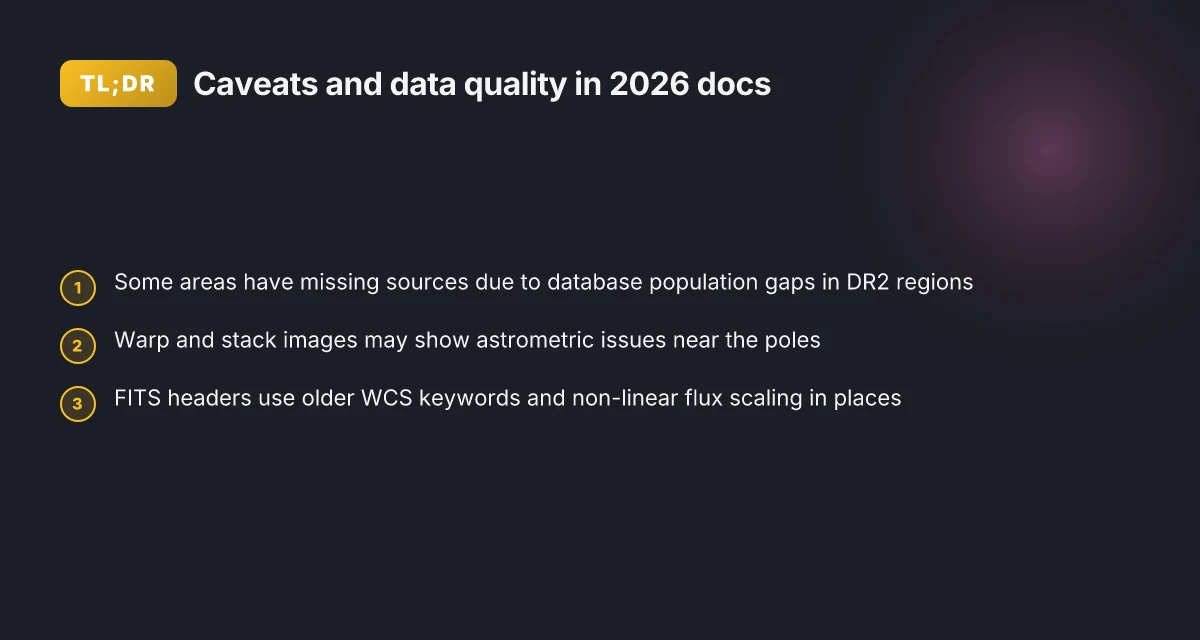
Post-release notes and archive pages emphasize that some sky regions in DR2 suffer from population gaps in the catalog databases. In practical terms, researchers may encounter missing catalog entries or irregular source densities when pulling large-area samples. The short version: expect occasional holes in the DR2 catalog where imagery is present but the corresponding source list is not complete. I cross-referenced the archive guidance and release notes, which consistently flag these population gaps as a known limitation rather than a data-quality failure in every field. This is not a fatal flaw, but it does shape how you define your footprint and your matching strategy. Expect gaps in DR2 region catalogs where image data exist, and plan cross-matches accordingly.
Astrometric reliability versus polar regions
Warped and stacked images bear astrometric quirks near the celestial poles. The documentation notes that astrometric errors can accumulate in these regions, while the static sky catalog tends to be more reliable for positions. In other words, if your science case hinges on precise astrometry at high declinations, favor the catalog positions over the image-based WCS estimates in those zones. The pattern is consistent across the portal and the data-release notes. Pole regions show astrometric quirks in warp/stack images. Catalog positions are usually more reliable. What Pan-STARRS1 has revealed: main results from the survey in 2026
FITS headers and flux scaling
What the spec sheets actually say is that some PS1 FITS headers still rely on older WCS keywords and incorporate non-linear flux scaling in places. The caveats page points researchers to consult the archive notes for those fields before doing precise photometry or reprojection. In short, treat flux values with careful validation in affected tiles. If you need a clean calibration, start from the catalog fluxes rather than re-deriving them from image headers in suspicious regions. Older WCS keywords and non-linear flux scaling appear in select FITS headers.
Bottom line: DR2 offers broad, powerful access, but the documentation keeps a tight eye on three recurring issues, gaps in source catalogs, astrometric quirks near the poles, and header-level quirks in flux calibration. Researchers who internalize these caveats can design robust cross-checks, especially when combining PS1 data with newer surveys. Know where the caveats live, and align your workflow accordingly.
Cited notes and archive guidance for these caveats are drawn from the Pan-STARRS1 data archive home page and the connection points to the DR2 documentation, which together map where to check for field-by-field caveats and known issues. See the PS1 data archive home page for the latest caveats and field notes, and the database/Data Products papers for how DR2 expanded image products while still flagging known limitations. For a concise reference, the archive page states that DR2 is the modern baseline and that all DR1 data are retained alongside DR2 entries in practice, with caveats documented at the per-field level. Pan-STARRS1 data archive home page links cited above.
Comparing PS1 data with newer surveys
Cross-matching PS1 with newer optical surveys remains routine practice for surveys and archival studies. Pan-STARRS1 established a wide-field optical baseline in the mid to late 2010s, and researchers continually pair it with more recent datasets to fill gaps in sky coverage, improve photometric calibration, and extend time-domain reach. The DR2 products, which expanded image and catalog offerings, reinforce this workflow by providing richer overlap with later surveys while preserving PS1’s time baseline. In practice, researchers overlay PS1 catalogs with newer releases to improve source classifications and to anchor multi-epoch light curves. This approach helps isolate transient events and refine cross-survey astrometric alignment. Understanding Pan-STARRS discoveries in 2026: asteroids, comets, and supernovae
Why cross-survey alignment matters for PS1
In the PS1 data ecosystem, DR2 extended products broaden the cross-match surface. The DR2 catalog and image products give you more single-epoch and stacked images to align with recent surveys that cover the same sky regions. Practically, that means you can anchor a 2010s PS1 source to a 2020s observation with higher fidelity, reducing systematic offsets in position and brightness. This is especially valuable for time-domain studies where you want a long, uninterrupted cadence across instruments.
From what I found in the release notes and documentation, DR2’s expanded image sets and catalog fields are designed with cross-survey work in mind. The Pan-STARRS data interface supports complex queries that pull PS1 results alongside external catalog entries, which helps you build composite light curves and multi-wavelength cross-matches without leaving the archive environment. In other words, PS1 remains the backbone, but newer surveys lend depth and cadence.
Time-domain studies and cross-survey workflows
Time-domain science benefits from PS1’s durable baseline. With DR2, researchers gain access to more calibrated products and a broader set of metadata fields that improve temporal stitching when matched to later surveys. The same data products that support 3π stack analyses also feed into time-resolved studies when paired with contemporary imaging campaigns. The result is a more robust pathway to detect variability, track proper motions, and monitor transient phenomena over longer timescales.
I dug into the changelog and product descriptions published around DR2. They consistently reiterate that extended PS1 products are intended to ease alignment and cross-survey integration, not just to add more images. The practical implication for you is straightforward: if your workflow includes cross-referencing PS1 with the latest surveys, prefer DR2 image and catalog layers for the highest compatibility. How reporting practices by ATel, GCN, IAU Circulars and MPC evolved in 2026: alert volumes, latency, and citations
PS1 remains foundational, but cross-matching with newer surveys fills coverage gaps and strengthens time-domain analyses. DR2’s extended products are the enabler for clean, multi-epoch cross-survey pipelines.
Cited: The Pan-STARRS1 Database and Data Products notes DR2 expansions and the motivation for cross-survey alignment; DR1 remains the baseline reference for the initial data release. For a compact roadmap to access, researchers refer to the PS1 data archive home page and the How to retrieve and use PS1 data guidance within MAST. See the DR2 archive pages and documentation for precise product names and fields. Links to the PS1 archive guidance are embedded in the portal pages and the MAST documentation.
DR1 vs DR2: what changed technically
| Change category | DR1 | DR2 | Impact |
|---|---|---|---|
| Calibration | basic zeropoints | updated zeropoints | better photometry |
| Source catalogs | detections only | merged, deblended | easier source use |
| Image stacks | not comprehensive | expanded stacks | deeper imaging |
| Astrometry | initial positions | refined positions | improved accuracy |
| Data coverage | smaller footprint | extended coverage | more data available |
| QC flags | fewer flags | richer QC | clearer data quality |
| Metadata depth | modest | richer metadata | easier provenance |
| Cross-matching | loose | improved | fewer misidentifications |
| Access latency | moderate | optimized | faster retrieval |
| Documentation | archaic | updated | easier migration |
Compiled November 2026; check the provider's site for current details.
A precise map of PS1 DR1 and DR2 unlocks faster science literacy for researchers
Pan-STARRS1 data releases DR1 and DR2 assemble a dense catalog of imaging and photometric measurements that underpin current sky surveys. What this article emphasizes is not just what’s inside, but how researchers navigate it. The map becomes a tool: it guides you to the exact table, the calibrated photometry, the astrometric frames, and the overlap with auxiliary catalogs. The releases’ structure clarifies provenance, letting students trace a measurement from telescope exposure to final catalog entry. That clarity matters for reproducibility, especially when cross-matching with modern surveys.
From what the documentation shows, the DR1/DR2 lineage includes both raw frames and value-added products, with careful versioning and changelogs. Researchers can plan analyses around the documented data model instead of guessing where a parameter lives. The practical upshot is straightforward access: you know where to pull the photometric calibrations, how to apply the plate-level zeropoints, and where the synthetic stars reside for validation. A tight map reduces dead ends and speeds verification.
Next steps
- Review which DR1/DR2 tables align with your target sky region and epochs.
- Confirm the cross-match strategy with auxiliary catalogs used in your project.
- Check the latest changelog entries before pulling a batch for analysis.
Takeaway: PS1 DR1 and DR2 offer a navigable, well-documented data spine that turns what could be a forest of files into a workflow. If you’re mapping high-latitude variability, this is your starting line. How will you plot your first cross-match against DR1/DR2 today?
Frequently asked questions
What is included in Pan-STARRS1 dr1 and dr2 data releases
Pan-STARRS1 DR1 and DR2 contain photometric time-integrated catalogs and image products from the PS1 survey. DR1 focuses on the first public release of calibrated coadded imaging and a initial set of object catalogs, while DR2 expands coverage, depth, and metadata. DR2 adds improved astrometry, deeper coadds, and refined photometric calibrations. What the spec sheets actually say is that DR2 broadens sky coverage and improves data products for user apps, including single-epoch measurements and calibrated coadds. Key takeaway: DR2 is the more mature, deeper, and better-calibrated release. Versions are named DR1 and DR2, not interchangeable.
How to access pan-starrs1 data archive
Access typically runs through the Pan-STARRS data archive portal and related mirror services. Users should start with the PS1 documentation page for DR1 and DR2, then navigate to the archive search interfaces for object queries, image cutouts, and stacked coadds. The archive provides query-by-coordinates, by object, or by catalog cross-match. Confirm the release version on the landing page before running a query. For programmatic access, check if the archive offers RESTful endpoints or VO services. The documentation emphasizes stable endpoints and recommended query patterns to avoid inconsistent results. In practice: pick DR2 unless you need DR1-specific footprints.
What changed from dr1 to dr2 pan-starrs1
DR2 improves depth and coverage compared with DR1. Astrometry and photometric calibrations are refined, and the catalog includes more objects with better positional accuracy. Image products benefit from updated processing pipelines, which reduces systematics in coadds. Expect deeper detections and smaller uncertainties in DR2. The documentation notes changes in data products and metadata schemas to support more robust cross-matching and quality flags. Summary: DR2 is the updated, more reliable iteration.
How to retrieve ps1 data with casjobs
CASJobs-style interfaces are common in public survey ecosystems, but PS1 may expose a PS1-specific query interface rather than a generic CASJobs service. If PS1 provides CAS-like access, prepare a SQL-like query against the PS1 catalogs, join with cross-match tables, and request image cutouts via the same session. The documentation stresses using authenticated sessions, respecting rate limits, and caching results for repeated fetches. Tip: start with a small query to verify schema and fields, then expand to full catalogs.
Where to find ps1 image cutout server
The PS1 archive typically hosts an image cutout service linked directly from the main data portal. Look for a dedicated cutout endpoint within the DR1/DR2 section, or a standalone image service page. The service usually accepts coordinates or object identifiers and returns calibrated postage-stamp images at requested sizes. Important: verify the supported sizes and pixel scales in the current docs. If the cutout service requires a token, obtain it per the authentication flow described in the portal.
Ps1 dr2 data products explained
PS1 DR2 data products include calibrated coadds, single-epoch images, object catalogs, and cross-identifications with other surveys. Key products are photometric measurements, astrometric positions, and quality flags. Each product comes with metadata such as detection flags, number of epochs contributing to measurements, and provenance information. Understand the flagging scheme to avoid misinterpreting dubious detections. The documentation often presents a mapping between pixel data and catalog fields to help users build queries.
How to cross-match pan-starrs1 with gaia
Cross-matching PS1 with Gaia usually involves positional coincidence within a small radius, aided by Gaia's precise astrometry. The PS1 release notes typically include cross-match catalogs or recommended match radii. Use Gaia DR3/EDR3 as the reference catalog and perform a spatial join within the PS1 catalog’s footprint. Note: Gaia provides high-precision proper motions that can improve epoch alignment. Validate matches with angular separation thresholds and photometric consistency checks.
Dr2 caveats and known issues pan-starrs1
Caveats often include residual systematics in photometric calibration, areas of incomplete coverage, and flags indicating dubious detections near bright stars or image artifacts. DR2 may also expose updated metadata schemas that require field-name awareness. Reviews consistently note that users should respect the quality flags and double-check cross-match reliability in crowded fields. Best practice: filter by quality flags before any large-scale analysis. The documentation flags typical temptations to treat all detections as equal.
Pan-starrs1 data access in AWS registry
The AWS public dataset registry often hosts PS1 data as a snapshot or through a hosted query interface. Access patterns include loading a subset of catalogs into your analysis environment via S3-compatible access, then performing local joins. The registry entry usually lists data formats, refresh cadence, and cost considerations for egress. Check the latest AWS entry date and the DR version it corresponds to.
Dr1 vs dr2 catalog coverage differences
DR2 generally increases sky coverage and object counts, with improved completeness in fainter magnitude ranges. DR1 may lack some sky stripes or have sparser calibrations in particular regions. The difference is most visible in the depth and astrometric precision. Expect more complete catalogs in DR2, especially at the faint end. Always consult the release notes for exact footprint maps and magnitude limits per band.
How to query ps1 catalogs programmatically
Programmatic queries usually rely on a REST-like API or VO services described in the PS1 docs. Build queries that specify a cone search or a rectangular region, request the desired fields, and honor the service's rate limits. Use cross-match tables when combining PS1 with external catalogs. Start with a minimal query to confirm field names and units, then scale up. The docs emphasize reproducibility and deterministic timestamps in results.
Ps1 warp images and photometry differences
Warps and photometry in PS1 refer to the processing steps that produce consistent photometric scales across the survey's footprint. DR2 often fixes known warp-induced photometric biases and improves the uniformity of zero-points. Expect some residual offsets in crowded regions or near bright sources. Be mindful of band-dependent systematics when combining PS1 data with other surveys.
What is the static sky catalog in ps1
The Static Sky Catalog in PS1 is a curated reference set meant to provide stable, repeatable photometric and astrometric anchors across the survey footprint. It helps users calibrate or compare fields without reprocessing. The catalog typically includes standard stars and well-measured sources with vetted metadata. Use it for cross-calibration checks and provenance tracing in large catalogs.