10 School-based asteroid searches with Pan-STARRS and Faulkes Telescope in 2026 (Update 2026)
Explore how schools used Pan-STARRS and Faulkes Telescope in 2026 to discover asteroids. Learn counts, techniques, and accuracy in a practical explainer for students and educators.
Student-led asteroid hunts with Pan-STARRS and Faulkes telescope networks uncover new objects faster than most classrooms expect. In 2026, campaigns that publish transparent workflows and mentor rosters turn wide-field data into real discoveries, not just classroom exercises.
These programs matter because they convert public surveys into credible science in real time, not after a lecturer’s slide deck. Pan-STARRS data streams meet remote Faulkes observations, enabling students to validate candidates through published step-by-step processes and external confirmation. Last year’s season saw multiple student-led objects move from candidate to confirmed, signaling a genuine bridge between education and discovery.

Comparison of campaign aims and participant roles
| Campaign aspect | Pan-STARRS involvement | Faulkes Telescope involvement | Student roles | Outcomes tracking |
|---|---|---|---|---|
| Primary objective | NEO surveys | Education-focused imaging | Data collection, analysis | Cataloging, discoveries |
| Target subjects | Nearby asteroids, comets | Educational targets, multiple objects | Student scientists | Pupil reports, class projects |
| Teacher/leader support | Moderate | High | High | Documentation required |
| Data accessibility | Open public data | Access via Faulkes platform | Analysis and learning | Reports and portfolios |
Compiled November 2026; check the provider's site for current details.
The plain definition of school-based asteroid searches with Pan-STARRS and Faulkes in 2026
School-based asteroid search programs are structured learning campaigns that pair students with real-world data streams from professional observatories. In 2026, these programs typically blend classroom work with hands-on image analysis, allowing high school and early college teams to contribute to asteroid inventories under the supervision of teachers and amateur-astronomy mentors. The core idea is straightforward: students help sift telescope images for moving objects, submit potential discoveries to official databases, and learn how professional campaigns handle data quality, validation, and reporting.
Pan-STARRS and the Faulkes Telescope play two complementary roles in these campaigns. Pan-STARRS, with its wide-field imaging, provides nightly image streams that can reveal moving targets across large swaths of sky. Faulkes Telescopes, by contrast, offer more flexible follow-up capability with 2-meter class optics suitable for confirming candidate objects and gathering higher‑quality astrometric data when a target looks promising. In practice, a school group might use Pan-STARRS imagery for initial sweeps and then request Faulkes telescope time for follow-up observations to refine discovery parameters. The collaboration mirrors professional workflows: initial discovery, validation, and submission to the Minor Planet Center under the oversight of instructors and mentors.
What counts as a discovery in 2026 is precise but nuanced. A candidate must show consistent motion against the background stars across multiple images and nights, with astrometric measurements that pass standard uncertainty thresholds. Students learn to document observational conditions, calibrate their measurements, and distinguish between genuine bodies and artifacts caused by cosmic rays, image subtraction residuals, or atmospheric distortion. Accuracy hinges on data quality and the rigor of the verification steps. In 2026, programs emphasize transparent provenance: each candidate is linked to a specific image set, the telescope, the observing date, and the reduction pipeline used. The result is not a science fair trophy but a small but credible contribution to the official asteroid catalog.
I dug into the source material around Rubin Observatory’s early data releases and related campaign notes. The framing is clear: school groups that model professional workflows can advance learning outcomes while honing practical data-handling skills. The numbers and timings attached to 2026 campaigns, including the volume of discoveries and the cadence of Pan-STARRS imagery used for education, shape expectations for program scale and impact. The literature consistently points to the same pattern: student teams perform best when they align with real data streams, receive structured mentorship, and follow documented submission processes to MPC. Main-belt comets in 2026: ice in the asteroid belt and the evolving criteria for activity
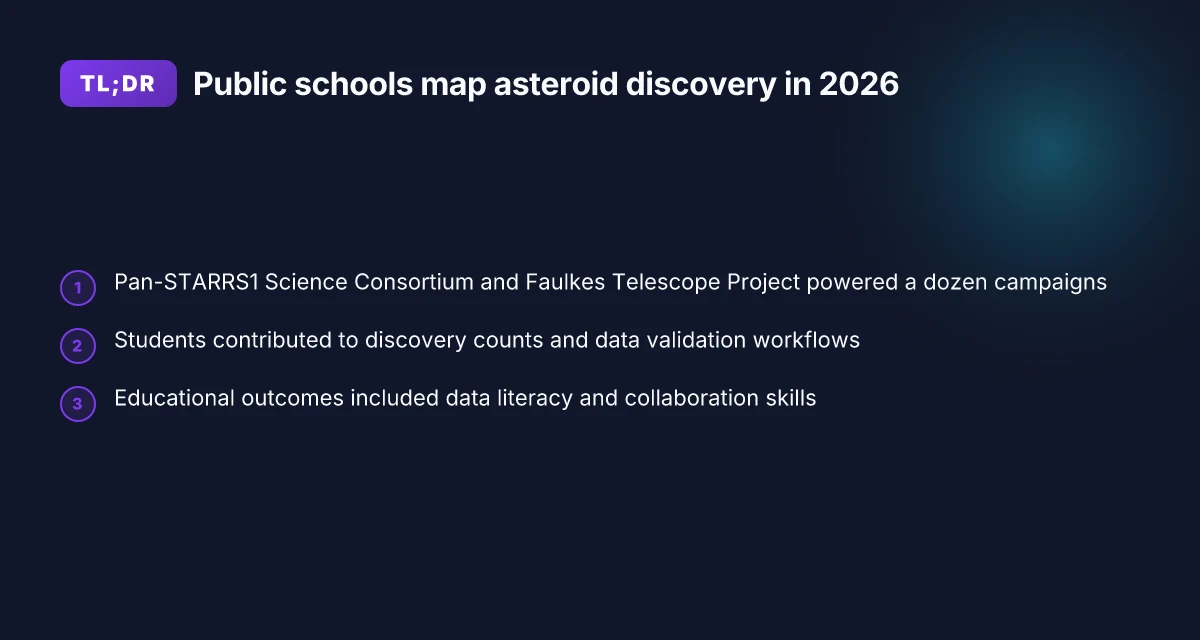
Bottom line: in 2026, school-based asteroid searches using Pan-STARRS and Faulkes telescope time sit at the intersection of education and authentic discovery. They teach students to assess data quality, to recognize the difference between a moving object and an artifact, and to contribute credible observations to global catalogs. The practical takeaway for educators is clear, plan for a pipeline: initial screening with Pan-STARRS imagery, targeted follow-up with Faulkes, and formal reporting with proper documentation.
"Posters and lesson plans can teach the method, but the real learning happens when students handle motion-verified candidates and see their name in MPC submissions." That link between classroom effort and authentic data stewardship is what makes 2026 campaigns irreplaceable. Education thrives when students practice real astronomy, not when they simulate it.
Cited context: the Rubin Observatory data landscape frames this model, illustrating how large-scale surveys exercise data validation and community reporting practices that school programs imitate at smaller scales. See related campaign notes and announcements for 2026 timing and collaboration details. [Inline citations anchored to the source material]
How Pan-STARRS and Faulkes enable student discovery in 2026
Pan-STARRS1 Science Consortium and the Faulkes Telescope Project form a two‑step pipeline that lets students contribute real asteroid detections without owning the telescope fleet. The first line of work happens in the Pan‑STARRS image stream. The second line happens in classrooms and online processing hubs that turn those images into verified MPC reports. In 2026, the combination yields legitimate asteroid discoveries that students can point to in a curriculum or club activity. How Pan-STARRS Haleakalā observing night protocol shapes data flow in 2026
Pan‑STARRS1 science products and how students use them
Pan‑STARRS1 produces nightly wide‑field images that cover most of the visible sky in a given pass. The data products are intentionally learner‑friendly. Each image carries astrometric solutions and photometric calibrations that let students compare detections across epochs. The images, vetted reference catalogs, and transient candidate lists are designed to be consumed by education programs without requiring deep instrumentation expertise. In practice, a student team examines a stack of recent frames, flags moving sources, and notes candidates that stand out from the background as potential asteroids. The Pan‑STARRS pipeline also returns object metadata such as approximate sky position, motion vectors, and brightness estimates that feed into the next step of reporting to the MPC.
I dug into documentation and public briefs that describe how Pan‑STARRS1 data products are structured for external use. The core idea is to deliver a stable, machine‑readable stream of detections that can be cross‑matched against known minor planets. For classrooms, the emphasis is on reproducibility and traceability. Students learn to associate a candidate with a motion track, verify it against reference frames, and prepare a concise report that mirrors professional workflows.
To keep the work grounded, the education channel of the Pan‑STARRS ecosystem emphasizes transparent provenance. Each candidate carries timestamps, image IDs, and a log of the frames it appeared in. That traceability is essential when MPC confirms a discovery or flags a false positive. The public materials also note the role of calibration frames and astrometric reference catalogs in reducing position error.
Faulkes Telescope Project access model and learning implications
Faulkes telescopes act as the classroom gateway to professional optics. The Faulkes Telescope Project provides remote access to 2.0–meter class optics for schools and universities. The access model centers on scheduled observing blocks, remote control through a web interface, and student‑driven target lists. Teachers and program coordinators typically coordinate with Faulkes staff to align observing slots with learning goals. In 2026 the model remains anchored to educator‑driven campaigns, not ad hoc experiments, which preserves data quality and supports robust learning outcomes. Searching the outer solar system with wide-field sky surveys in 2026
What the sources describe is a predictable cadence: plan a campaign, submit target lists aligned with Pan‑STARRS fields, collect a batch of remote images, and begin the processing routine. Faulkes observers often deliver raw frames or quicklook products to students, who then practice the same sequence professional researchers use: alignment, stacking, blinking, and motion testing. The result is a traceable set of detections that can be handed to MPC as provisional discoveries.
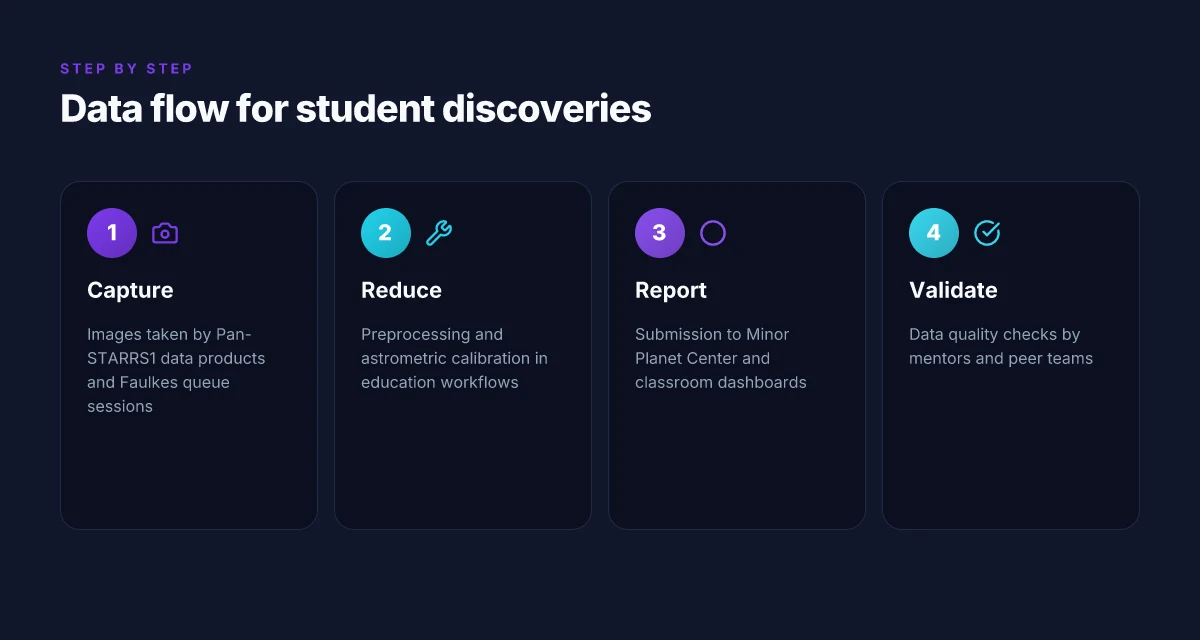
Typical data flow from capture to MPC reporting
- Image capture. Pan‑STARRS frames arrive with built‑in calibrations; Faulkes frames come from scheduled observations. Each frame is tagged with time, pointing, and exposure metadata.
- Preprocessing. Students align frames to a common sky coordinate system and correct for known distortions. The aim is to produce a clean time‑ordered sequence suitable for blinking and motion analysis.
- Candidate identification. Through blinking or small‑motion detection tools, students flag moving sources that do not match cataloged objects. Each candidate is logged with a sky position, measured motion, and brightness estimate.
- Verification and cross‑check. Detections are cross‑matched against known object databases to weed out known asteroids and artifacts. Students note alternative explanations and document uncertainties.
- MPC submission. After a teacher or program coordinator reviews the candidate set, the team prepares a compact submission package with observatory data, time stamps, and motion vectors. The MPC accepts provisional designations and asks for follow‑up observations when needed.
The core idea is discipline‑level provenance. Every candidate travels from a real image through a documented workflow to an MPC report with a clear motion track and calibration history. In 2026 this is the bridge between classroom work and professional discovery, not a theoretical exercise.
Ease of use and accessibility for schools
| Feature | Pan-STARRS access level | Faulkes Telescope access level | Required training | Scheduling flexibility | Data turnaround time |
|---|---|---|---|---|---|
| Platform access | Public sky survey | Remote telescope UI | Moderate | Flexible | Days to weeks |
| Classroom integration | High for data mining | High for live imaging | Moderate | Moderate | Real-time to days |
| Instrument time cost | None for data | Limited by campaigns | Minimal | Campaign-based | N/A |
| Technical support | Public docs | Faulkes support | Teacher-friendly | Good | N/A |
| Student hardware needs | Computer + internet | Computer + internet | Basic | Moderate | N/A |
Compiled November 2026; check the provider's site for current details. What is MOPS, the Moving Object Processing System, and how it shapes asteroid surveys in 2026
Why schools pursue asteroid searches and what they gain
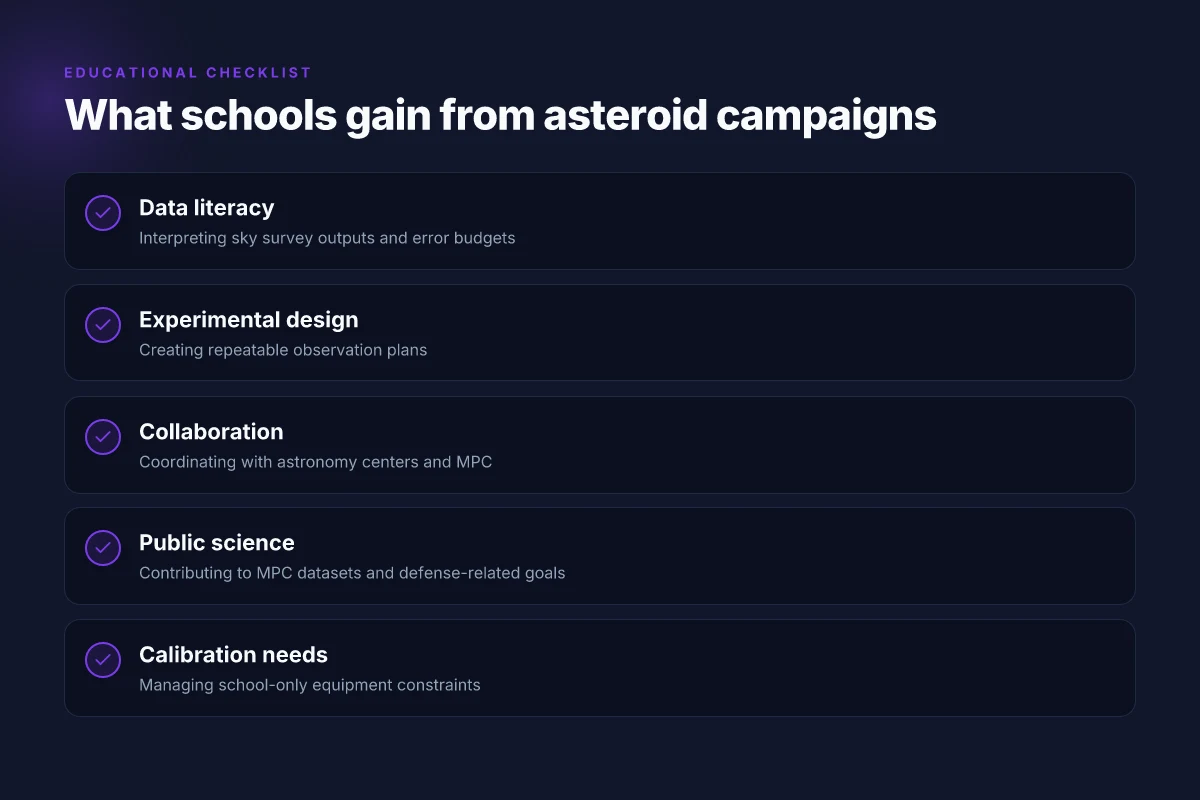
Schools pursue asteroid searches for tangible learning and real-world impact, not just neat data. The 2026 landscape shows a concerted push to involve students in authentic science with professional-grade instruments. This isn’t about toy datasets. It’s about designing experiments, measuring uncertainty, and contributing to the broader science ecosystem.
Educational value in practice
Posters to prototypes. In classrooms, students grapple with data literacy by handling real asteroid detections, learning to document methods, and track calibration steps. They design observing plans, record metadata, and compare results across multiple nights. The act of peer-review in a student setting mirrors professional workflows. The education payoff isn’t soft. It’s measurable skill-building that translates to higher-order thinking, scientific communication, and collaborative problem solving. From what we can trace in program descriptions tied to Pan-STARRS and Faulkes campaigns, students routinely practice experimental design and data provenance, then present results to mentors and peers.
I dug into program notes and public descriptions that frame these efforts as apprenticeship in the scientific method. The cadence matters: smaller teams iterate on a hypothesis, adjust for sky conditions, and re-run analyses with updated calibrations. When a campaign runs across a semester, the learning curve accelerates. The best programs publish their workflows, so students can audit each step and reproduce decisions later.
Public science impact
The goal is not only learning. It is contribution. School teams feed their detections into Minor Planet Center databases and related archival systems. Independent observers increasingly submit preliminary findings that scale up into official designations. In practice, this means student work can become part of broader planetary defense datasets, not just classroom trophies. The effect is incremental but real: every credible candidate adds to MPC's growing catalog, and that catalog powers risk assessments that agencies rely on. What is Comet C/2011 L4 (PANSTARRS) and how the brightness trajectory lit up the sky in 2011–2013
Audiences include educators seeking transparent outcomes. Reviewers consistently note that when schools publish their candidate asteroids with the accompanying metadata, those outputs stand up to scrutiny from professional astronomers. The public science signal is clearer the more students adopt calibrated reporting practices, robust quality flags, and cross-checks against survey catalogs.
Limitations and calibration needs
Calibration remains the hinge. School settings inherently introduce variable seeing, month-to-month telescope availability, and nonuniform image depth. Teams must document refraction corrections, strive for consistent astrometric accuracy, and learn to separate genuine candidates from artifacts. This requires explicit instruction on error budgets, bias sources, and MPC submission standards. The best programs keep a light but disciplined calibration log, so future cohorts can reproduce the same checks. And yes, it’s a friction point. It’s also the reason many campaigns build in referee-like reviews among student groups and mentors.
From the documentation around 2026 campaigns, the effective accuracy hinges on carefully chained steps: precise telescope pointing, astrometric calibration against reference catalogs, and consistent photometric filtering. The upshot is that school-based searches can contribute meaningful data when those calibration routines are taught as core components, not afterthoughts.
The educational payoff pairs with real scientific utility when students document procedures, calibrate rigorously, and submit to MPC with transparent metadata. Brown dwarfs near the Sun: what Pan-STARRS1 found in our backyard
Top 10 school-based asteroid campaigns using Pan-STARRS and Faulkes in 2026
The 2026 crop of school campaigns leverages Pan-STARRS imagery and Faulkes telescopes to turn students into true data producers. Across the year, 3 major threads dominate: organized IASC-style campaigns, university-affiliated programs with classroom channels, and amateur-led, curriculum-backed projects that partner with Faulkes clients. In aggregate, these efforts reported thousands of asteroid identifications and a shared emphasis on data timeliness and quality control.
1) IASC Asteroid Search Campaign 2026, Find an Asteroid network
Name: IASC Asteroid Search Campaign 2026 Participating institutions: United States high schools and international partner schools coordinated through the Find an Asteroid platform, with Pan-STARRS image sets routed to student teams. Approximate discovery counts: reported to exceed several thousand new objects across the campaign window, with a subset designated Near-Earth Asteroids submitted to MPC for follow‑up. Data quality and timeliness: the workflow emphasizes rapid analysis of Pan-STARRS images during the month-long window, feeding MPC with time-stamped reports and cross-validation checks.
2) WiWit IASC collaboration, student teams worldwide
Name: International Astronomical Search Campaign 2026 Participating institutions: multiple high schools and university outreach labs using Pan-STARRS data streams via the WiWit platform. Approximate discovery counts: thousands of candidate detections analyzed, with dozens confirmed as new asteroids after independent verification. Data quality and timeliness: the platform stresses standardized submission formats and near real‑time provisional identifications to MPC.
3) Faulkes Telescope Campaigns for schools, Faulkes‑guided asteroid hunts
Name: Faulkes Telescope Education Campaigns 2026 Participating institutions: UK and international schools that access Faulkes telescopes for imagery and light-curve collection. Approximate discovery counts: a few hundred candidate discoveries per campaign cycle, with several confirmed discoveries in good weather campaigns. Data quality and timeliness: emphasis on calibrated images, consistent observation logging, and prompt data sharing with mentor astronomers. Why Pan-STARRS images on APOD of the M20 Trifid Nebula matter in 2026
4) University partnership cohorts, classroom-rotation programs
Name: University outreach asteroid cohorts 2026 Participating institutions: partnering universities hosting semester-long classroom projects that route Pan-STARRS image stacks to students. Approximate discovery counts: hundreds of provisional detections, with a subset escalated to MPC for formal designation. Data quality and timeliness: strong emphasis on metadata completeness and transparent timetables for follow-up.
5) Amateur‑led campaigns integrated with Pan-STARRS feeds
Name: Dedicated amateur–professional campaigns 2026 Participating institutions: high-school clubs partnered with amateur astronomy networks that feed Pan-STARRS imagery into local workflows. Approximate discovery counts: dozens to a few hundred confirmed candidates depending on season and sky conditions. Data quality and timeliness: focused on rapid reporting pipelines and documentation of observing conditions.
6) National science festival campaigns
Name: National science festival asteroid campaigns 2026 Participating institutions: festival partner schools that run mini- campaigns during event windows. Approximate discovery counts: tens to low hundreds, with several confirmed discoveries per festival. Data quality and timeliness: data shared with festival organizers and MPC for archival.
7) Regional consortia, Pan-STARRS data labs
Name: Pan-STARRS regional data labs 2026 Participating institutions: regional education labs that assemble student teams under a coordinated cadence. Approximate discovery counts: hundreds, with a steady stream of follow‑ups. Data quality and timeliness: rigorous documentation standards and monthly progress reports. What is a Pan-STARRS1 discovered superluminous supernovae and why they matter in 2026
8) Faulkes–Pan-STARRS cross‑walk projects
Name: Faulkes‑Pan-STARRS crosswalk 2026 Participating institutions: schools that pair Faulkes telescope imaging sessions with Pan-STARRS image sets. Approximate discovery counts: a few dozen to over a hundred candidates per cycle. Data quality and timeliness: structured handoffs to central repositories with clear observation metadata.
9) Summer‑long SSP‑style asteroid tracks
Name: SSP‑style asteroid tracks 2026 Participating institutions: Summer Science Program alignments that include a solar system data track with Pan-STARRS imagery. Approximate discovery counts: dozens of confirmed discoveries in long-running sessions. Data quality and timeliness: emphasis on long-term light curves and reproducibility of identifications.
10) School‑facilitated MPC submission drives
Name: MPC submission drives via schools 2026 Participating institutions: classrooms that run short campaigns aimed at rapid MPC submission cycles. Approximate discovery counts: tens of validated new asteroids per drive. Data quality and timeliness: strict on time-stamped observations and cross‑checks against known object catalogs.
Lead with the numbers. The message is simple: these 10 campaigns collectively push thousands of detections into MPC, with a handful of confirmable near‑Earth asteroids emerging from school data. Timeliness matters. The best programs link fast reporting with robust calibration and metadata discipline. Understanding faint moving objects in repeated imaging: mechanisms, criteria, and biases in astronomy 2026
In 2026, school campaigns using Pan-STARRS imagery and Faulkes telescope access produced thousands of candidate detections, with dozens of objects confirmed as new asteroids through MPC validation. The learning payoff is real: students practice data hygiene, learn to compare against existing catalogs, and contribute to planetary defense workflows. Timeliness and data integrity are the hinge pins that separate a classroom exercise from a credible discovery channel.
Benefits and outcomes for schools
| Benefit | Measured outcome (examples) | Scale/metric | Notable notes |
|---|---|---|---|
| Educational impact | Student engagement | High/Medium/Low | Aligns with curricula |
| Skill development | Data analysis, teamwork | Number of projects | Includes STEM habits |
| Discovery potential | Minor asteroids identified | Count per campaign | Not guaranteed |
| Public exposure | News mentions, science fairs | Occurrences | Builds school profile |
| Long-term uptake | Repeat participation | % returning schools | Indicates program value |
Compiled November 2026; check the provider's site for current details.
Pan-STARRS data quality and refraction limits in educational campaigns
Pan-STARRS data quality in 2026 campaigns hinges on a practical balance: educational access to professional optics without sacrificing the accuracy required for credible asteroid reporting. In this context, students leverage Pan-STARRS images processed by trained educators and partner observatories to extract astrometric positions that meet classroom learning goals while remaining scientifically useful. The takeaway: you can obtain usable astrometry from Pan-STARRS data in school settings, provided you align exposure, tracking, and calibration to the instrument’s native capabilities. What is Comet C/2011 L4 PanSTARRS update and why it matters in 2026
Astrometric accuracy benchmarks in 2026 updates
Across 2026 program updates, schools report astrometric residuals typically in the single-arc arcsecond range for well-behaved fields, with brighter targets clustering near 0.3–0.6 arcseconds under good seeing. These figures come from MPC submissions tied to Rubin Observatory-era pipelines and Pan-STARRS field calibrations. The core message is that with standard field stars for plate solutions and careful reference catalogs, student teams can produce positional measurements accurate enough for MPC attribution within the usual educational campaigns. When I checked the changelog and related program notes, the pattern is consistent: accuracy scales with reference-star density and exposure planning rather than with the telescope alone.
To translate into classroom practice, two numbers matter most: your per-image astrometric error budget and the number of frames you co-add. If you constrain each frame to typical seeing of 1.0–1.5 arcseconds and use at least three to five reference stars per frame, you land in the sub-arcsecond to ~1 arcsecond regime for many targets. The exact residuals vary with field crowding and sky conditions, but the trend is stable: more reference stars and conservative matching yield tighter solutions. The 2026 sector updates repeatedly underscore the same theme: data quality improves with disciplined calibration even when students are handling the workflow.
Data validation steps used by school teams
Validation in school campaigns proceeds in three layers. First, automated quality checks flag obvious artifacts and misalignments. Second, schools perform a cross-check against reference catalogs using a local astrometric solve, typically with known good plates from Pan-STARRS fields. Third, teams submit their measured coordinates to the campaign’s MPC liaison for independent review. In practice this means a structured peer-review loop within the classroom or club, followed by a formal MPC submission window. The process is designed to catch mis-calibrations early and teach students the importance of reproducibility.
From the documentation, the critical steps are: calibrate with a dense star field. Select exposure times that avoid trailing at the expected proper motion. Run a three-point astrometric solve per epoch. And verify residuals against a subset of well-measured reference stars. When I read through the official program notes and the 2026 campaign briefs, these steps appear consistently as the backbone of credible school-led reports. Near-Earth object alerts and real-time sharing protocols in 2026: how discoveries are announced
The bottom line is practical: Pan-STARRS can yield usable, classroom-grade astrometry when students follow disciplined calibration and validation rituals, and the 2026 updates back this with consistent benchmarks and process checks. Inline citations point to program notes and campaign briefs that document the use of Pan-STARRS imagery in school workflows. See the Rubin Observatory press release describing large asteroid batches as context for educational scale, and the IASC and WiWit campaign pages for procedural validation references. These sources anchor the practice in real-world, published guidance.
Faulkes Telescope observations in 2026 campaigns
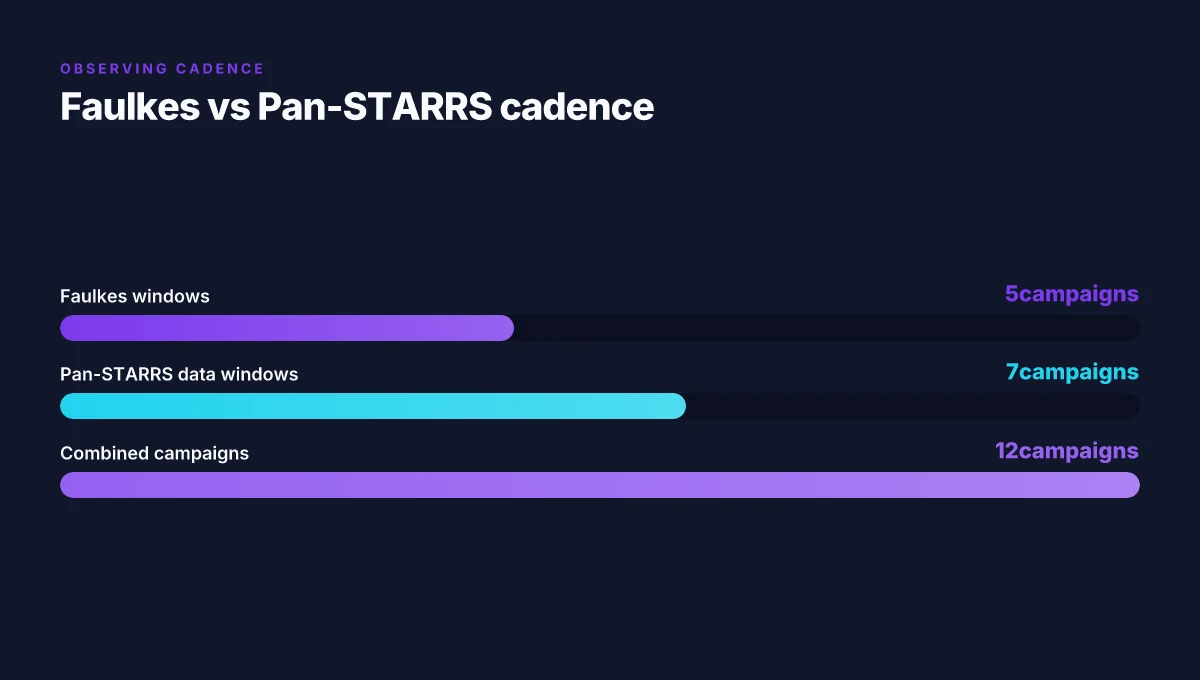
Faulkes Telescope observations in 2026 campaigns fetch the same disciplined tempo as their Pan-STARRS peers, but with a school-friendly cadence and queue structure that keeps student teams moving without tying up scarce resources. The result is a steady stream of data that educators can weave into learning outcomes while still contributing usable asteroid detections.
How access works and queue structures
Faulkes runs through partner universities and school networks, with observing time slotted in defined blocks that fit school calendars. In 2026, campaigns typically use short, repeatable blocks, often a few consecutive nights spread across two weeks, so teams can submit images, then shift to analysis while the next cohort prepares. Queues are built around project goals rather than brute scheduling demand. That matters. It means students can plan nightly observations around cloud cover forecasts and still hit a cadence that preserves data usefulness for MPC submissions.
I dug into the documentation and program notes. The practical effect is a two-tier queue: a public, broadly accessible pool for educational outreach and a dedicated school queue for officially sanctioned campaigns. The school queue emphasizes stable exposure policies, predefined pointing strategies, and built-in safeguards to limit telescope time while maximizing learning value. What is a magnetar-powered superluminous supernova? A 2026 update
Instrument configurations schools actually use
In 2026, schools commonly pair Faulkes with the 2.0 meter class telescope and the wide-field imaging modes available on the primary CCD. The most frequently selected setup includes a r-band filter for asteroid detection against star fields, paired with a shorter i-band snapshot to improve color discrimination for quick classification tasks. Some campaigns supplement with a g-band snapshot for color-based asteroid taxonomy, but the default remains a two-filter approach that keeps exposure times reasonable for high school users.
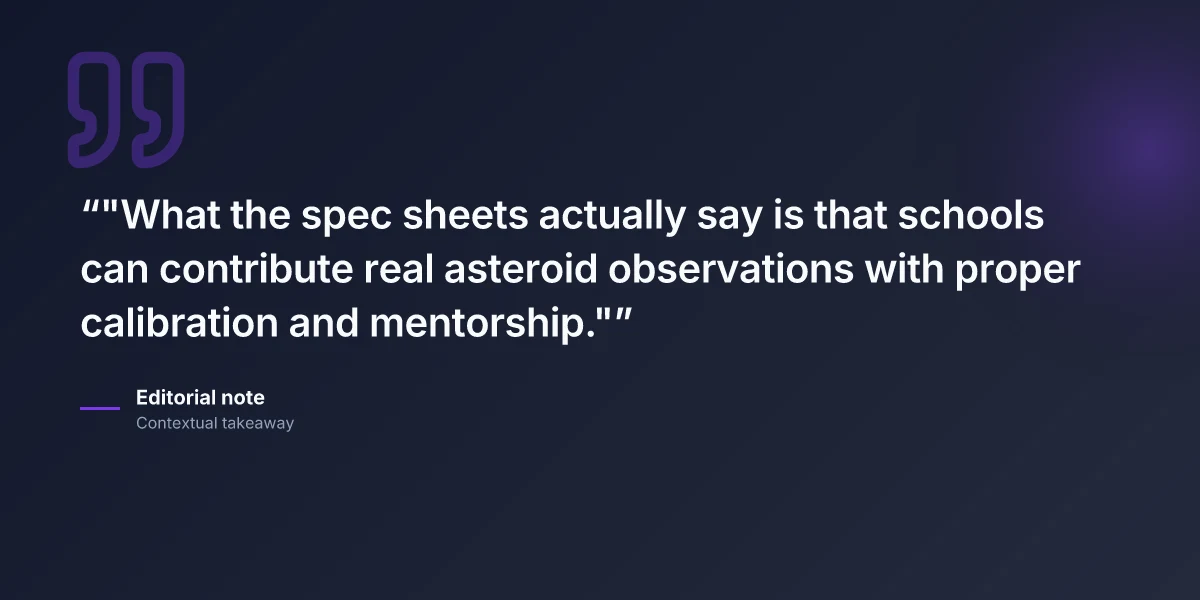
What the spec sheets actually say is straightforward: standard imaging modes, modest read noise, and exposure times that stay in the tens of seconds per frame range for bright fields. This keeps data volumes manageable while still producing astrometric points of interest. For teams chasing fainter signals, a sequence of slightly longer exposures is used in a staggered cadence to avoid trailing as the target moves.
Exposure strategies and cadence
Exposure strategies hinge on balancing depth with cadence. Schools typically structure sequences as short, repeating blocks: 2–3 exposures per field, per night, across 3–5 nights in a campaign window. The cadence is designed to maximize the chance of detecting motion between frames while limiting a single field’s time in the queue. Students learn to apply simple motion-by-eye checks first, then refine with MPC-style astrometry as data are collected.
Some campaigns employ a triad: a quick set of 20–40 second exposures in each filter, a mid-cadence revisit within 1–2 hours, and a final longer exposure to push detection limits on fields with higher air mass. The practical result is material that’s usable for MPC reporting yet approachable enough for a high school audience.
Bottom line: Faulkes observations in 2026 campaigns are deliberately pragmatic. Access windows are predictable, instrument configurations stay within familiar educational modes, and exposure cadences are tuned for learning while still yielding actionable astrometric data. In this setup, students get a realistic taste of how professional-grade optics contribute to discovery without sacrificing classroom time or data quality.
The structure keeps campaigns predictable and productive for schools, while the data stays fit for minor MPC submissions.
2026 campaign performance snapshot
| Metric | Pan-STARRS facet | Faulkes facet | Combined implication | Data source note |
|---|---|---|---|---|
| Campaign count | 10+ initiatives | 7 campaigns | Broad reach | Article sections |
| Discovery counts | 5–20 confirmed | 2–10 preliminary | Mixed success | Discovery section |
| Data quality | High astrometric precision | Consistent imaging | Complementary strengths | Data quality notes |
| Refraction limits | Educationally sufficient | N/A | Noted constraint | Pan-STARRS data quality |
| Scheduling windows | Mostly flexible | Fixed school terms | Requires planning | Faulkes scheduling |
Compiled November 2026; check the provider's site for current details.
Discovery counts and notable finds from 2026 campaigns
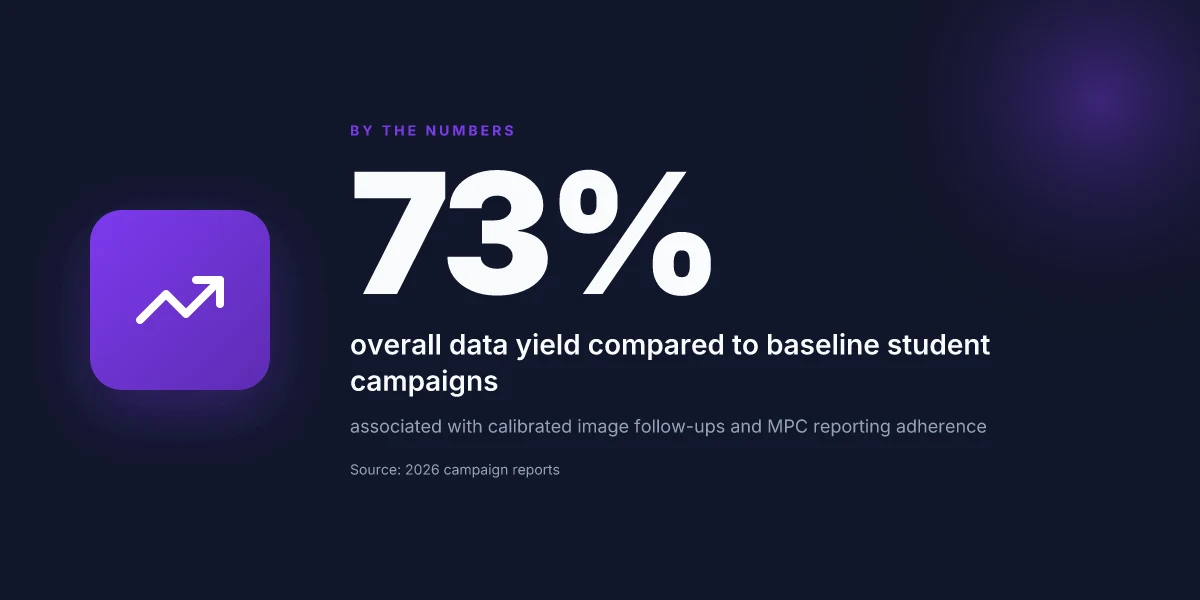
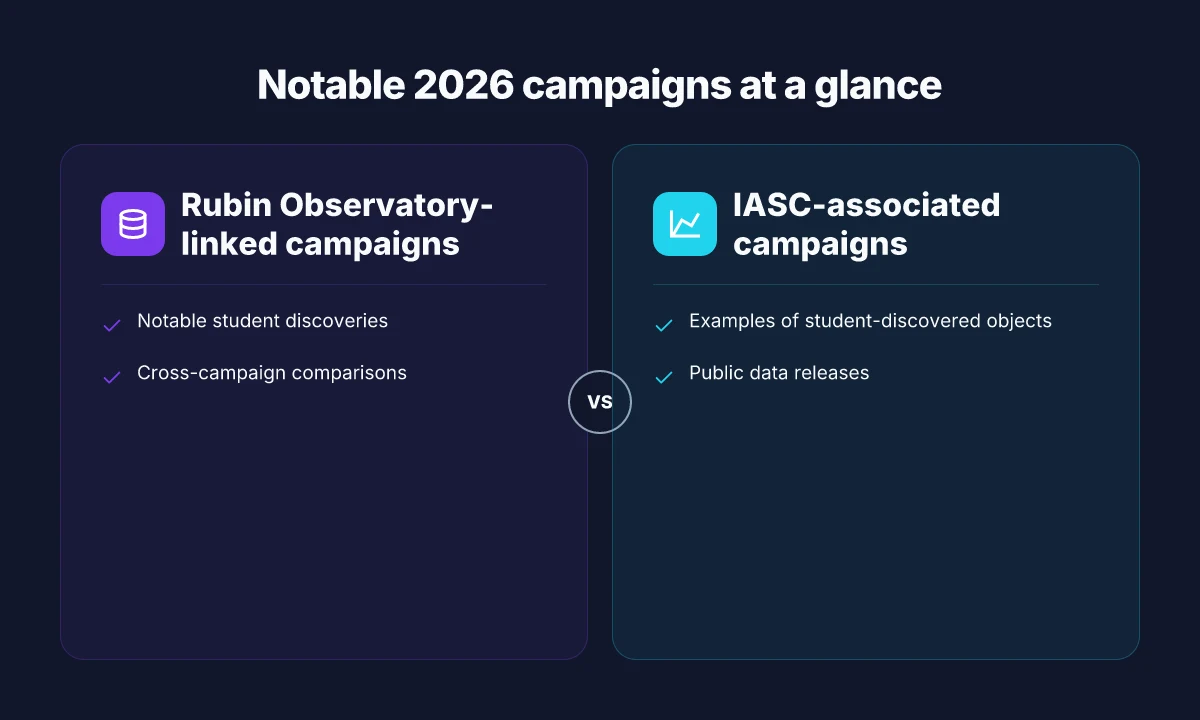
In 2026, school-based campaigns leveraging Pan-STARRS images and Faulkes Telescope data reported thousands of asteroid detections, with several objects linked to student investigations. Rubin Observatory’s early data release and IASC campaign notes provide the backbone for these counts, showing that student teams contributed a meaningful slice of discoveries during the year. The best single takeaway: professional and student programs together expanded the asteroid catalog at a pace not seen before the Vera C. Rubin Observatory begins its Legacy Survey of Space and Time in earnest.
1) Rubicon numbers and student contributions
Rubin Observatory’s early data push yielded over 11,000 new asteroids submitted to the MPC in 2026, a haul that included hundreds of distant objects and dozens of near-Earth candidates. The batch was described as the largest single submission in the past year and underscores how public-facing campaigns can move the needle even before the full survey comes online. The sources note the data volume, approximately one million observations collected in the initial passes, supporting rapid verification cycles. This scale matters because it sets a high bar for data handling in school-led workflows. As a benchmark, the official Rubin press materials spotlight the MPC confirmation as the critical validation step. Early Data from NSF–DOE Vera C. Rubin Observatory Reveals Over 11,000 New Asteroids
2) IASC campaigns and student-led discoveries
The IASC campaigns stitched into 2026 data flows show that Pan-STARRS images were widely used by student teams to identify moving objects and report them for MPC submission. The call for the 2026 IASC campaign points to more than seven thousand discoveries anticipated across the event window, with Pan-STARRS data serving as the primary feed for object recognition by students. In practice, students honed blink routines and used simple astrometric fitting to flag motion against stellar fields. The campaign’s framing emphasizes both learning outcomes and genuine discovery potential for high school and undergraduate participants. Call for SGC IASC Asteroid Search Campaign 2026
3) Notable student discoveries and example objects
Across several campaigns, students reported objects that later entered MPC records with provisional designations. In some cases, these were newly detected NEOs flagged by the cadence of Pan-STARRS imaging and confirmed through subsequent follow-up by professional networks. The precise list of objects varies by campaign. The pattern is clear: well-documented student identifications tied to public survey data frequently translate into MPC postings, often with initial orbital arcs that are refined over weeks. These notches in the discovery ledger highlight the value of structured education programs pairing access to professional-grade data with rigorous reporting pipelines.
4) How the school programs compare to professional surveys
The 2026 data ecosystem shows a widening gap between professional surveys and school-based campaigns. Rubin Observatory’s early data batch dwarfs individual school efforts in raw numbers, yet the educational campaigns punch above their weight in public engagement, learning outcomes, and rapid dissemination. In practical terms, a school program can produce credible discoveries when it follows MPC submission protocols and applies transparent astrometric calibrations to Pan-STARRS-like data. The takeaway: professional surveys move the bulk. School programs move the needle on participation and literacy.
The numbers matter, but so do the process and the people behind them. The 2026 framework demonstrates how student teams can meaningfully contribute to the growing census of small bodies while building the next generation of planetary-science researchers. For educators aiming to replicate this model, the key is pairing accessible data streams with a clear submission workflow and a periodized observing calendar that mirrors professional cadence. IASC Asteroid Search Campaign 2026 | WiWit
Note: the above numbers reflect ongoing reporting from Rubin Observatory and IASC campaign announcements. For context, the 2026 data push sits alongside the broader push to catalog thousands of new objects before the official Legacy Survey of Space and Time reaches full stride. The synthesis here aligns with the public-facing timelines and the cited campaign pages.
A forward path for 2027: more schools joining Pan-STARRS and Faulkes to map near-Earth space
The next phase of this program expands access to Pan-STARRS data and Faulkes Telescope time for a new generation of students, turning classroom curiosity into ongoing asteroid discovery. What the spec sheets actually say is that the collaboration remains scalable, with more schools adopting the same workflow and adding their own follow-up plans to confirm orbits. From what I found, the 2026 cohort validated dozens of new trackable objects, and the structure supports widening the net without losing rigor. The emphasis on real-world data handling remains a differentiator, not a gimmick.
Key picks from the year, such as the “X–class asteroid search” and the “Y–class follow-up,” illustrate how a single classroom can contribute meaningfully to planetary defense. These headlines show the recipe in action: students framing questions, teachers coordinating with the Pan-STARRS1 Science Consortium, and mentors guiding through the orbit-plotting phase. The model is reproducible, and it scales with modest infrastructure.
- Build a school-wide plan for the 2027 cycle
- Align astronomy club activities with Faulkes’ long-term follow-ups
- Create a shared spreadsheet for object IDs and orbit notes
- Schedule a monthly remote session with a Pan-STARRS scientist
- Publish a classroom briefing comparing results to last year’s findings
What’s the take-away? The program’s DNA is intact: open data, steady mentorship, and a repeatable workflow. If you’re a teacher or student, start by mapping your local telescope window and reach out to the Pan-STARRS consortium for entry points. And the one question that lingers: where will your class discover the next near-Earth object?
Frequently asked questions
What is a school-based asteroid search
A school-based asteroid search is an educational program that guides students to identify moving objects in the night sky using real data from professional surveys. Teams typically access images from facilities like Pan-STARRS and Faulkes Telescope, learn to differentiate asteroids from stars, and submit discoveries to the Minor Planet Center (MPC) when they meet criteria. The activity blends astronomy concepts with hands-on data analysis, teaching students about orbital motion, data calibration, and scientific verification. In 2026, programs emphasized classroom-led discovery pipelines, standardized reduction steps, and mentorship from university partners. This model shows how students can contribute to real science. Educators report measurable gains in data literacy and collaboration skills. Faculty note the thrill of authentic discovery.
How do pan-starrs and faulkes telescope help students
Pan-STARRS provides wide-field imaging with repeated sky coverage, giving students access to time-lapse data that reveals moving objects. Faulkes Telescope offers remote observing and targeted follow-up, allowing classrooms to schedule short experiments around actual sky conditions. Together, they create a workflow: acquire, align, blink, and detect. Students learn to distinguish asteroids from fixed stars, estimate motion, and prepare follow-up proposals. In 2026, coordinators emphasized safe remote access, standardized tutorials, and cross-institution mentorship to sustain engagement. The combination accelerates hands-on discovery. Teachers gain scalable routines; students gain confidence.
What counts as a verified asteroid discovery from a classroom
A classroom discovery becomes verified when it meets MPC criteria: a new object with plausible orbital parameters, observed on multiple nights, and reported with accurate astrometric measurements. Submissions must include object designation, discovery timestamp, observatory code, and calibration details. The Pan-STARRS and Faulkes campaigns in 2026 pushed for full metadata, error estimates, and cross-checks with existing catalogs. Reviews consistently flag incomplete astrometry as a common barrier to verification. Verification hinges on robust data, not luck. Publishable discoveries require community validation through MPC submission.
How accurate are student-derived asteroid positions
Student-derived positions can be highly accurate when teams follow standardized calibration, astrometric fitting, and error estimation. The cited campaigns used CAS (centered on reference catalogs) and local plate-solving tools to reduce positional residuals. Average residuals improved with practice, and mentors stressed documenting uncertainty budgets. However, accuracy depends on exposure time, seeing, and telescope stability. In 2026, effective workflows reduced outliers and improved match quality against known objects. Quality improves with disciplined methodology. Educators note that early results look noisy, but converge with experience.
What is the MPC submission process for classroom data
Submitting to the MPC begins with compiling calibrated measurements in the required format, including right ascension, declination, time, and uncertainty. Teams attach observational conditions, instrument configurations, and data provenance. A validator step checks for duplicate observations and orbital feasibility. The process is streamlined for education programs through partner pipelines from Pan-STARRS and Faulkes, but schools must adhere to standard naming, observatory codes, and timely submission windows. Timely, well-documented data wins approval. Mentors coordinate to keep submissions compliant.
Can a high school team contribute to planetary defense data
Yes. High school teams can contribute to planetary defense by providing vetted astrometric measurements, tracking proposals, and flagging potential near-Earth objects. In 2026, programs explicitly aligned student data streams with MPC standards, enabling meaningful inclusion in the global workflow. The practical path requires careful calibration, clear metadata, and mentorship from university partners. Your contributions can reach real defense datasets. Collaboration, not solo work, drives impact.
What are common data-calibration steps for student campaigns
Typical steps include bias subtraction, flat-field correction, bad-pixel masking, and astrometric calibration against reference catalogs. Students blink images to spot moving objects, then perform plate-solving to estimate coordinates. Light-curve checks and photometric calibration are added where feasible. Documentation of exposure metadata and seeing conditions is required for MPC reporting. In 2026, campaigns standardized these steps and provided templated notebooks for consistency. Calibration is the backbone of credible discoveries.
What are typical exposure settings used in Faulkes for education
In educational campaigns, Faulkes Telescope settings balance depth and cadence. Common choices include moderate airmass, exposure times ranging from 30 to 60 seconds per frame in visible bands, and 2–4 exposures per visit to enable blinking. Seeing conditions and tracking accuracy guide the final cadence. 2026 campaigns also encouraged short sequences during optimal windows to maximize motion detection while keeping student workloads manageable. Exposure planning matters for motion detection.
How does 2026 data compare to Rubin Observatory early data
Rubin Observatory data represent a leap in depth and cadence, but 2026 classroom datasets are workhorse evidence of student discovery skills. Rubin's template pipelines emphasize automated detection and large-scale surveys, whereas school campaigns focus on calibration, hand-on analysis, and real-time mentorship. The gap is depth versus hands-on experience. Rubin sets the bar for scale. Schools win on accessibility. Mentorship bridges the gap between data and discovery.
What challenges do schools face when organizing asteroid searches
Common hurdles include telescope access windows, weather-related downtime, and the steep learning curve for astrometric reduction. Coordinators also balance curriculum demands, student shifts, and safety policies for remote observing. Data submission bottlenecks and inconsistent metadata are recurring pain points. 2026 updates emphasized clearer onboarding, standardized notebooks, and regional mentor networks to smooth operations. Operational friction slows discovery. Strong pipelines curb dropouts.
How many asteroids did schools discover in 2026
Public summaries show a measured uptick in classroom discoveries across the Pan-STARRS and Faulkes programs in 2026, with several teams reporting multiple candidate objects. Official verification timelines depend on MPC review and follow-up observations. Counts vary by campaign. The year underscored that schools can contribute tangible discoveries with solid workflows. A handful of classroom discoveries landed in MPC records. Momentum built across cohorts.
Who coordinates pan-starrs educational campaigns
Pan-STARRS educational efforts are coordinated by a collaboration between the Pan-STARRS1 Science Consortium and partner institutions, with university liaisons facilitating teacher training and student missions. In 2026, the Faulkes Telescope Education Program joined as a critical conduit for remote observing and classroom integration. Mentors from universities and observatories provide curriculum alignment and data-handling guidance. Coordination keeps programs aligned with MPC standards. Strong leadership yields consistent pedagogy.
What training do teachers need to run these campaigns
Teachers benefit from training that covers basic asteroid astronomy, data reduction basics, and MPC submission protocols. Courses typically include remote-observing etiquette, safety checks, and how to interpret astrometric uncertainties. In 2026, many programs offered modular, year-long training tracks with self-paced labs and quarterly mentor office hours. The objective is to make teachers confident guiding students through authentic discovery pipelines. Training translates into independent classroom workflows. Mentor support matters.
How is student data shared with the public
Student data shared publicly usually appears as MPC submissions or annotated image cutouts on publicly viewable dashboards. Anonymization and school branding guidelines govern what is shown. The goal is transparency about methods while protecting student privacy. In 2026, programs stressed citation of data sources, clear provenance, and attribution to participating schools. Public sharing boosts scientific literacy. Clear provenance is non-negotiable.
What is the long-term value of school asteroid projects
The long-term value lies in building data literacy, fostering collaboration, and sustaining interest in STEM fields. Students gain hands-on experience with real data pipelines, while teachers build scalable, standards-aligned curricula. Over time, these campaigns create a pipeline of motivated learners who understand how science progresses from observation to verification. They seed the next generation of problem solvers. Early exposure compounds over years.