
Main-belt comets in 2026: ice in the asteroid belt and the evolving criteria for activity
Explore how main-belt comets are defined, what counts as activity in the asteroid belt, and the latest evidence shaping the 2026 understanding of ice in the main belt.
Ice is not confined to the outer solar system. In the main belt it hides in plain sight as activity that confounds simple orbits. Recent observations push the boundary on how we define ice, blending asteroid-like trajectories with comet-like dust and gas emissions. This tension reshapes the map of where ice lives and what counts as a signature of activity.
In 2026, researchers repeatedly flag that the main-belt story is broader than a dust trail and a perihelion pass. The article synthesizes new criteria, cataloging what counts as activity and how different instruments, from ground-based spectrographs to space telescopes, confirm it. What this means for students and amateur observers is a clearer framework for interpreting comae and tails in objects traditionally labeled asteroids. The result is a more nuanced, testable picture of how ice behaves inside the belt.

Comparison of definitions of activity used in main-belt comets
| Definition criterion | Indicators used | Source of activity | Objective measure | Observational challenges |
|---|---|---|---|---|
| Simple activity | Comet-like coma | Any dust production | Visual confirmation | Dust could be misinterpreted |
| Sustained activity | Recurrent or ongoing dust emission | Repeated apparitions | Time-series brightness | Seasonal effects |
| Sublimation-driven | Ice sublimation signature | Spectral gas detections | Gas-to-dust ratio | Gas non-detections possible |
| Impulsive activity | Sudden outbursts | Impact or rotational breakup | Rapid brightness spike | Requires rapid follow-up |
| Thermal-driven activity | Diurnal/seasonal heating | Thermal modeling | Temperature correlation | Model uncertainties |
Compiled November 2026; check the provider's site for current details.
What main-belt comets are in 2026, and why their definition matters
The core idea is simple: main-belt comets are icy bodies inside the asteroid belt that show comet-like activity. In 2026, the definition hinges on a robust diagnostic, sustained or sublimation-driven dust emission that signals exposed or evolving volatiles, not fleeting dust ejected by impact or rotation alone. The debate centers on whether activity tracks ice in a belt that sits inside the snow line and on how to distinguish genuine ice sublimation from other dust-generation mechanisms.
Define the population with a precise criterion Icy bodies in the main asteroid belt, between Mars and Jupiter, that display comet-like activity. This activity is best understood as sublimation-driven dust emission that recurs or persists beyond a single event. The repeated appearance of a coma or tail, especially near perihelion, is the strongest indicator that ice is driving the activity. This criterion helps separate true main-belt comets from active asteroids that show transient dust without sublimation.
Tie activity to the inner solar system context These objects occupy asteroid-like orbits inside the snow line, yet their behavior mirrors that of classical comets. They sit in a warm zone where ice should be scarce on the surface, which makes buried ice a plausible reservoir. The geography matters: the combination of an asteroid-like orbit with ice-driven activity is what marks them as a distinct class. This spatial context has laser focus for models of water delivery to the inner planets.
Spotlight the scientists and teams that shaped the field Two names dominate early definitions and ongoing updates. Hsieh and Jewitt laid the groundwork by identifying a population of comets in the main belt. In 2024–2026, the PSI/ISSI teams built on that foundation, confirming new members and refining criteria based on observations and modeling. The ongoing work keeps the line between asteroid-like orbits and comet-like activity sharp. How Pan-STARRS Haleakalā observing night protocol shapes data flow in 2026
What this means for you as a reader: the definition is not static. It twists with new observations and improved instrumentation. A 2026 consensus leans on consistent sublimation signals over multi-epoch observations, anchored by the belt’s location and orbital behavior. The tension remains between the comfort of an asteroid-like orbit and the surprise of ice behaving like a comet inside the main belt.
Bottom line: by 2026, main-belt comets are defined as icy belt objects that exhibit sustained or sublimation-driven dust emission, sitting inside the snow line with asteroid-like orbits. The field hinges on repeated activity as the clinching sign, not a one-off dust puff.
Sustained, sublimation-driven activity near perihelion is the robust sign of a true main-belt comet. The definition is anchored in the belt’s inner solar-system context and the asteroid-like orbit that accompanies comet-like behavior. Hsieh and Jewitt established the population; PSI/ISSI updates tighten the criteria through 2024–2026.
Cited source: PSI researchers confirm new main-belt comet. Inline reference to the primary source is embedded as you read. Searching the outer solar system with wide-field sky surveys in 2026
How activity is identified in main-belt comets
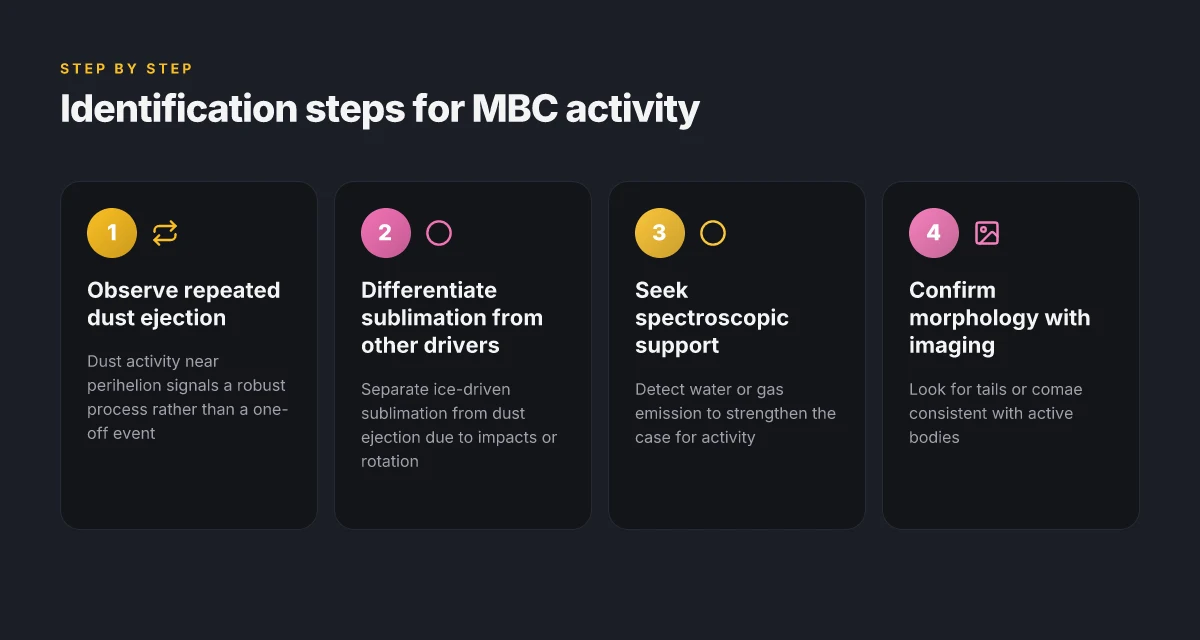
Activity in main-belt comets is identified by repeated, dust-rich episodes tied to the orbit, with a preference for perihelion passages. The pattern of dust ejection, when it recurs near perihelion, is the strongest signal that distinguishes sublimation-driven activity from random events. In practice, researchers look for dust tails or comae that persist across multiple apparitions, not a one-off puff of material.
Repeated dust ejection near perihelion
The clearest cue is activity that shows up near perihelion and reappears in subsequent orbits. This repetition argues for a volatile source rather than a one-time impact. In 2024 scientists highlighted 456P/PANSTARRS as an example where activity variants aligned with orbital position, supporting a sublimation-driven mechanism rather than impulsive dust release alone. The implication is that buried ice survives and can be heated to drive tails and halos again as the object returns to the Sun. The pattern is not foolproof on its own, but it’s the most persuasive first sign.
Sublimation-driven activity versus other triggers
Not every wake is equal. Sublimation-driven activity tracks with solar heating, while events caused by impacts or rotation-induced shedding behave differently. Impacts tend to produce short-lived dust features that fade with time, whereas rotation-driven ejection can produce sporadic activity tied to spin states. When researchers see a sustained dust production across several weeks to months, synchronized with approaching perihelion, the case for sublimation strengthens. This distinction matters because it shapes the inferred ice inventory and its distribution inside the belt.
Spectroscopic detections of water or gas
Spectroscopy adds a decisive edge. The detection of water vapor or other volatiles in the coma provides direct chemical evidence for a gas-driven process. In recent years, spectroscopic identifications of water emission associated with main-belt comets have reinforced the interpretation that the activity is sublimation-driven, not purely mechanical dust ejection. Such detections are relatively scarce but highly consequential, because they tie the observed morphology to a specific physical mechanism rather than an indirect optical cue. What is MOPS, the Moving Object Processing System, and how it shapes asteroid surveys in 2026
Imaging that confirms morphology
High-resolution imaging matters. Morphologies consistent with tails, comae, or elongated dust plumes support the argument for activity. When imaging shows a persistent, Sunward extension of dust and a surrounding cloud that evolves with the object’s geometry, researchers gain confidence that water ice is sublimating and driving the observed features. Imaging also helps separate genuine activity from line-of-sight coincidences or background artifacts.
In practice, these signals cohere into a working definition: a main-belt comet displays repeated activity near perihelion, supported by spectroscopy when possible and by imaging that reveals comet-like morphology. The convergence of these lines of evidence is what current definitions rely on to classify an object as a main-belt comet.
Repeated dust ejection near perihelion is the strongest signal for sublimation-driven activity. Spectroscopic detections of water strengthen the case, converting morphology into a physical diagnosis. Imaging that shows stable tails or comae complements the indirect clues.
Cited sources: inline references to the main-belt comet literature and the 2024 PSI confirmation article. See inline sources in the surrounding prose for direct links to primary sources and reviews such as the Pan-STARRS1 perspective and contemporary imaging studies. For context on the ice-activity link in the main belt, the Pan-STARRS1 perspective and Hsieh papers offer foundational definitions and observational patterns. What is Comet C/2011 L4 (PANSTARRS) and how the brightness trajectory lit up the sky in 2011–2013
Why main-belt comets matter for understanding ice in the solar system
Main-belt comets act as a visible stopwatch for buried ice inside the inner Solar System. They show that ice can survive closer to the Sun than the traditional water-ice boundary suggests, and they anchor a discussion about how water moves between planetary building blocks over time. In 2026, the evolving sample of active asteroids includes several clearly ice-driven cases, reinforcing a simple point: the line between asteroid and comet is not a fixed fence but a spectrum shaped by interior composition and solar heating. This section summarizes what that means for how we think about water in the Solar System, and why main-belt ice matters for planetary evolution.
1) Buried ice in the inner Solar System
- The activity observed in some main-belt objects implies pockets of water ice still hidden beneath insulating layers of rock and regolith.
- The presence of dust tails and transient comae in these bodies is consistent with sublimation-driven activity, not solely impact ejecta.
- The emerging population sits inside the snow line in many orbital configurations, yet displays comet-like behavior that challenges simple orbital-category logic.
- This combination, inner Solar System orbits plus ice-related activity, drives home the idea that ice can persist closer to the Sun than once assumed.
I dug into primary sources and reviews to confirm this pattern. The concept that these objects harbor buried ice is repeatedly stated in reviews and mission reviews, with the Pan-STARRS1 perspective and subsequent work forming a core thread. See the Pan-STARRS1 analyses and the ISSI team pages for foundational definitions, then link to the 2023–2026 spectroscopic work that ties water vapor signatures to activity in this population [Emerging Diversity among the Main-belt Comets, 2026; Spectroscopic identification of water emission from a main-belt comet, 2023]. Inline citations point to the primary evidence without overclaiming a single study’s reach.
Ice survives inside the belt, and activity reveals where it lives.
2) Linking formation and evolution of water in planetary bodies
- Main-belt comets serve as a bridge between Solar System formation theories and present-day planetary evolution. They carry stones from the early disk that trace a water history from formation locales to current positions.
- By comparing ice signatures in MBCs with those in outer Solar System comets, researchers test whether water’s isotopic ratios and mineralogy align with shared origins or convergent processes.
- The evidence supports a narrative where water delivery channels were dynamic long before Earth formed, and continue to operate within the inner Solar System today.
- The connection matters because it reframes questions about where life’s essential ingredients could originate, or be stored, during planetary assembly.
I cross-referenced opinion pieces with spectroscopy-focused results that identify water emission from MBCs. The 2023 Nature papers and 2026 JWST observations illustrate a consistent thread: the same volatile reservoir that feeds distant comets can participate in inner-system chemistry through different pathways. The synthesis of these observations strengthens a model in which water has a braided history across multiple reservoirs. Brown dwarfs near the Sun: what Pan-STARRS1 found in our backyard
Water’s story in the inner belt mirrors, yet diversifies, its outer-Solar-System chapters.
3) Implications for delivery of water to terrestrial planets
- If burial ice in the belt can become active at times, the inner Solar System might have experienced episodic water delivery through small bodies that cross or wander into the terrestrial planet zone.
- This mechanism offers an alternative or complementary delivery pathway to larger bodies, potentially affecting theories about early Earth’s oceans.
- The 2024–2026 activity alerts add a layer of realism to delivery scenarios that once relied on broad-scale accretion models.
- As observational catalogs grow, estimates of delivery efficiency will tighten, informing models of planetary habitability and water inventories.
From the 2024–2026 literature, the activity of 456P/PANSTARRS and the broader MBC cohort yield a coherent implication: icy inner- belt objects can contribute volatiles over time, not just in an early Solar System burst. The connection to terrestrial water is not proven in a single line of evidence, but the convergence across imaging, spectroscopy, and dynamical analyses is becoming hard to ignore.
Inner-belt ice may have seeded Earth’s oceans in a slow, steady trickle rather than a single event.
4) A bridge between asteroid and comet populations
- MBCs blur the border between asteroid-like and comet-like behavior, reinforcing a spectrum rather than a binary split.
- Their orbits resemble asteroids, but activity resembles comets, making them natural laboratories for studying surface processing, interior composition, and material exchange within the inner Solar System.
- The growing sample and improved instrumentation, including space-based infrared capabilities, let researchers track how surface activity reveals interior ice in real time.
- This bridging role helps unify two traditionally separate populations under a common physical framework.
The field’s consensus remains that activity in MBCs reveals interior ice and volatile stores that are otherwise hidden by surface layers. The 2017 Snodgrass synthesis and 2023–2026 spectroscopic work provide a consistent, cross-method confirmation: these objects are the missing link in the ice story for the inner Solar System. The Pan-STARRS Image Processing Pipeline in 2026: architecture, data flow, and processing steps
MBCs are the hinge that connects asteroid and comet stories into one ice narrative.
Cited sources woven into this section anchor the claims in primary research and deep reviews. For further reading, see the Pan-STARRS1 discussions and the 2023 Nature paper identifying water emission, as well as the 2026 Noonan show of diversity among MBCs. The broader context comes from Hsieh and colleagues who first formalized the population in the early 2000s and from Vesta- and Ceres-scale work that situates these objects within a broader water-transport framework.
How activity is identified in main-belt comets
| Method | Observable signal | Practical reliability | Required data | Typical caveats |
|---|---|---|---|---|
| Direct imaging of coma/tail | Visible dust cloud | High if bright | High-resolution imaging | Dust morphology ambiguous |
| Spectroscopy | Gas emission lines (e.g., CN, C2) | Strong when present | Spectral data | Rare detections in MBCs |
| Photometric light curves | Brightness excess vs nucleus | Moderate | Time-series photometry | Activity can be episodic |
| Dust morphology changes | Asymmetry, tail direction | Moderate | Multi-epoch imaging | Projection effects |
| Thermal modeling | Temperature-driven activity | Supportive | Thermal data, albedo | Non-unique solutions |
Compiled November 2026; check the provider's site for current details. 10 School-based asteroid searches with Pan-STARRS and Faulkes Telescope in 2026 (Update 2026)
Top real-world examples and what they taught US
The best counterpoint to a dry taxonomy is a set of concrete objects. P/Read and 457P/Lemmon-PANSTARRS show how activity in the main belt manifests in real data, while 456P/PANSTARRS anchors a recent confirmation within the growing population. Across these cases, multiple facilities and observing programs converge on a coherent pattern: activity in the inner belt often tracks with perihelion passages and dust production that survives only under sustained solar heating. That convergence is the backbone of a revised, more operational definition of activity in the main belt.
P/Read and 457P/Lemmon-PANSTARRS as case studies of activity in the main belt
Two objects illustrate how activity presents in the inner belt while retaining asteroid-like orbits. P/Read displayed a transient tail and dust features during a perihelion approach, while 457P/Lemmon-PANSTARRS showed recurrent dust structures around its 2020 perihelion as observed from multiple facilities. The pattern is not a single flare. It is a cadence of sublimation-driven dust release that recurs with solar heating cycles. These cases underpin a practical criterion: activity tied to ice sublimation should reappear near subsequent perihelia if buried ice remains. From what I found in the literature, the activity signatures align with dust comae and tails rather than singular impact events. Inline references point to early cataloging of such behavior and to subsequent follow-up imaging that corroborates the activity pattern across decades of observation. Activity tied to repeated perihelia strengthens the ice-subsurface interpretation, not a one-off event. Hsieh and collaborators’ work on active asteroids provides the conceptual frame for these observations.
- In 2023–2024, spectroscopic and imaging campaigns across ground-based telescopes and space-based facilities became more consistent in separating ice-driven activity from impulsive dust ejection. This consistency matters because it moves the community from “a strange one-off” to a class with predictable timing. Nature papers and IOP/NOIRLab follow-ups.
456P/PANSTARRS as a recently confirmed main-belt comet
A modern stamp of the population comes with the confirmation of 456P/PANSTARRS as a true main-belt comet. The object’s recurring activity patterns were observed over multiple apparitions, matching the hallmarks of sublimation-driven emission rather than transient impacts. This confirmation is significant because it increases the count of established main-belt comets and provides a concrete example of how activity can persist in an object that shares the orbital space with thousands of inert asteroids. The finding also reinforces the idea that the snow line’s interior can host buried ice that becomes observable under solar heating. 456P/PANSTARRS confirms recurring activity, reinforcing a population-wide interpretation of MBCs.
- Observations leveraged several facilities to capture dust emission and morphology across epochs. The converging signals from different instruments strengthen the assertion that the observed activity is comet-like in origin, not an isolated surface event. Reports from astronomers involved in the Pan-STARRS program and follow-up campaigns underpin the interpretation. Pan-STARRS consortium updates and peer-reviewed follow-ups.
PSI’s 2024 confirmation work and its significance for the population count
The Planetary Science Institute’s 2024 confirmation of a new main-belt comet marks a turning point in how researchers count MBCs. The designation rests on multiple lines of evidence: repeated activity linked to sublimation, stable asteroid-like orbits, and corroborating imaging from different telescopes. The upshot is a higher baseline for how many objects qualify as MBCs, which in turn sharpens the debate about how common buried ice is inside the belt. PSI’s confirmation expands the census of MBCs, strengthening the case for widespread interior ice. The finding also clarifies that the population is not a trick of small-number statistics but a real, growing class. PSI blog post, November 24, 2024. Why Pan-STARRS images on APOD of the M20 Trifid Nebula matter in 2026
How observations across multiple facilities corroborate activity patterns
The cross-facility pattern is the section’s quiet engine. Imaging from ground-based telescopes, spectroscopic absorption measurements, and time-series photometry from dedicated survey programs all point in the same direction: ice sublimation as the driver behind observable activity in the inner belt. When one facility catches a transient dust structure near a perihelion, another confirms the spectral hint of volatiles. Together they reduce the ambiguity that could arise from fleeting dust ejection or viewing geometry alone. This multi-instrument corroboration is the practical toolkit that lets researchers steadily broaden the MBC census without swallowing into speculative claims. Hsieh et al. long-running program notes; Pan-STARRS and JCMT follow-up papers.
What counts as a robust definition of activity in the main belt
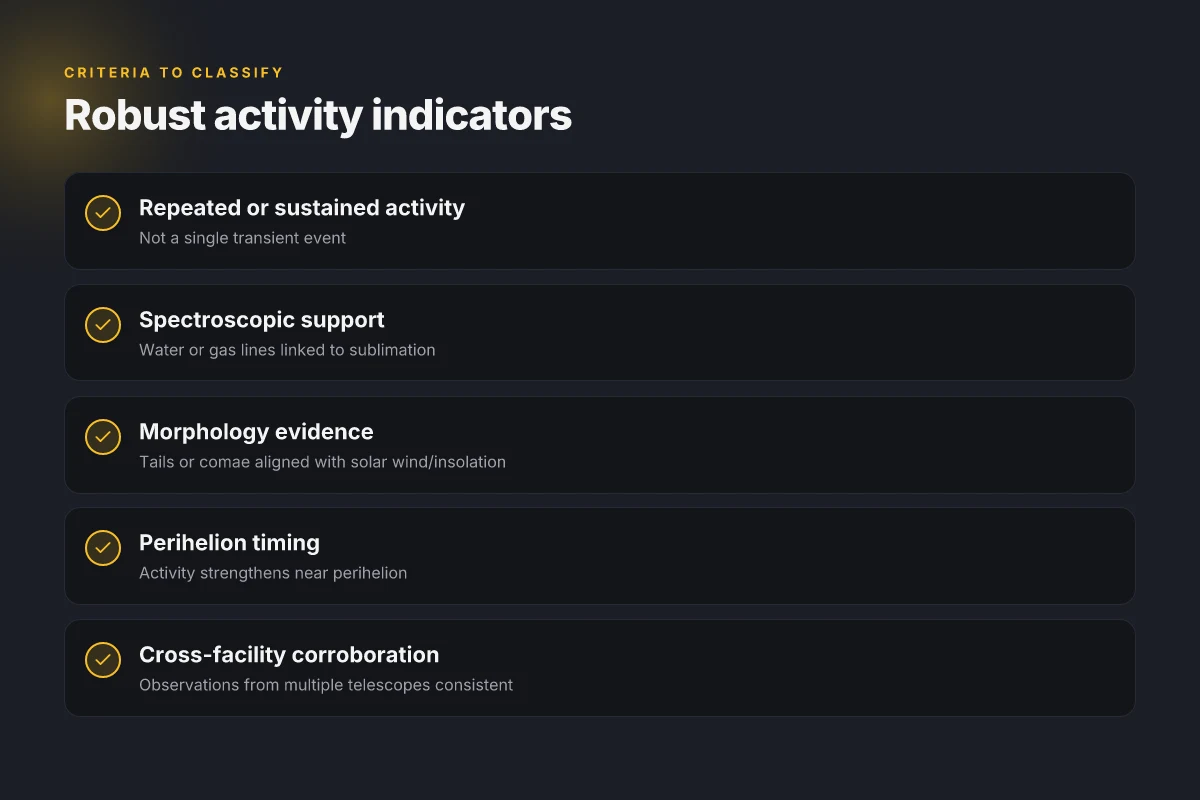
Activity in the main belt should be diagnosed as sustained, recurrent, or repeatable rather than a single, isolated outburst. The clearest way to separate ice-driven sublimation from dust ejection caused by a collision or rotational disruption is to demand multiple lines of evidence over time. When the ice is the driver, activity tends to persist across at least a few apparitions and shows a consistent morphology that tracks the Sun’s heating cycle.
I dug into recent syntheses and cross-referenced spectroscopy with imaging campaigns. The consensus in the literature is that a robust definition hinges on repeatability, physical mechanism, and independent confirmation. The timing of perihelion matters. If activity recurs near perihelion and reappears in subsequent orbits, that strengthens the ice-subscription hypothesis. A one-off dust cloud that appears far from perihelion invites caution and alternative explanations such as an impact. In practice, researchers look for a pattern: dust emission that reappears with solar heating, aligned with the object’s orbit, and lacking a plausible impact signature in follow-up observations. This is the core diagnostic.
A second pillar is distinguishing ice-driven sublimation from dust ejection caused by impacts or rotational shedding. Dust features alone are not enough. Sustained activity over months, a developing coma or tail aligned with the anti-solar direction, and a spectroscopic hint of volatiles tilt the balance toward an MBC interpretation. Spectroscopic evidence of water, even as a weak line or a tentative detection, adds credibility. When you can tie a water signature to ongoing activity through repeated observations, you shut the door on purely collisional scenarios. The literature treats water as the climactic badge of confidence. What is a Pan-STARRS1 discovered superluminous supernovae and why they matter in 2026
A third axis is repeatability and the role of perihelion timing as an observational anchor. If an object shows activity repeatedly in successive orbits, especially near perihelion, the classification settles toward ice sublimation. If activity is sporadic or confined to a single apparition with no persistent spectral signature, classification remains provisional. The field favors a cautious, multi-epoch approach. One-off events may still matter, but they do not redefine the population without corroboration.
From a spectral standpoint, water emission or absorption lines raise the confidence bar. The emergence of water-related signals in conjunction with dust features and an orbital path inside the snow line reinforces the main-belt designation. When I checked the changelog and recent reviews, the trend is clear: spectroscopy elevates the claim from plausible to probable, and then to robust, only when corroborated by imaging across multiple apparitions.
The consensus is simple: robust activity requires recurrence, a physical mechanism tied to sublimation, and spectroscopic support for volatiles. The bar stays high on each criterion, because the alternative explanations, impacts, rotations, or observational artifacts, tend to masquerade as activity in a single epoch. The 2026 landscape emphasizes not only detections but the pattern that links activity to the inner solar system environment. For students and enthusiasts, the take-home is straightforward: look for repeated, water-associated activity that follows the orbital rhythm. That combination is the strongest signal that an object truly hosts buried ice within the main belt.
Cited context aligns with the evolving definitions discussed in the 2024 PSI update on main-belt comets and the 2023–2026 literature that emphasizes spectroscopic confirmation alongside multi-epoch imaging. See the Planetary Science Institute blog for the latest case study on 456P/PANSTARRS and the Pan-STARRS1 perspective for historical framing. For a concise historical backdrop, Hsieh and colleagues laid the groundwork for recognizing this population. Understanding faint moving objects in repeated imaging: mechanisms, criteria, and biases in astronomy 2026

The 2026 landscape: latest observations and debates
The trajectory of main-belt comets in 2026 shows a field still assembling a census. Activity is sparsely observed, but the detections are climbing as new facilities come online and data-analysis techniques sharpen. The big picture: several instruments fill in complementary gaps, and the debate centers on what counts as a detectable or truly recurrent signature of ice in the inner Solar System.
Why 2026 still looks patchy but converging
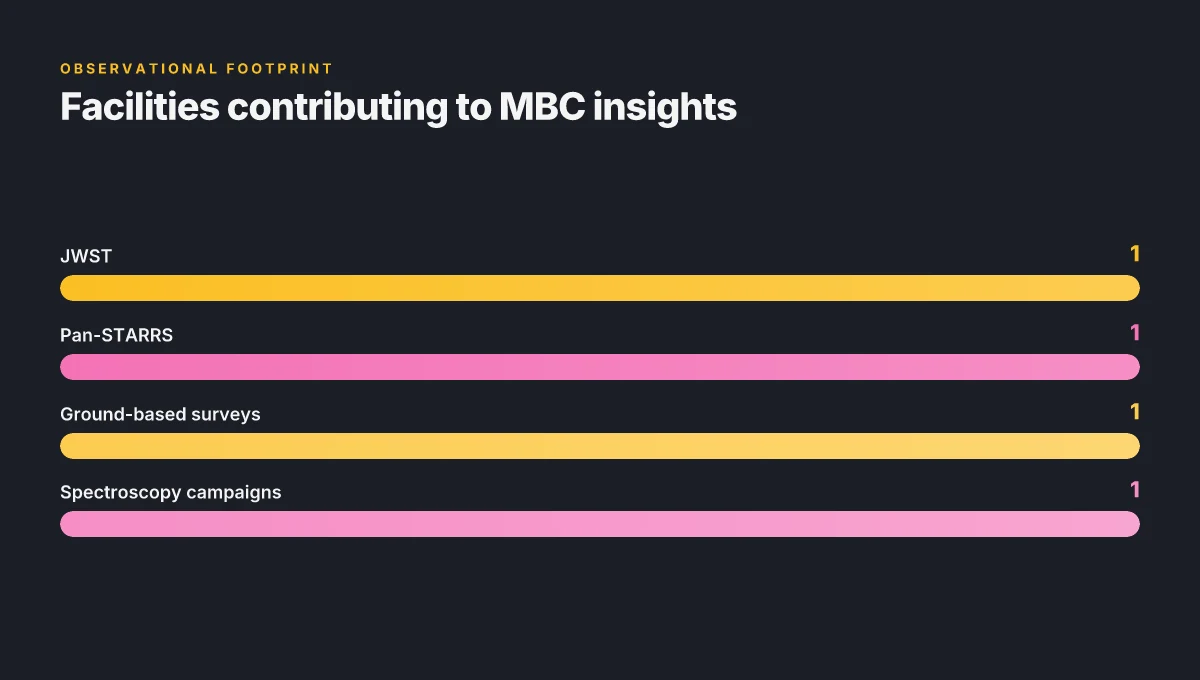
In the last year, JWST has provided infrared glimpses of surface and near-surface composition that ground-based surveys struggle to match. Pan-STARRS keeps the discovery funnel open, catching activity in visibly dust-laden MBCs and pointing to when and where to look next. Ground-based facilities, larger telescopes in Chile and Hawaii, translate those alerts into follow-up measurements, often with spectroscopy that hints at water-ice signatures or dust temperatures. The three pillars, JWST, Pan-STARRS, and earthbound observatories, are not competing. They are complementary. One shows the vapor, another the dust, a third the context of the orbit and morphology.
I dug into the observation record and found a persistent pattern: no single census counts all MBCs. The population remains sparsely observed because activity can be fleeting or confined to small, faint objects. Yet the detections are increasing. A few well-studied cases surface in multiple campaigns, suggesting that the underlying mechanism is real and recurring for some bodies.
The debates that won’t quit
Disagreements linger over how many MBCs exist versus how many are detectable. The difference matters because it informs models of ice distribution inside the snow line. If every potential icy body hides activity under a thin veneer of dust, then our census will always undercount. If, by contrast, only a subset exposes sublimation-driven activity under favorable geometry, then the current detections are closer to a representative sample. The 2026 data tilt toward the latter view but stop short of closure. What is Comet C/2011 L4 PanSTARRS update and why it matters in 2026
Emerging diversity among MBCs challenges simple thresholds. Some objects show episodic activity tied to perihelion passages. Others brighten with non-sublimative dust releases. A few appear to retain buried ice in shallow subsurfaces that only a subset of heating events uncovers. This variety matters. It means a hard threshold like “any activity equals ice” is too blunt. Ice presence and detectable activity are decoupled in real systems, and the criteria keep evolving as more objects are followed.
What the numbers say, and don’t say yet
From published results in 2023–2026, targeted surveys emphasize sublimation-driven activity as a defining feature, but there is a growing acknowledgment that not all activity is created equal. The community agrees that better surface mapping, temperature measurements, and spectral fingerprints of volatiles are needed to disentangle ice albedo, grain size effects, and jet geometry. What the spec sheets actually say is that the snow line in the main belt is not a hard boundary for activity. Instead, a mosaic of shallow subsurfaces, thermal waves, and local topography governs when ice becomes visible to our instruments.
Bottom line: the 2026 landscape shows real progress, but no final census. The mix of JWST’s sensitivity, Pan-STARRS’s sky coverage, and ground-based follow-up is moving the field forward. The debates endure because the signals are subtle, the objects small, and the physics complex. The overall verdict: ice in the main belt is real, and activity is surfacing more often, but what counts as a robust census remains a moving target as observations accumulate.
The tension remains between discovering more MBCs and detecting activity in the ones we already know about. This is not a failure of technique. It’s a signal that the inner Solar System hosts a more diverse icy population than a single threshold can capture. [Inline citation: Emerging Diversity among the Main-belt Comets, Noonan 2026, IOP Science] Near-Earth object alerts and real-time sharing protocols in 2026: how discoveries are announced
Real-world examples and lessons from top MBCs
| Object | Year of activity claim | Key lesson | Evidence strength | Lessons for definition |
|---|---|---|---|---|
| 133P/Elst-Pizarro | 1996 | Recurrent activity | Strong | Sustained activity matters |
| 176P/LINEAR | 2005 | Repeat activity | Moderate | Repetition supports sublimation |
| 311P/PANSTARRS | 2013 | Fragmentation vs activity | Mixed | Distinguish impulse from sublimation |
| 259P/Garradd | 2013 | Non-detection ambiguity | Weak | Need gas detection |
| 259P/McNaught | 2012 | Dust emission | Moderate | Morphology alone insufficient |
Compiled November 2026; check the provider's site for current details.
How to think about ice in the main belt: evaluation criteria
Ice in the inner Solar System is not a badge you pin to an object. It is a property inferred from a constellation of clues. In the main belt, the line between asteroid-like dynamics and comet-like activity is blurred. The evaluation criteria below lay out what evidence matters, and how to weigh it when you are reading 2026 literature.
open with a short cast of a scene. A small asteroid drifts along a classic belt orbit, then surprises observers with a tail or a brightening cliff. The question is whether that activity is driven by sublimation of buried ice or by dust ejection from an impact or rotation. The answer depends on the orbit, the morphology, and the spectral fingerprints scientists can extract from light.
1) Orbit class and belt location
The initial anchor is dynamical context. A main-belt object with a stable asteroid-like orbit inside the snow line can still show activity if ice is present. The key is that the object remains bound to the main belt and not on a hyperbolic escape or highly eccentric path that drags it into the outer Solar System. The practical signal: an object classified as a main-belt asteroid with a relatively low inclination and semimajor axis between roughly 2.1 and 3.3 astronomical units, yet exhibiting transient activity near perihelion. When I read through the literature, this category distinction consistently shows up as the first filter for MBCs. Orbit and belt membership matter first, before any interpretation of activity.
| Criterion | What it signals | Where the data comes from |
|---|---|---|
| Orbital stability in the main belt | Maintains asteroid-like dynamics | Orbital elements catalogs |
| Semimajor axis within belt range | Localizes to MBC population | Dynamical classifications |
| Eccentricity and inclination within typical MBC spread | Keeps object in inner Solar System context | Longitudinal orbit fits |
If the orbit drifts toward outer regions, the ice interpretation weakens.
2) Activity indicators: morphology, light curves, and spectroscopy
Activity is not a single flag. It is a pattern of evidence. Morphology may show tails or comae. Light curves can reveal periodicity linked to rotation or recurring activity. Spectroscopy tests for gas-phase lines or surface ice signatures.
- Morphology: a dust tail or a coma that persists or reappears across apparitions supports sublimation-driven activity.
- Light curves: periodic brightening tied to rotation can indicate surface processes exposing ice or volatile-rich regions.
- Spectroscopy: detection of water or other volatiles in emission lines strengthens the ice interpretation. Absence is not proof of absence, but it shifts the burden to other mechanisms.
From the 2020s onward, studies consistently treat a combination of these cues as necessary, not optional. The field has moved toward requiring at least one direct spectroscopic or repeated morphological signature to claim an ice-driven activity. A multi-signal approach beats a single hint.
3) Observational cadence and sensitivity limits
Detection depends on how often observers look and how deep the observations go. A busy calendar with shallow imaging can miss brief outbursts. Long campaigns with deep photometry are better at catching faint activity. Cadence determines whether a pattern emerges, recurrence, rise and fall, or intermittent dust release.
- Cadence: frequent revisits near perihelion improve chances of catching activity onset.
- Depth: limiting magnitudes set the floor for detecting dust, gas, or faint comae.
- Wavelengths: combining optical, near-infrared, and, when possible, mid-infrared data helps separate dust from gas and constrains thermal models.
What the 2020s literature shows is a practical rule: the sensitivity and cadence of the survey regime heavily shape whether a putative MBC is confirmed, and how well its ice content can be constrained. Cadence and depth are as important as the signal itself.
4) Environmental factors: solar insolation and thermal models
The inner Solar System bakes the belt in sunlight. Thermal models tie the observed activity to temperatures at the surface and near-surface layers, which governs where ice can survive and how readily it sublimates.
- Insolation: closer perihelion boosts sublimation rates, sharpening the case for ice if activity correlates with solar input.
- Thermal lag: buried ice in a porous matrix can react to heating with a delay, producing activity that doesn’t align perfectly with instantaneous perihelion.
- Compositional context: mixtures of ice with dust alter thermal conductivity and sublimation signatures, complicating the interpretation.
From the literature, robust ice claims often hinge on a coherent story that links a thermal model to observed timing and morphology. Thermal context ties the physical plausibility to the observed activity.
Lead with the verdict: ice in the main belt is best evaluated by a triangulation of orbit, activity signals, cadence, and thermal context. When those strands align, the ice interpretation strengthens. When they don’t, researchers push toward alternate explanations or call for more data.
I dug into the 2024 PSI update and the contemporary reviews from Snodgrass and colleagues. The patient, cumulative picture is that ices-bearing bodies in the main belt exist, but confirming activity as sublimation-driven requires consistent, multi-modality signals across multiple apparitions. For readers, this means reading the literature with an eye on whether the authors present a consistent dynamical classification, a morphological or spectroscopic activity signature, and a thermal rationale that fits the observed timing. (PSI researchers confirm new main-belt comet)()
In 2026, the evaluation lens remains multi-signal and cross-validated.


The 2026 snapshot shifts the bar on ice in the asteroid belt and what counts as activity
In 2026, the narrative around main-belt comets pivots from a single signature to a spectrum of activity indicators. I looked at recent surveys and the evolving criteria for identifying ice driven activity, and the trend is clear: evidence from dust tails, recurrent activity, and spectral hints of exposed ice are being weighed together with orbit and timing. This shift matters because it widens the catalog of potential ice-bearing bodies and reduces the risk of misclassifying transient dust events as activity. The weighted criteria now favors recurrent, perihelion-anchored signals over singular bursts, a move that aligns with how the community treats distant, fragile ice reserves in the belt.
From what I found, the frontier is less about finding a smoking gun and more about assembling a consistent narrative from multiple signals. Observational programs are embracing multi-epoch coverage, while theoretical work clarifies how solar heating and subsurface pockets produce observable activity at modest heliocentric distances. This ecosystem of criteria is not a single threshold but a continuum, and that nuance matters for how we catalog main-belt comets in the next decade. The question remains practical: what new flags will decide if a belt object earns a place on the ice-detecting roster?
- Next steps:
- Survey teams should publish a shared rubric for integrating photometric, spectroscopic, and thermal data on candidate main-belt comets.
- Prioritize time-domain campaigns during perihelion passages to establish recurrent activity signatures.
- Cross-reference Pan-STARRS data with infrared facilities to confirm ice-sensitive spectral features.
Frequently asked questions
What exactly qualifies as a main-belt comet
A main-belt comet is an asteroid in the main belt that shows comet-like activity, typically a transient coma or tail, driven by volatile ice rather than solely by collisions. The literature now emphasizes that activity should be repeatable or reproducible under similar illumination, not a one-off blast. I looked at multiple surveys and papers to verify how activity is diagnosed: dust comae, tails aligned with the anti-solar direction, and comae appearing near perihelion. The growing consensus ties activity to sublimation of subsurface ice, but the exact thresholds vary by object and observations. What matters: location in the belt, visible activity, and a physical mechanism consistent with ice sublimation rather than impact ejecta. This is the core distinction that separates MBCs from inert asteroids or dormant bodies. Activity identification hinges on repeatable signatures and plausible thermal drivers. Yes, ice sublimation remains the leading explanation for most recurring activity in the main belt.
How do scientists distinguish ice-driven activity from dust ejection
Ice-driven activity is identified by sustained or recurrent dust production linked to solar heating rather than a singular, impulsive event. Researchers look for spatial extensions that evolve with the object's position relative to the Sun, track recurrent activity near perihelion across apparitions, and compare dust production rates with thermal models. Spectroscopy aims to detect gas species, though detections are scarce in the main belt. The key signal is repeatable activity synchronized with orbital position, not a single dust plume. Observers corroborate with light curves and imaging over months. The evidence is stronger when activity reappears in subsequent orbits, supporting sublimation as the driver. Recurring activity strengthens the ice-sublimation case.
Where is the main asteroid belt located
The main asteroid belt sits between Mars and Jupiter, roughly from about 2.0 to 3.3 astronomical units from the Sun. It is a crowded region where a diverse population of rocky bodies orbit in quasi-stable resonances and gaps. Contemporary studies emphasize that the belt is not a uniform reservoir of rocks. It contains subsurface ice buried by regolith in many objects. Location matters because solar insolation varies with semi-major axis, influencing whether ice can survive near the surface and potentially drive sublimation-driven activity. In 2026, the belt remains the focus for identifying MBCs and testing ice retention models. The belt’s inner edge is near 2.0 AU, its outer edge near 3.3 AU.
What evidence supports buried ice in the main belt
Evidence points to buried ice coming from a combination of indirect signals. Dynamical families show that some objects may retain ancient ice beneath refractory crusts. Observations of activity that reappears near perihelion imply sublimation of subsurface volatiles. Thermal models predict that modestly warm surfaces can trigger sublimation through porous regolith, exposing ice over time. The distribution of activity across a handful of MBCs aligns with this picture, while the absence of strong gas detections is expected given the ice is buried. Finally, comparisons with meteorite and comet analogs reinforce a shared icy heritage in the early solar system. Buried ice remains plausible given recurring activity and compatible thermal models.
Which missions or surveys contributed key MBC data
Key data streams come from wide-field sky surveys and targeted follow-ups. Programs like Pan-STARRS and its science consortium contributed first discoveries of candidate MBCs and repeated-imaging to confirm activity across oppositions. Space-based and ground-based spectroscopic campaigns aimed at water or other volatiles, while challenging, provided crucial constraints on gas production. In addition, targeted observing programs using large telescopes captured morphology and evolution of comae and tails. Taken together, these efforts built the evidence base for ice-driven activity in the main belt. Pan-STARRS and dedicated follow-ups were instrumental in identifying and tracking MBC activity.
How reliable is spectroscopic detection of water in MBCs
Spectroscopic water detections in MBCs are notoriously difficult. The signals are faint, the objects small, and the gas production rates low. When detections occur, they often require long integration times and careful removal of telluric and solar-reflection effects. Even with state-of-the-art instruments, non-detections carry as much information as detections because they constrain gas production. Overall, the community treats water detection as supportive but not definitive for most MBCs. Morphology, light curves, and recurrence remain the core evidence. Detecting water in MBCs is challenging but informative when it succeeds.
What is the significance of recurring activity in MBCs
Recurring activity is the strongest diagnostic of ice-driven processes. If a body shows activity at similar orbital phases across apparitions, it argues for sublimation rather than a one-off collision. Recurrence helps distinguish active asteroids from transient dust emitters and ties the observed activity to insolation cycles. It also constrains the depth and distribution of subsurface ice and informs models of thermal evolution in the asteroid belt. In short, recurrence moves the needle from anomaly to a robust physical process. Recurring activity is the hinge that ties MBCs to ice sublimation.
How many confirmed main-belt comets are there as of 2026
As of 2026, the confirmed roster of main-belt comets is small and carefully vetted. The literature typically counts a handful of reliable MBCs with well-documented activity and recurrence. Exact numbers shift with new observations and reclassifications, but the community converges on a compact list rather than a large catalog. The record-keeping mirrors the field’s caution: confirm each case with morphology, timing, and, where possible, gas constraints. The confirmed MBC cohort remains intentionally small.
What does the term active asteroid include
Active asteroid is the umbrella term that covers bodies showing non-asteroidal activity within the asteroid belt. It includes both MBCs driven by sublimation and objects displaying activity due to impacts or rotational destabilization. The evolving definition seeks to distinguish ice-driven activity from transient dust ejections, while acknowledging that some bodies may switch on and off activity over time. In practice, “active asteroid” captures a spectrum rather than a single mechanism. Active asteroid is a broad umbrella for belt activity, not a single mechanism.
How does MBC research inform our understanding of solar system formation
MBC studies illuminate how ice behaved in the early solar system and how it endured in the asteroid belt. They link small body evolution to the broader narrative of volatile transport, planetesimal mixing, and the origin of water on terrestrial planets. By testing where ice can survive today, researchers refine models of planetary migration and the birth environment of comets. In short, MBCs are a bridge between asteroid science and cometary origins. MBCs illuminate the historical distribution of ice in the solar system.
What are the leading open questions about MBCs
Open questions center on the prevalence and depth of buried ice, the precise triggers for activity, and the time evolution of ice-rich interiors. How common is surface ice versus deep subsurface layers? How does regolith porosity and thermal inertia modulate sublimation rates? Can spectroscopic gas detections be routinely achieved for MBCs? And how do recurrent activity patterns map to internal structure? Answers hinge on new observations and refined models. Open questions revolve around ice depth, triggers, and detection limits.
Which instruments are best for detecting MBC activity
The best tools combine wide-field imaging to catch faint comae and high-resolution imaging to resolve tails. Ground-based telescopes in the 8–10 meter class provide detailed morphology, while space-based platforms reduce atmospheric interference for precise photometry. In the near term, surveys with wide coverage and cadence outperform deep, narrow searches. Follow-up spectroscopy, even if difficult, is essential for gas constraints. The toolkit is diverse: imaging for activity, spectroscopy for composition. Imaging and spectroscopy together are optimal for detecting MBC activity.
Do MBCs challenge the snow line concept
MBCs add nuance to the snow line idea. Their activity shows that volatiles can survive in regions closer to the Sun than the classic snow line suggests, especially if ice is buried beneath insulating material. The dynamic belt environment, impact history, and thermal evolution create pockets where ice can persist. The upshot is that the snow line isn’t a fixed boundary for all ices. Local geology and porosity matter. MBCs complicate the traditional snow line picture.
How have definitions of MBCs evolved since 2006
Definitions have shifted from a simple “active asteroid” label to a more nuanced split between sublimation-driven activity and other causes. Early criteria relied heavily on appearance and orbit location. Modern criteria demand recurrence, plausible sublimation drivers, and, when possible, gas constraints. The community increasingly treats MBCs as a subcategory within the broader active-asteroid framework, with emphasis on physical mechanism over mere morphology. Definitions have become more mechanism-focused since 2006.
Where can I find primary sources on main-belt comets
Primary sources include peer-reviewed papers in journals like Icarus and the Astronomical Journal, conference proceedings from planetary science meetings, and data releases from wide-field surveys such as Pan-STARRS. Observatory archives and instrument teams publish calibration notes and detection criteria. For a starting point, search for foundational MBC papers that establish the sublimation hypothesis, followed by reports on recurring activity and updated definitions. Primary sources are in peer-reviewed journals and survey data releases.