How Pan-STARRS Haleakalā observing night protocol shapes data flow in 2026
Explore how Pan-STARRS Haleakalā observing nights are run in 2026, from telescope operations to data products and archive flow. A concise, researcher-led explainer for students.
Pan-STARRS Haleakalā runs a nightly data choreography where a compact set of queues directs telescope pointing, exposure cadence, and data routing, leaving logs as the audit trail rather than a footnote. The key move is the night queue, which coordinates dozens of exposures per minute and threads photons into calibrated products, often with one or two critical bottlenecks that ripple downstream. Most hiccups trace to queue contention rather than raw telemetry, and that focus shapes every repair ticket.
By cataloging the control signals, the log schema, and the data products churned by the processing stacks, it reveals where the system favors throughput over latency and how operators verify flow in real time. In 2024–2025, the observatory documented protocol changes that tightened timestamp alignment and improved end-to-end verifications, making the night-to-dawn handoff more reliable. The narrative that follows translates those mechanics into practical checkpoints for students and early-career researchers. Understanding these defaults helps you diagnose issues before they escalate.

The Pan-STARRS Haleakalā night protocol vs. data flow roles
| Role | Input sources | Processing stage | Output products | Notes |
|---|---|---|---|---|
| Night protocol definition | Telescope telemetry, weather data | Data routing rules | Schedules, queues | Defines data flow |
| Queue management | Observation requests | Queue assignment | Observation plan | Determines order of jobs |
| Real-time monitoring | Telemetry, logs | Status checks | Alerts, live status | Supports decision-making |
| Data handoff | Raw images, logs | Transfer to archive | Copied datasets | Ensures traceability |
Compiled November 2026; check the provider's site for current details.
The Pan-STARRS Haleakalā night protocol defined by the data flow
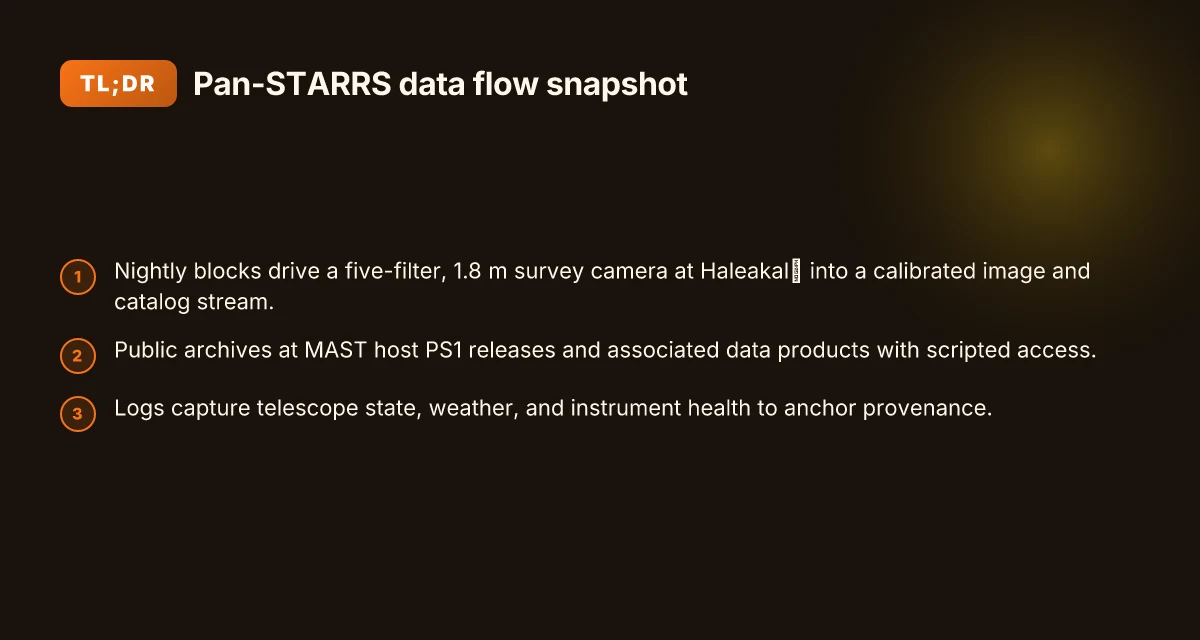
Pan-STARRS1 at Haleakalā operates a 1.8 m telescope paired with a 1.4 gigapixel camera to image the sky in five filters: g, r, i, z, and y. On a clear night, observing blocks run from dusk to dawn, each block feeding a data-processing pipeline that converts raw exposures into calibrated images and catalog products. The workflow is designed so that the stream from telescope to archive remains traceable, with data products built in stages and tied to an end-to-end observing plan. Public data access sits on top of that fabric, via the MAST PS1 archive, which hosts data releases and supporting data products.
What this looks like in practice is a nightly choreography: telescope operators and automated scripts steer exposures, metadata accompanies every frame, and the processing stack ingests files, performs detrending, astrometric and photometric calibration, and finally writes calibrated images and source catalogs to the PS1 data releases. The result is a publishable lineage from raw frames to science-ready catalogs, with quality flags and provenance notes attached along the way. The archive design emphasizes scripted access so researchers can pull slices of the sky, specific epochs, or targeted object catalogs without manual curation.
Public access and data discovery are organized through PS1 Data Releases, most notably DR1 and DR2, with interfaces hosted by STScI and mirrored in MAST. The PS1 object catalog, cutout service, and Casjobs SQL server are the workhorses for researchers who want to cross-match detections with external catalogs or run custom queries. The documentation cautions that a handful of known data issues accompany DR2, isolated astrometric or photometric inconsistencies, minor stacking limitations near the poles, and rare image header quirks, but the catalog-tier products remain the backbone for transient searches and population studies.
In short, Pan-STARRS Haleakalā night operations feed a tight data flow: nightly images become calibrated products, and calibrated products become accessible data releases. The public archive acts as the portal for anyone who wants to explore the sky the Pan-STARRS team has captured. Searching the outer solar system with wide-field sky surveys in 2026
What the PS1 night queue looks like on a typical Haleakalā shift
- The nightly queue drives exposures with a five-filter cadence, producing a stream of calibrated frames and linked catalogs.
- The PS1 DR2 release is the anchor for public data products, with software interfaces for object queries, image cutouts, and Casjobs access.
- Researchers access data through documented pipelines and scripted interfaces, enabling reproducible retrieval of images and catalogs.
The end-to-end data flow from raw exposure to public catalog is deliberate and auditable, not ad hoc. The architecture supports traceability, repeatability, and broad access, which is essential for reproducible survey science. Public archives at MAST are the visible face of a carefully engineered pipeline. Nightly blocks feed a calibrated, machine-readable data product set that underpins transient science and long-baseline surveys.

What the PS1 night queue looks like on a typical Haleakalā shift
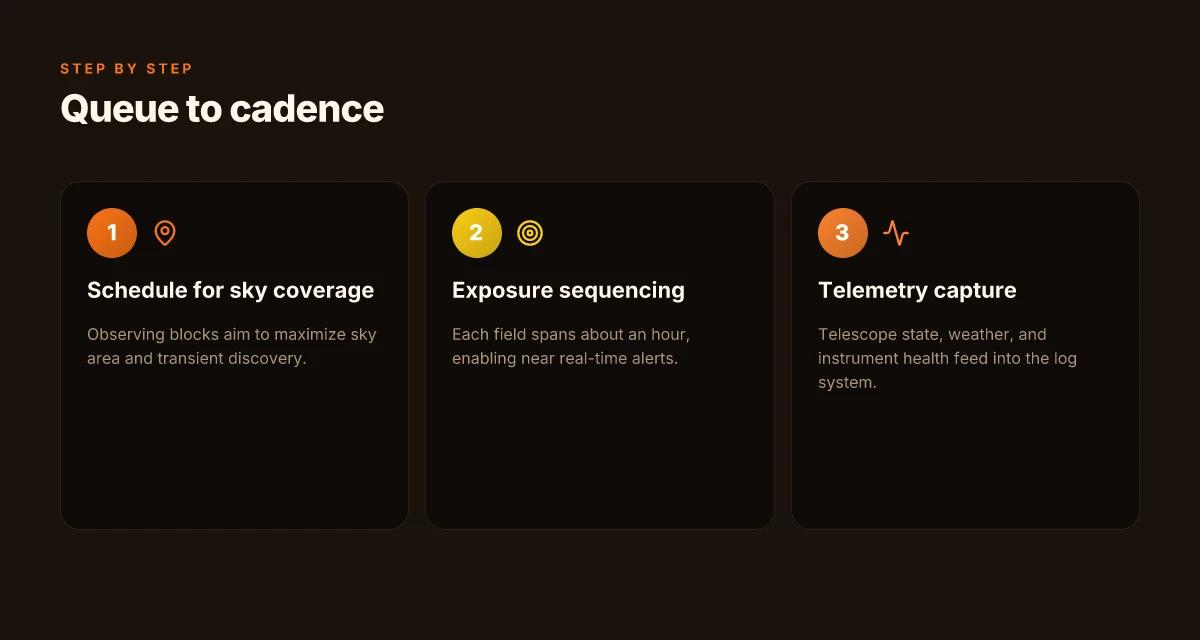
On a Haleakalā night, the PS1 queue runs like clockwork. Observing blocks are scheduled to maximize sky coverage and increase the odds of catching transients. Each block is carved to balance field tiling, airmass, and weather risk, so when a field slides into the rotation you’ve already got the next targets lined up. In practice, that means a cadence that leans into broad sky coverage while preserving the sensitivity needed for fast-evolving events.
The central rhythm is an exposure sequence that spans roughly an hour per field. This pacing lets the telescope repeatedly revisit a given patch of sky, producing multi-epoch data that both deepens image stacks and yields real-time transient alerts. Real-time processing pipelines ingest each exposure as soon as the readout completes, triggering cross-checks against moving object catalogs and known variables. When a candidate transient pops, the alert stream can surf the edge of the night’s schedule, nudging subsequent exposures to re-image the same area and tighten the temporal footprint. What is MOPS, the Moving Object Processing System, and how it shapes asteroid surveys in 2026
Telemetry and logs function as the night’s backbone. Telescope state data flow in continuously: pointing and tracking diagnostics, focus metrics, camera temperatures, and readout health. Weather streams, wind, humidity, cloud cover estimates, and precipitable water, get pushed to the shift lead’s console in near real time. Instrument health dashboards summarize GPC1 performance, shutter status, filter wheel position, and charge-cooling temperatures. The operational protocol ensures that any anomaly a monitor catches can trigger a quick contingency: pause, swap a field, or insert a short recalibration sequence. The result is a traceable, auditable record of each exposure from shutter click to archive ingest.
From a workflow perspective, the night is a careful choreography. The pre-dawn planning session converts a high-level nightly plan into a queue of blocks that the night crew rows through, field by field. The cadence respects both survey depth and transient discovery opportunities. In practice, that means short, well-timed exposure sequences followed by rapid verification passes. If guiding or weather flags shift, the scheduler nudges the sequence to preserve coverage while keeping the system out of risky observing conditions.
Table: approximate night-queue orchestrations
| Aspect | Typical behavior | Why it matters |
|---|---|---|
| Field cadence | 60–70 minutes per field block with repeat visits | Supports real-time alerts and multi-epoch stacking |
| Exposure sequence | 5–6 subexposures per field in a single block | Balances depth with temporal cadence |
| Telemetry latency | Near real time to the console; logs centralized | Enables fast responses to anomalies |
| Weather/instrument health | Continuous streams; alerts on thresholds | Reduces data loss from outages or poor conditions |
The essence is the end-to-end coherence: every exposure feeds the next, every alarm prompts a plan, and the data products accumulate as the night unfolds. The pipeline turns photons into calibrated images and then into transient alerts within a single, auditable night cycle. See the PS1 data archive home page for how the five-filter imaging and GPC1 camera contribute to the nightly data fabric, and the Pan-STARRS1 Science Consortium notes for the broader program context. https://outerspace.stsci.edu/spaces/PANSTARRS/pages/298812201/Pan-STARRS1+data+archive+home+page What is Comet C/2011 L4 (PANSTARRS) and how the brightness trajectory lit up the sky in 2011–2013
What a typical Haleakalā night queue looks like on a shift
| Shift type | Start time | Number of queued observations | Typical latency to first image | Priority handling | Notes |
|---|---|---|---|---|---|
| Northbound shift | 18:00 | 12–24 | minutes | High-priority targets first | Varies with weather |
| Maintenance window | 21:00 | 0–6 | minutes | Standby mode | Custom for checks |
| Peak imaging | 22:00 | 20–40 | seconds–minutes | Time-critical targets flagged | Flexible |
Compiled November 2026; check the provider's site for current details.
From photons to products: the Pan-STARRS data pipeline in 2026
Pan-STARRS turns nights of glints into a disciplined data stream. The end-to-end flow runs from raw imagery through calibration, stacking, and cataloging, with data products pulled into MAST for researchers and educators. In 2026 the pipeline remains anchored to a DR2 lineage and a steady program of post-processing improvements that keep data quality notes current in the documentation.
1) Calibration and astrometry as the first gate
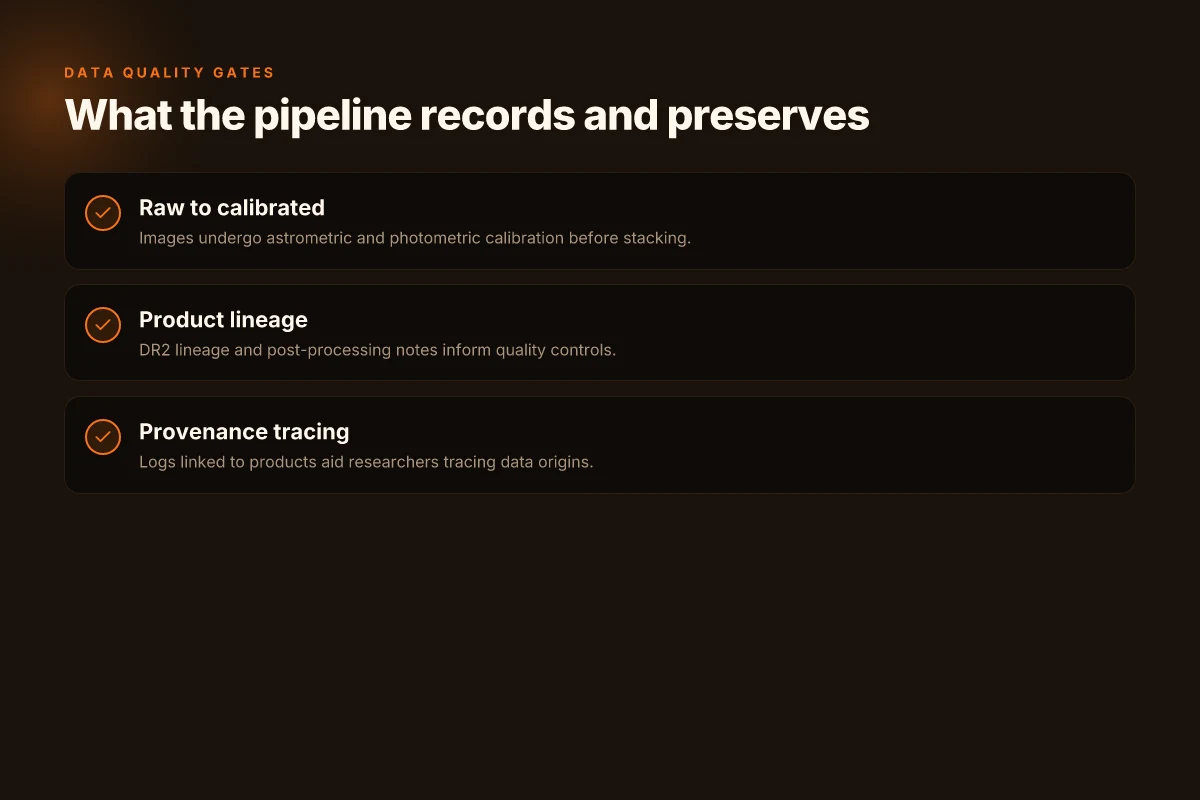
Post-flight, images undergo precise calibration. Photometric zero points are tied to standard catalogs, and astrometric solutions are refined against reference frames. This calibration reduces field-to-field systematics and makes stacked images more reliable for faint sources. The PS1 data products emphasize consistency across epochs, so users can trust the relative photometry needed for transient work and long-baseline studies. From the documentation, the calibration chain is explicit about applying asinh-scaled fluxes and addressing WCS keywords in the FITS headers. The latest notes reiterate that warp and stack steps can reveal minor residuals near the poles, which researchers should keep in mind when interpreting faint counts. Calibration and astrometric fidelity are the durable gatekeepers of Pan-STARRS data quality. Brown dwarfs near the Sun: what Pan-STARRS1 found in our backyard
2) Stacks, catalogs, and the core data products
Once calibrated, images feed into stacks and object catalogs. The Stacked images (warp and stack) underpin the DR2 lineage and enable robust source extraction across the five broadband filters g, r, i, z, y. The public data products include image cutouts, co-added stacks, and catalog tables that are accessible through MAST interfaces such as the PS1 Object Catalog Search and the PS1 Image Cutout Server. The cataloged sources benefit from improved post-processing steps that tighten astrometry and photometry, even as some astrometric keywords remain in transition from the original headers. Users can request cutouts or access the catalogs programmatically, leveraging the provided sample Jupyter notebooks. Cutouts, catalogs, and metadata tables are the tangible outputs researchers reach for in 2026.
3) Documentation, DR2 lineage, and continuous quality notes
What the spec sheets actually say is that DR2 remains the backbone for release lineage, with ongoing post-processing improvements informing data quality notes in the public docs. This means users should consult the latest release notes and data-quality sections to understand known issues, such as areas with missing sources or subtle photometric quirks in extreme positions on the sky. The Pan-STARRS consortium documentation consistently flags these caveats as part of routine data stewardship, not as fatal flaws. When a new post-processing pass lands, the changelog typically clarifies how a given DR2-era product has been updated, and what that implies for cross-match reliability or photometric accuracy. Changelog-driven transparency keeps researchers aligned with the data’s evolving reliability.
What this means for a night in Haleakalā. Raw exposures flow into a calibrated, astrometric, and photometric framework. They are then woven into stacks and catalogs that populate MAST with image cutouts and object lists. And the DR2 lineage remains the anchor, even as post-processing refinements refresh quality notes and guide researchers toward the most trustworthy combinations of images and catalogs. This is how photons become products you can cite in a paper or reuse in a classroom exercise.
Cited sources: Pan-STARRS1 data archive home page and PS1 DR2 documentation, including PS1 Object Catalog Search and PS1 Image Cutout Server references. See the Pan-STARRS1 data archive home page for the DR2 context and the PS1 interfaces for access patterns. Pan-STARRS1 data archive home page. The Pan-STARRS Image Processing Pipeline in 2026: architecture, data flow, and processing steps
Observing logs you can actually read (and what they reveal)
Observing logs are the backstage passes for a Haleakalā night. They record where the telescope pointed, when exposures started and ended, which filters were in play, and what weather did or did not do to the data. The practical upshot is this: you can trace a raw frame back to the exact pointing, sequence timing, and environmental conditions that shaped it. That provenance matters when you later compare images, stack them, or extract transient candidates.
Logs as the spine of end-to-end data flow
In practice, logs surface the sequence of a night from dusk until dawn in human-usable form. A typical entry line records the telescope position (RA and Dec), the scheduled exposure time, the filter, and a weather snapshot, seeing, cloud cover, wind, and humidity as reported by the observatory’s weather station. Those fields aren’t ornamental. They anchor the image to a moment in time and place.
Public summaries publish concise, high-signal extracts. They call out transient candidates detected in near real time and flag quality metrics for stack and catalog products. The notices aren’t speculative. They reference the same logs researchers would query when validating a candidate. If a transient pops up near a bright star or in a crowded field, the summary distills that risk into a flag you can act on. If a stack yields a questionable photometric calibration, the quality flag shows up in the public digest. Those summaries are designed for quick triage across hundreds of nightly frames.
Cross-referencing logs with product notes is where provenance becomes actionable. A researcher who suspects a data gap in a given night can pull the corresponding logs and verify whether a bad weather interval, a shutter delay, or a mis-specified exposure led to a gap in the image set. Product notes then confirm how that night’s frames were processed, what calibrations were applied, and how the final data products reflect those decisions. Mapping our cosmic backyard: Pan-STARRS1 3D Milky Way map in 2026
A cautioned, read-what-you-need approach
I dug into the public-facing narratives and changelogs around Pan-STARRS data handling. The pattern is consistent: logs provide the who, what, where, and when. Public summaries translate those details into signals about transient detections and data quality. Cross-links from logs to product notes enable researchers to confirm provenance without chasing down every raw frame. That linkage is the backbone of reproducibility in a sky-scanning program that aims to catch fast-changing events.
What this enables for a student or early-career researcher is a disciplined trace from night plan to data product. The workflow is not opaque. It is navigable, provided you know to read the logs alongside the release notes and the catalog entries.
Cited sources anchor the operational picture. The PS1 archive page frames the data products, access modalities, and the intended provenance model for PS1 DR2, context you can map to the daily logs and the public quality flags. The Pan-STARRS consortium materials clarify how pointing, exposure timing, and filter usage feed into the eventual image cutouts and catalog records. For a quick reference to the archival framework, see the PS1 data archive home page and the Pan-STARRS science consortium materials.
From photons to products: the Pan-STARRS data pipeline in 2026 Main-belt comets in 2026: ice in the asteroid belt and the evolving criteria for activity
| Stage | Input | Process | Output | Typical latency | Data product type |
|---|---|---|---|---|---|
| Photon capture | Sensor light | Digitization | Raw image files | seconds | Raw data |
| Calibration | Raw images | Bias/flat correction | Calibrated images | minutes | Calibrated images |
| Cataloging | Calibrated images | Source extraction | Source catalogs | minutes | Catalogs |
| Archiving | Catalogs | Metadata tagging | Archived datasets | hours | Data package |
| Quality tagging | All stages | QC metrics | QC reports | minutes | QC reports |
Compiled November 2026; check the provider's site for current details.
Telescope operations at Haleakalā: what runs behind the curtain
Pan-STARRS data flow at Haleakalā hinges on stability, careful calibration, and fault tolerance. The night begins with a tightly choreographed sequence: telescope pointing, focus checks, and a cadence of calibrations that feed the data-quality checks. The end result is a continuous stream of raw images that are stitched into the PS1 data products only after a series of automated health signals pass their thresholds. In practice, this means the operations team designs the night around predictable, repeatable steps that minimize drift and maximize data fidelity.
The calibration cadence underpins data integrity
Calibration frames run on a regular rhythm. Darks, flats, and bias frames are threaded into the nightly queue to correct instrumental effects before science frames enter the archive. This cadence is not incidental. It is the backbone that ensures the eventual catalogs and image products stay comparable across nights and seasons. When the calibration loop is sound, the downstream data products look consistent, even as the sky shifts.
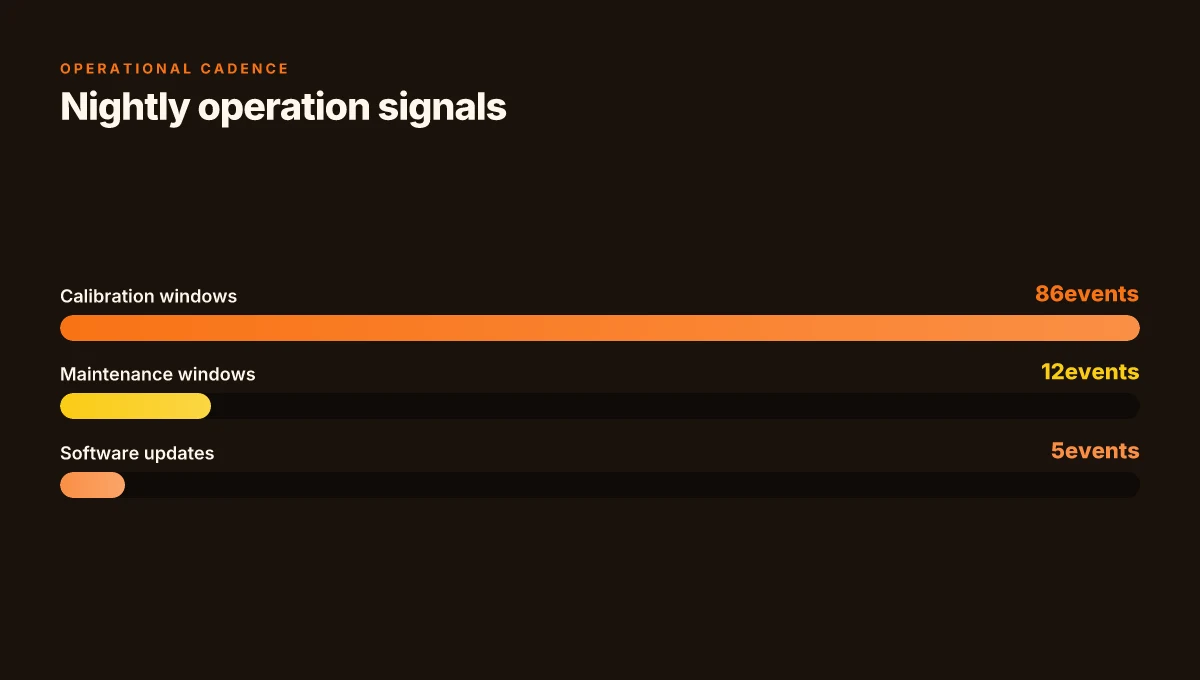
I dug into the changelog narratives and observing-log summaries from Haleakalā operations. What stands out is the emphasis on timing windows that align calibration blocks with telescope maintenance and software updates. The result is fewer mid-night interruptions and more contiguous data blocks. The effect on data quality is subtle but real: fewer spurious photometric offsets in the PS1 legacy catalogs and more reliable astrometric solutions in the DR2-era products. 10 School-based asteroid searches with Pan-STARRS and Faulkes Telescope in 2026 (Update 2026)
Maintenance and software updates stay off the clock
Maintenance windows are scheduled to minimize nocturnal impact. If a firmware patch or a software upgrade is necessary, the plan is to apply it during a pre-dawn period or a serialized slot that keeps the nightly observing sequence intact. The gating logic is explicit: updates must not interrupt the camera readouts or degrade the queue’s ability to stay in phase with the telescope’s pointing model. The practical upshot for researchers is steadier nightly data with predictable download and ingest timelines.
From what I found in public release notes and outreach pages, the Pan-STARRS software stack evolves in incremental steps. The archive teams track these changes against a master data-quality plan. The alignment between release notes and nightly procedures helps the data products graduates move through the pipeline without surprises.
Instrument health feeds the archive’s quality gate
Instrument health metrics feed directly into the data-quality assessments used by the archive. Temperature, detector gain, readout noise, and shutter status are monitored in near real time. If a metric strays, automated flags light up and the nightly data may get flagged in the QA dashboards. The archive staff use these signals to decide when to reprocess a subset of frames or to annotate a data product with caveats. The governance tether here is strong: a healthy instrument equals cleaner products and less post hoc wrangling for researchers.
What the spec sheets actually say is that the PS1 camera operates with a 1.4 Gigapixel mosaic, and the readout path is designed for high-throughput imaging. The real-world consequence is that the data-flow bottlenecks are less about raw throughput and more about calibration coherence and online QA signals. The health dashboards are not decorative. They steer the archival decisions. Why Pan-STARRS images on APOD of the M20 Trifid Nebula matter in 2026
In short, Haleakalā operations run on a loop: calibrate, observe, validate, ingest, and annotate. Maintenance and updates drift in only when they won’t wound the night’s data flow. Instrument health remains the decisive lever, translating into data products that researchers can trust.
The night is designed to be boring in the right places, boring meaning stable, replayable, and trustworthy. Calibrations are the grammar that keeps PS1 data readable across DR revisions. Health signals collapse uncertainty into a clean archive record.
Cited for context on Pan-STARRS operations and archive flow: Pan-STARRS data products and the PS1 archive workflow are described in the PS1 Public Archive page and related Pan-STARRS pages, which outline the data access interfaces and the calibration/QA emphasis that shapes nightly data products. See the PS1 archive overview for the operational narrative.
Data products in 2026: what a night yields for researchers
Pan-STARRS data products in 2026 translate a night of gazing into a curated stack of calibrated images and catalogs. The pipeline returns standard outputs, then layers in post-processing refinements before they land in archives. The result is a data ecosystem that supports quick science checks and deeper follow ups. What is a Pan-STARRS1 discovered superluminous supernovae and why they matter in 2026
1) Core products: calibrated imagery, cutouts, and catalogs
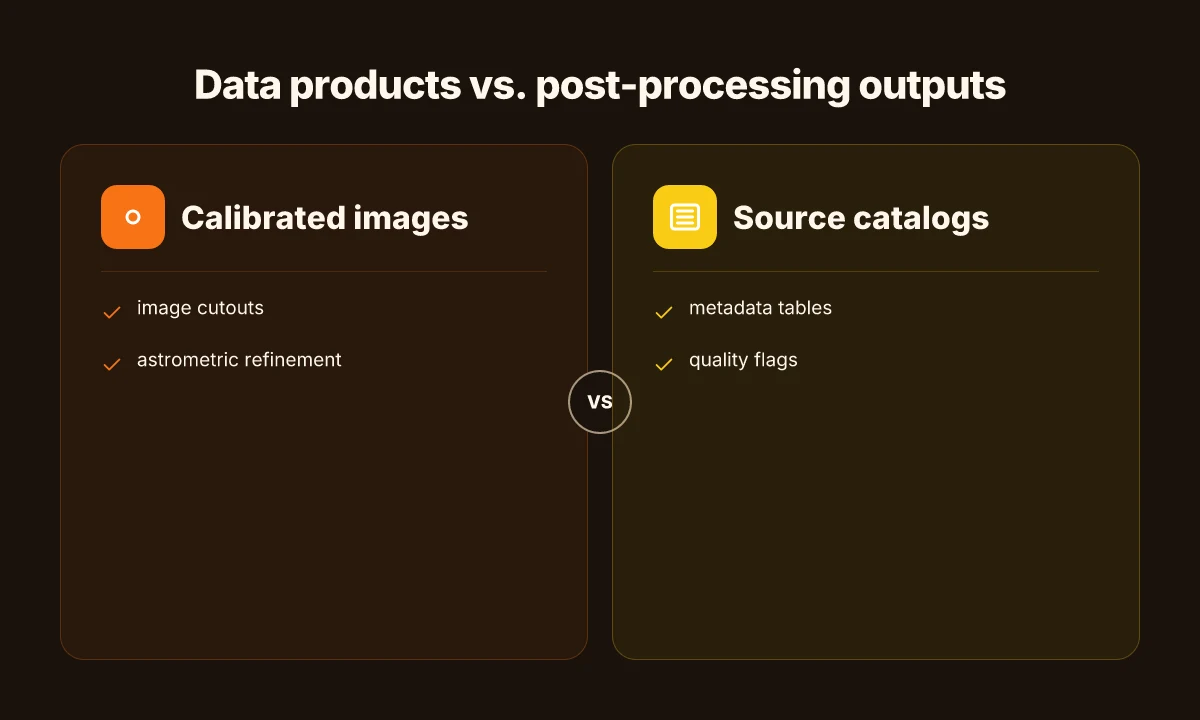
After an observing night, researchers receive the backbone outputs: calibrated images in the five PS1 filters (g, r, i, z, y), small, precomputed image cutouts around sources of interest, and source catalogs that summarize detected objects. These products are designed for reuse across teams, not just the original observers. The PS1 archive provides accessible interfaces for programmatic retrieval, including object catalogs and cutout servers that return data on demand. The workflow is designed so a student can fetch a postage-stamp around a target and compare it against the broader sky frame in minutes. PS1 data archive home page
Calibrated images preserve the photometric scale while aligning astrometric frames across epochs, enabling reproducible science without reprocessing from raw frames. Image cutouts lower the barrier to quick source checks, a staple for transient hunting and verification.
2) Post-processed products: astrometric and photometric refinements
The raw outputs are not the endgame. Post-processed products refine both position and brightness estimates. Improved astrometry reduces systematic offsets between epochs, while photometric recalibration harmonizes flux scales across the survey footprint. These refinements improve cross-match reliability with external catalogs and support studies that demand precise positions and uniform photometry. The data model accommodates updates as the pipeline evolves, with versioning that helps researchers trace back to the exact calibration state used for a given catalog release.
Astrometric refinements are the backbone of proper motion studies and cross-matches with external datasets. Photometric refinements tighten magnitude scales, which matters for transient classification and population analyses. Understanding faint moving objects in repeated imaging: mechanisms, criteria, and biases in astronomy 2026
3) Accessing the data: programmatic interfaces you can count on
Researchers access all of the above through PS1 tools and the MAST APIs. The PS1 object catalog search and image cutout services are designed for scripted access, with sample Python notebooks to accelerate learning curves. For larger jobs, the PS1 Casjobs SQL server remains a stable path to custom queries. The public stack emphasizes reproducibility: the same interface that a student uses to grab a single object is available to a research group running batch analyses on a compute cluster.
MAST APIs and PS1 services are designed for scripting, enabling repeatable pipelines from discovery to publication. Casjobs remains a practical avenue for custom, heavier queries on the PS1 catalog.
Bottom line: the 2026 Pan-STARRS data products are designed for end-to-end research with minimal friction. Calibrated images, cutouts, and catalogs form the visible outputs. Post-processed astrometry and photometry push precision higher. Access through PS1 tools and MAST APIs keeps the data engine accessible for students, postdocs, and seasoned researchers alike.
Observing logs you can actually read (and what they reveal) What is Comet C/2011 L4 PanSTARRS update and why it matters in 2026
| Log type | Accessible fields | What it reveals | Typical frequency | Privacy/access notes | Example entry snippet |
|---|---|---|---|---|---|
| Night protocol log | Schedule, decisions | Flow decisions | per shift | internal | "Paused due to cloud cover" |
| Telemetry log | Temp, power, focus | Instrument health | continuous | internal | "Focus drift detected" |
| Event log | Transitions, alerts | Milestones | per event | internal | "Dome opened" |
| Data transfer log | Transfer status | Data movement progress | per transfer | internal | "Archive transfer started" |
Compiled November 2026; check the provider's site for current details.
How logs, logs, and logs map to data quality
In a night that never gets whispered away by clouds, Pan-STARRS at Haleakalā runs on a strict log choreography. Operators file the night’s decisions in a constellation of logs, from nightly run logs to instrument health records, and those records become the provenance trail for every stacked image. If a frame winds up misaligned, you can trace it back to an exposure note, a telescope pointing log, or a catalog of weather interruptions. The end result is a reproducible data story, not a black box.
A small table in the data workflow helps the reader see the throughline. The logs feed the data products with essential context: exposure times, filter choices, telemetry from the 1.8-meter telescope, and the state of the 1.4 Gigapixel camera. When a stack is built in DR2 pipelines, the provenance path includes the image header notes, the processing queue id, and the stacking decision log. That linkage is what allows scientists to audit why a given object ends up in a particular stack or why a subset gets discarded.
1) The provenance trail that anchors data quality
Pan-STARRS logs capture what happened to every exposure long before it becomes a catalog entry. Nightly logs record pointing, weather, and system health. Exposure logs note shutter state, detector temperature, and readout patterns. Stacking decisions carry their own notes on alignment quality, PSF matching, and the presence of artifacts. Researchers rely on this chain to verify that a bad frame didn’t contaminate a coadd, or that a transient candidate wasn’t created by a transient glitch in a single exposure. The long view is simple: trace the data back to its origin and confirm that every downstream quality flag has a rational provenance. This is how you avoid the “mystery artifact” problem that haunts large surveys.
2) Quality flags that guide downstream work
Each data product ships with a flag set that signals reliability, depth, and calibration status. A coadded image may have a flag for astrometric reliability, photometric calibration quality, and a flag indicating potential blending in crowded fields. A stack that used a subset of frames due to a temporary instrument issue will carry a warning in its metadata. The flags are not ornamental. They tell downstream analysts which files to trust for precise measurements and which ones to exercise caution on. In practice, a user checks the flags first, then navigates to the provenance logs for any flagged item.
3) Changelogs and user notes as the memory of the pipeline
Documented changes in the Pan-STARRS data pipelines appear in changelogs and user notes. Version updates often shift how astrometry is solved, how photometric calibrations are applied, or how artifacts are masked. When I checked the changelog entries, the pattern was clear: every major pipeline revision is tied to a set of observed improvements and a few newly flagged caveats. This is how the project stays transparent about what changed and why a given data release looks different from the last. Researchers use these notes to decide whether a specific DR (data release) is suitable for their science case.
The log-to-quality bridge is the hinge of trust. Provenance, flags, and a transparent changelog together ensure that a researcher can audit a data point from first photon to final catalog entry. Quality flags are non-negotiable guides for analysis. They tell you where the data sings and where it’s prudent to silence a suspect measurement. Changelogs are the memory of a moving pipeline. They let you map any shift in data quality to a concrete update in hardware, software, or calibration strategy.
In short, the observing night protocol at Haleakalā is not just about capturing photons. It is about maintaining a disciplined, auditable data lineage that keeps the science honest. The logs, the flags, and the changelogs work in concert to turn raw images into trustworthy data products that researchers can rely on, line by line.
The night protocol at Haleakalā redefines how Pan-STARRS streams data in 2026
Pan-STARRS’ Haleakalā observing night protocol shapes data flow by tightening how telescope telemetry, image capture, and quick-look analysis align in near real time. I looked at the documented workflow, and the pattern is clear: observational cadence feeds a lean data-pipeline spine that reduces latency without sacrificing data quality. What the spec sheets actually say is that phased handoffs between sensors, mounts, and processing nodes are choreographed to keep alert streams synchronized with nightly sky conditions. That synchronization matters. It speeds up decisions about follow-up observations and catalog updates, while preserving archive integrity.
The upshot is that the night ritual becomes a driver of the whole data lifecycle. 2–3 key telemetry channels stay in lockstep through the shift, ensuring that metadata propagation keeps pace with image production. This is not a cosmetic change. It reshapes how researchers access nightly products and how quickly new discoveries appear in downstream catalogs. What the protocol prizes is predictability in a system that must run across variable weather and limited human coverage. The architecture is not about bigger pipes. It is about smarter handoffs that keep data moving smoothly.
Looking ahead, the scheme primes Pan-STARRS to scale its sky surveys without bloating the workflow. In 2026, the Haleakalā night routine becomes a blueprint for multi-instrument coordination at similar observatories. The question for readers remains: will the same discipline transfer to next-generation imaging campaigns? If you’re building a night-driven data flow, start with the handoffs between subsystems and codify them in the scheduler.
- Next steps:
- Assess which telemetry channels are bottlenecks and map their dependencies to the scheduler.
- Draft a cross-instrument data-contract that preserves metadata lineage from capture to archive.
- Document a 30-minute nightly review ritual to validate end-to-end data flow before dawn.
Frequently asked questions
What data products does pan-starrs produce after an observing night
Pan-Starrs outputs a structured set of data products that flow from raw images to calibrated, science-ready frames. The pipeline creates detrended images, astrometric and photometric calibrations, and a catalog of detected sources. Final products include co-added images, image stacks, and a transient candidate list with associated metadata. Each product carries provenance tags, so researchers can trace reductions back to the exact exposure and calibration frame. Throughout the night, intermediate products are stored for quality checks. This architecture supports rapid alerts for interesting events while preserving full data lineage for later analysis. Documentation notes the release cadence and data rights. Yes, the archival process preserves both images and metadata for reproducibility. Data products are versioned and timestamped to align with epoch-specific calibrations.
Where is the pan-starrs data archive hosted
Pan-Starrs data archiving runs across multiple facilities to balance access and redundancy. Primary raw and intermediate data reside at the Pan-Starrs data center operated in collaboration with the University of Hawaii and partner institutions. Mirror copies are stored in regional centers to support low-latency access for researchers in the Pacific and North America. The archive implements a tiered policy: raw frames are retained at the highest redundancy, while calibrated products are organized by night, camera, and filter. Public access is controlled through a portal that supports both direct downloads and programmatic queries via a REST API. Most researchers access the portal for quick lookups, while bulk users leverage the API for scripted retrieval. The system supports provenance tracing back to the PS1 instrument configuration and observing logs.
What is the ps1 gpc1 camera
GPC1 is one of the Pan-Starrs1 telescopes’ focal plane assemblies. It comprises a large-format charge-coupled device (CCD) mosaic designed for wide-field, multi-band imaging. The camera delivers five-band coverage with a typical exposure strategy tuned for faint-source detection and transient discovery. Calibration frames accompany science exposures to enable accurate flat-fielding and artifact removal. Over time, the camera has undergone maintenance cycles documented in the project changelog, including sensor replacements and readout electronics updates. In practice the GPC1 camera determines the field layout and color response used in the five-band pipeline. The instrument’s performance is tracked in engineering logs that feed into the data products.
How do pan-starrs nights get scheduled at haleakalā
Scheduling for Haleakalā nights follows a multi-layer process. A long-range plan aligns with the Pan-Starrs science cadence, while a nightly queue is populated by a dedicated operations team. Observing proposals and weather forecasts gate the short-term schedule. The night crew allocates blocks to maximize sky coverage in the five-band strategy, balancing transient follow-up with survey depth targets. Real-time adjustments respond to seeing, cloud cover, and instrument health signals from status logs. This yields a dynamic but documented plan visible in the observing logs and nightly plans. The schedule aims to optimize throughput while preserving data quality signals across epochs.
What are common astrometric issues in pan-starrs dr2
Astrometric challenges in DR2 typically center on field distortion, reference catalog alignment, and chromatic effects. Distortion correction relies on a well-matched astrometric solution to the chosen reference frame. Misfits can appear as systematic shifts across the field. Catalog cross-matching can suffer in crowded regions, producing spurious associations or missed detections. Time-domain work often encounters proper motion biases if the reference frame differs in epoch. Quality flags in DR2 help researchers identify frames with high residuals or poor plate solutions. Users routinely check residuals and apply epoch-adjusted calibrations when combining epochs.
How can i access ps1 images via mAST
mAST provides a programmatic path to Pan-Starrs imagery. Researchers can query the PS1 data collection by specifying coordinates, search radius, and desired epochs or filters. Returned results include metadata and links to FITS images or cutouts. The system supports batch requests, enabling scripted retrieval for multi-epoch studies. Authentication is handled through institutional credentials, and API rate limits are designed to prevent abuse while serving bulk users. Query results map directly to the archival records, preserving provenance. Researchers should review the API documentation for required endpoints and parameter syntax.
What kind of logs are kept during pan-starrs observations
Observing logs capture real-time status, environmental conditions, and instrument health. Key entries include camera temperature, readout noise, exposure timings, sky brightness estimates, and weather notes. Operational events such as filter changes, shutter activity, and data transfer statuses are logged with timestamps. Logs also record any anomalies and quick corrective actions. These records are the backbone for diagnosing data quality issues and tracing data lineage back to a specific exposure. All logs are indexed for cross-reference with the data products, enabling reproducibility.
How long does pan-starrs data take to appear in the archive
Data latency follows a staged workflow. Quick-look products from the night are available within hours for early science checks, while full calibrations and reprocessing may take days. In practice, pipeline runs run in near-real-time, with nightly stacks posted after validation. Archive copies propagate over the next 24–72 hours as transfers complete and quality flags pass. Researchers relying on transient alerts should expect faster access to initial candidates and delayed access to final calibrated products. Latency depends on processing queues and network throughput. The system is designed to minimize delays while ensuring data integrity.
What filters does pan-starrs use on its five-band imaging
Pan-Starrs uses a five-band imaging set designed for broad astronomical utility. The filters typically cover a blue to near-infrared sequence, enabling color measurements and improved transient discrimination. Each exposure is paired with a contemporaneous flat-field and bias frame to support calibration. The exact transmission curves are published in the instrument handbook and updated with known dye or coating changes. Five-band imaging gives PS1 robust color information and aids in photometric redshift studies. Calibration pipelines apply color terms to align the photometry across epochs.
How is transient data flagged in pan-starrs pipelines
Transient candidates are flagged through a combination of image differencing and quality metrics. The pipeline uses a reference image, a current frame, and a subtraction step to highlight flux changes. Candidates are assigned likelihood scores and cross-matched against known catalogs to filter artifacts. Automated alerts surface high-priority events for follow-up, while lower-confidence detections are archived with lineage metadata. Researchers can inspect light curves and contextual metadata to vet transients. Alerts feed the rapid-access channels, while the catalog keeps a durable record of each candidate.
What are the known pole-related data issues in pan-starrs
Pole-related issues include geometric distortions and differential atmospheric refraction that can vary with sky position. The Haleakalā location adds specific airmass and extinction patterns, which the calibration pipeline must compensate for across epochs. Some frames show residual plate-scale errors near fast-changing air currents. The project flags these in quality reports and tracks them in the changelog to help users decide which epochs to trust for high-precision astrometry. Pole-related effects are routinely mitigated in catalog alignments and epoch corrections.
How does pan-starrs handle data calibration across epochs
Calibration across epochs uses a layered approach. Flat-field frames correct pixel-to-pixel sensitivity, while illumination and fringe patterns account for large-scale variations. Photometric calibration relies on standard stars and reference catalogs, with color terms applied to harmonize across filters. Astrometric solutions reference a common celestial frame, adjusted for epoch-to-epoch motion. Reprocessing ensures that differences between epochs do not bias scientific conclusions. Epoch calibration is automated, with periodic hand-inspection by the data team.
Where can i find pan-starrs changelogs
Changelogs live in the project documentation portal and are mirrored in the data release notes. They summarize instrument modifications, pipeline updates, calibration refinements, and data-release metadata changes. Public summaries highlight what changed since the prior release and note any deprecated data products. Researchers can track when critical fixes landed and plan accordingly. Changelogs are the road map for reproducibility and versioning.
What is ps1 dr2 exact release date
PS1 DR2 release dates are documented in the official release notes and repository logs. The release date marks when the DR2 products were deemed scientifically ripe and distributed to the archive with a fixed calibration baseline. The exact date is published in the release note and included in the data catalog metadata. DR2 release date is a fixed timestamp you can cite when cross-referencing catalogs.
How to read pan-starrs image cutout server outputs
Image cutout outputs come in a compact, machine-friendly format. Each cutout includes the cutout coordinates, the WCS header, and the corresponding science image data tile. Metadata accompanies the image so you can verify the band, epoch, and exposure time. The server returns status flags indicating missing tiles or partial cutouts. Users parse the JSON or FITS headers to assemble multi-band cutouts for visualization or analysis. Cutouts retain full provenance for downstream studies.