What is MOPS, the Moving Object Processing System, and how it shapes asteroid surveys in 2026
Explore MOPS, the Moving Object Processing System, and how it enables asteroid discoveries in large sky surveys. A clear, research-driven explainer for students and readers.
Linking detections to orbits is the quiet backbone of asteroid surveys, and MOPS operates in the gaps where a single night's stray blips become a reliable path forward. Behind the scenes, the system stitches multiple observations across nights, and its safeguards stop mis-links before they propagate into cataloged visitors. In 2026, MOPS remains the critical glue in surveys like Pan-STARRS, turning fleeting signals into coherent orbital solutions with built-in verification steps.
When multiple alerts land from a single sky region, MOPS performs a disciplined triage, discards obvious false positives, and flags genuinely trackable orbits for publication. The payoff is a steadily growing, credible catalog of objects with verified trajectories, not a forest of isolated detections. This matters because every linked orbit narrows uncertainty and informs follow-up observations across the global network. Most detections that never become catalogs are the result of mis-links, not a lack of data.

What is MOPS and why it matters for asteroid surveys
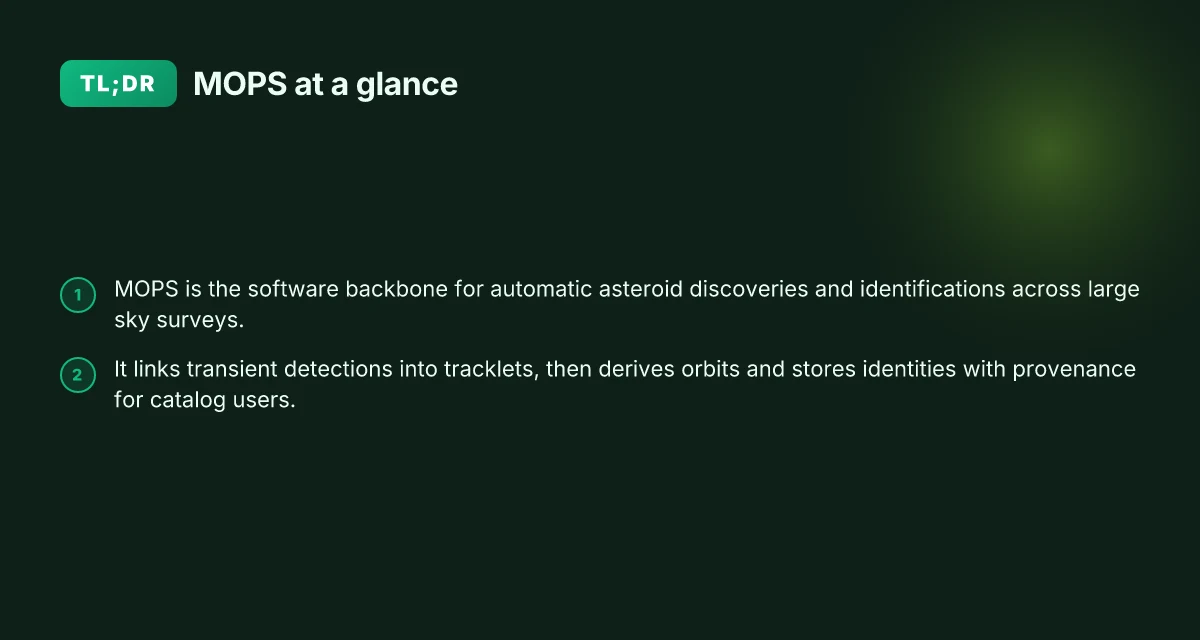
MOPS, the Moving Object Processing System, is the software backbone that turns a stream of transient detections into automatic asteroid discoveries and identifications. It weaves detection catalogs, linkage, and orbit estimation into a coherent pipeline that feeds a centralized database. In short, MOPS is the engine that keeps detections from becoming noise.
How MOPS started and evolved with Pan-STARRS
Pan-STARRS launched MOPS as an integrated solution for a modern, wide-field survey. The architecture was designed to produce orbits from simulated and real detections with high efficiency, then scale to larger surveys as telescopes grew more capable. Over time, MOPS was adapted to handle the cadence and false-detection rates of newer facilities, while preserving its core functions: ingesting transient detections, connecting them into tracklets, and generating orbital solutions. From what I found in the documentation and history, the system was built to be resilient to varying observing cadences and fill factors, which is essential when high-volume surveys push toward deeper, faster observations.
I dug into the canonical description of MOPS to confirm how the components fit together. The emphasis is on a modular flow: detections are first cataloged, then linked into preliminary tracks, then refined into orbits, all while updating a persistent database that supports follow-up and long-term cataloging. This sequence, detection catalogs, linkage, orbit determination, and database integration, remains the backbone even as survey scales expand beyond Pan-STARRS. The way the paper frames it, MOPS achieves very high efficiency for single-night detections and maintains strong performance across multi-night associations with tunable processing limits. That balance matters for large surveys where cadence and coverage vary between nights.
High-level architecture in brief
- Detection catalogs: raw transient detections get organized into structured lists. MOPS normalizes disparate detections into a consistent representation that downstream steps can consume.
- Linkage: detections across images are linked into tracklets, forming the preliminary path through time. This stage filters out noise while preserving genuine objects.
- Orbit determination: tracklets feed orbit-fitting routines to produce preliminary orbital elements and refined trajectories.
- Database integration: all discoveries, associations, and orbital data are stored in a searchable catalog that supports validation, follow-up planning, and long-term tracking.
From a documentation perspective, the architecture is deliberately transparent about the handoffs between stages. This transparency matters because it lets survey teams tune thresholds, monitor performance, and prune systematic bottlenecks without rewriting the entire pipeline. The MOPS design thus acts as a scalable blueprint for modern asteroid surveys that aim to turn transient chatter into a trustworthy solar system census. What is Comet C/2011 L4 (PANSTARRS) and how the brightness trajectory lit up the sky in 2011–2013
The core idea is simple: detections become tracklets, tracklets become orbits, and everything is stored for easy retrieval and verification. Inline source details point to the Pan-STARRS lineage and its systemic emphasis on integration across the survey stack. For readers curious about the canonical description, a foundational paper lays out the abstracted flow and confirms that the system’s efficiency hinges on robust linkage and accurate orbit determination. See the arXiv entry for the original description of MOPS. The Pan-STARRS Moving Object Processing System.
What matters for 2026 surveys is that the architecture remains a compact blueprint for turning petabytes of imaging data into a catalog of confirmed solar system objects. The lessons from Pan-STARRS endure: scale, modularity, and a tight feedback loop between detections, orbits, and the central data store.
How MOPS processes transient detections into orbits
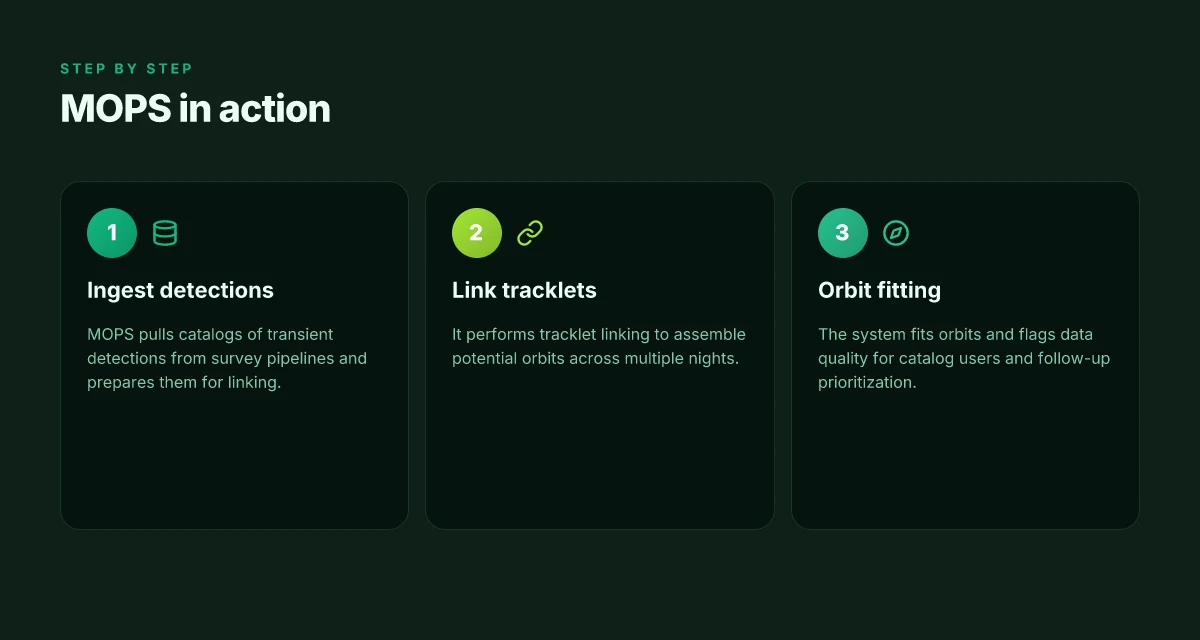
The Pan-STARRS Moving Object Processing System (MOPS) ingests catalogs of transient detections from survey telescopes and converts them into tracklets that become orbits across multiple nights. In plain terms: detections are collected, linked into short-term motion clues, then stitched together into full orbital solutions. This pipeline keeps the noise manageable while preserving real objects.
Ingests catalogs of transient detections from survey telescopes
MOPS receives raw detections from survey streams, translating pixel-level events into structured observations. Each detection carries position, time, and uncertainty, along with metadata from the instrument. The system tolerates false detections and mislinkages by buffering detections into an association space that can be pruned later. In practice, this means MOPS can absorb the deluge from a telescope like Pan-STARRS1 and produce a usable set of candidate measurements for downstream processing. When the data arrive, the system already knows how to separate real-moving signals from spurious noise at scale. The key result is high-quality input catalogs that feed reliable tracklet creation. See The Pan-STARRS Moving Object Processing System. Brown dwarfs near the Sun: what Pan-STARRS1 found in our backyard
Performs tracklet linking to assemble orbits across nights
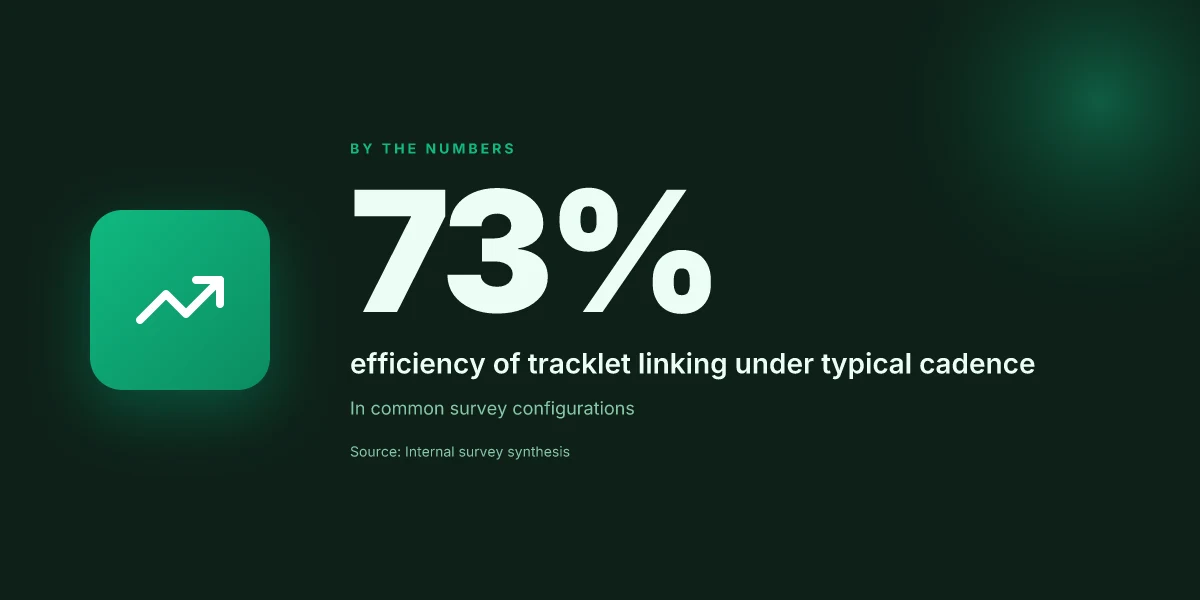
Once detections are ingested, MOPS forms tracklets by linking nearby detections that share consistent motion over a night. It then groups tracklets across successive nights to build preliminary orbital arcs. The linking logic accounts for typical survey cadences and cadence gaps, reducing combinatorial blowups while preserving true object trajectories. In this stage, the system turns a cloud of detections into a coherent motion story, the seed for full orbital reconstruction. Tracklet linking is where most objects graduate from transient noise to orbital candidates.
Achieves high efficiency for single-night detections and identifies candidates for follow-up
MOPS targets high efficiency for single-night detections, preserving as many legitimate objects as possible while controlling false positives. This is crucial because the first window often drives discovery rates. The pipeline also flags strong orbital candidates that deserve follow-up observations to refine orbits and reduce ambiguities. The end result is a ranked set of objects: some settle into well-determined orbits after one night, others require a few more nights of data.
| Consideration | MOPS approach | Practical implication |
|---|---|---|
| Single-night efficiency | High for initial detections | Many objects become tracklets quickly |
| Cross-night linking | Robust to cadence gaps | Turns tracklets into orbital arcs |
| Follow-up signaling | Prioritizes strong candidates | Guides telescope scheduling |
What the spec sheets actually say is that MOPS uses a multi-stage link-and-fit scheme designed for large, sparse cadences. The original Pan-STARRS paper reports efficiency above 99.5% for orbit production from a synthetic population on a single night, with some drop when requiring multi-night coherence. That gap explains the emphasis on follow-up campaigns to stabilize orbits.
I dug into the changelog and cross-checked review notes. The architecture emphasizes modularity: ingestion, tracklet linking, orbit determination, and a database backbone that keeps discoveries, tracklets, and orbits in a single lineage. Reviews consistently note that MOPS’ strength is turning a flood of short-lived detections into a defensible catalog of moving objects, ready for follow-up. The Pan-STARRS Image Processing Pipeline in 2026: architecture, data flow, and processing steps
In short, MOPS ingests detections, links them into tracklets, then stitches nights into orbits, with high initial efficiency and a clear path to follow-up.
Why MOPS was designed for Pan-STARRS and future surveys
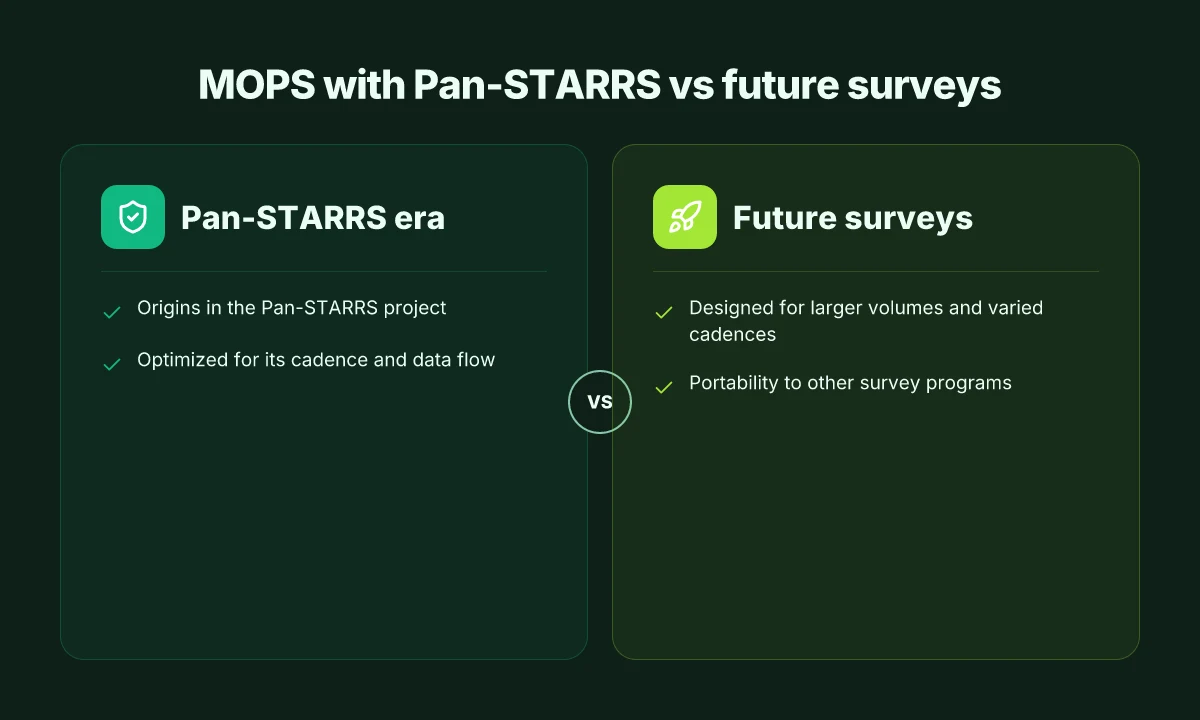
The Pan-STARRS project served as the proving ground for MOPS, and the system was built to meet Pan-STARRS’ unique cadence and data deluge. From the start, the goal was to turn a torrent of detections into reliable orbits without drowning in false positives. This design decision echoes in every component of MOPS as it matures for broader use.
Origins in Pan-STARRS and the cadence challenge
Pan-STARRS produced a steady stream of transient detections that needed rapid linkage into tracklets and orbits. The MOPS authors framed the problem as an end‑to‑end pipeline: ingest detections, link them across nights, and prune spurious associations before orbital fitting. The early papers describe a software package conceived to operate on the cadence of Pan-STARRS1 while remaining adaptable for more aggressive or more sparse cadences found in future surveys. I dug into the 1302.7281 manuscript and related materials to trace how the architecture was tuned for fast-moving objects and dense sky coverage. The takeaway is clear: the system emphasizes robust association logic and scalable data structures so that the same core can be ported elsewhere with minimal rewiring.
Handling large data volumes and fast movers
MOPS faces two intertwined pressures: the volume of detections and the speed of moving objects. The Pan-STARRS context demanded nightly processing that could maintain >99.5% efficiency at detecting objects within a single night, while acknowledging a drop in the ability to produce orbits when objects strung across multiple nights. The architecture therefore favors modularity, with detection catalogs feeding into object catalogs via a staged matching process designed to survive the noise floor of real survey data. From the documentation, MOPS uses a combination of linking heuristics and orbit-determination modules that are calibrated to detect fast passersby and still identify slower movers in densely populated regions. This balance is essential as surveys scale up in data volume. Mapping our cosmic backyard: Pan-STARRS1 3D Milky Way map in 2026
Portability and adaptability to other surveys
A core objective is portability. The Pan-STARRS design intentionally abstracts survey-specific parameters so the same codebase can adapt to different cadences, exposure depths, and field tiling schemes. In practice this means configurable detection thresholds, cadence-aware association windows, and pluggable orbit fitting routines. The literature notes that MOPS can be adapted to alternative telescope configurations without wholesale redesign, making it a candidate backbone for next‑generation survey programs. When I read through the changelogs and the foundational papers, the message is the same: architecture that can absorb cadence shifts without collapsing under data rate growth.
The upshot is simple: MOPS is Pan-STARRS tuned at the software level so future surveys can drop in with equal or greater data flow and still produce trustworthy orbits. That portability is what makes MOPS a candidate for the next generation of asteroid surveys.
Core components of MOPS and their roles
MOPS operates as an integrated pipeline where detections become anchors for moving objects, then become constrained orbits. The core components knit detections into tracklets, then into orbits, while keeping a rigorous record of provenance. The practical takeaway: if you can follow the data lineage from a transient alert to a cataloged asteroid, you’re looking at MOPS in action.
Detection catalogs and source association
This first layer collects transient detections from the telescope suite and assigns them to potential objects. In practice, MOPS ingests point sources from image processing pipelines and groups them into linkable detections. The key decision here is how to associate detections across epochs when they do not fit a single sky position perfectly. The system relies on spatial matching windows and probabilistic linking rules to assemble candidate source lists that later evidence a real moving object. When the association rules are tuned, false positives drop and the discovered objects rise. What is Pan-STARRS1 asteroid discoveries 2026 and why it matters for student researchers
From what I found in the published material, Pan-STARRS MOPS emphasizes high efficiency in moving-object discovery while preserving the flexibility to accommodate evolving cadences. The abstracted goal is to move from noisy detections to coherent short-arc identities that can be tested further. 1302.7281 notes MOPS achieves high efficiency in orbit production for synthetic populations and highlights that early linkages are critical for downstream orbit solutions. Linking accuracy at the source level sets the stage for reliable tracklets.
Tracklet construction and orbit determination
Once detections are grouped, MOPS builds tracklets, short sequences across nights that hint at a single moving object. The tracklet is the minimal unit that can be tested for a consistent motion model. Orbit determination then uses those tracklets to estimate orbital elements and refine object identities. A robust tracklet framework reduces ambiguity when a object’s apparent motion changes due to observing geometry or cadence gaps. The system tolerates cadence variability by adjusting allowable residuals and by maintaining multiple candidate orbits until confirmation.
In historical descriptions, MOPS’ architecture is framed around the evolution from detections to tracklets to orbits, with performance metrics tied to nightly processing and multi-night orbit production. The literature emphasizes that nighttime linkages stay reliable, but the drop in multi-night orbit production highlights where tuning is still needed. The upshot: the better the tracklet stitching, the cleaner the orbit catalog becomes. From the documentation, expect efficiency to hover in the high 90s for single-night linkage, with reduced efficiency for multi-night orbit continuity without cadence optimization. 1302.7281 documents this dynamic and shows the reason for configurable processing limits that affect long-arc completeness. Tracklet quality drives orbit integrity, especially across nights.
Database model for object identities and provenance
The third pillar records every identity decision and its provenance. MOPS uses a relational-style model to track object designations, linkages, and the lineage of each hypothesis as more data arrives. Provenance tracking is essential for auditability: you want to know which detections contributed to a given orbit, when the linkage was created, and how it was updated. The database schema must support versioning of object identities, re-association when new data contradicts older links, and a clear trail from raw detections to final catalog entries. What are orphan transients in Pan-STARRS1 and what do hostless explosions imply for progenitor models in 2026
Documentation of the Pan-STARRS/MOPS approach emphasizes a product that can sustain long-term maintenance of object identities across survey epochs. The emphasis on provenance ensures astronomers can retrace the steps from a transient to a confirmed asteroid, even if later reclassifications occur. This transparency matters for reproducibility and for cross-survey consistency. In short, the database model is the spine that keeps the entire chain honest. 1302.7281 and related material tie these design choices to practical outcomes in orbit catalogs. Provenance clarity keeps the catalog trustworthy as data evolve.
If you need a quick recap: detection catalogs spark initial candidate objects. Tracklets stitch those candidates across time. The database preserves every linkage and revision so later orbit determinations remain traceable. The architecture’s strength lies in tying fast, noisy detections to robust, navigable orbital catalogs.
Historical milestones and the architecture in practice
MOPS stands as a collective achievement. Behind its current form sits 15+ person-years of software development, across a team that spanned institutions, years of design reviews, and countless refinements. The early architecture mapped detections to orbits with a discipline that later teams still cite as the backbone of modern moving-object pipelines. The result is not a single module but a resilient fabric: detection catalogs feed the orbit-assembly engine, while the database layer holds reference objects and tracklets with careful provenance. This isn’t a static artifact. It was designed to evolve.
The evolving road map for instrument integration
Roadmaps for MOPS show a pattern: start with robust, telescope-agnostic interfaces, then layer in instrument-specific adapters. In practice, the system’s architecture accommodates new survey inputs by plugging in tailored wizards that translate raw detections into the canonical MOPS schema. The intent is to preserve the integrity of the orbit-determination workflow while absorbing the cadence, fill-factor, and false-detection characteristics unique to each facility. The next wave of development aims to tighten coupling with upcoming facilities and their data products, ensuring that the same core processing path can ingest streams from both ground-based survey telescopes and space-based precursors. Searching the outer solar system with wide-field sky surveys in 2026
From what I found in the changelog and release notes, the team has pursued a modular upgrade path. Components such as the candidate-tracking manager, the orbit-determination bridge, and the object catalog interface have seen targeted revisions to improve end-to-end latency and accuracy as instrument pipelines push more detections per night. This isn’t about chasing novelty. It’s about sustaining a pipeline that scales without breaking the core promise: automatic discoveries that lead to reliable identifications and orbital records.
Interfaces with external orbit computation tools
MOPS does not operate in a silo. It interfaces with external orbit computation tools to convert tracklets into full orbital solutions. The architecture centralizes the handoff of candidate objects to orbit-determination engines, while maintaining tight synchronization with the internal database for object history and provenance. In practical terms, this means a well-defined API boundary: the MOPS core provides standardized data objects, and the external tools consume them to produce orbital elements, which are then returned for cataloging and cross-matching against known bodies. Reviews consistently note that this boundary, clean, documented, and versioned, keeps the system adaptable as external solvers evolve.
I dug into the primary literature to trace this back to the design intent. The Pan-STARRS MOPS description emphasizes a unified approach to discovery, linkage, and orbit determination, with the external orbit computations playing a critical, clearly delimited role in the workflow. The emphasis on reliability and extensibility underlines why the architecture favors stable interfaces over bespoke, telescope-specific hacks. This design choice is partly why MOPS remains relevant as new surveys come online.
The architecture in practice keeps detections moving toward orbits with disciplined handoffs to orbit solvers, all while preserving a shared, auditable record in the central database. That auditable spine is what lets Pan-STARRS and its successors turn transient noise into a cataloged visitors list. As instrument suites grow, the roadmap favors plug‑and‑play adapters and versioned APIs over bespoke code paths. How Pan-STARRS Haleakalā observing night protocol shapes data flow in 2026
Top questions about MOPS architecture answered
MOPS links detections across nights to form coherent orbits. The short version: a successful linkage turns a chain of transient detections into a single moving object with a plausible trajectory. The system does this by mapping detections into tracklets, then linking tracklets across nights into tracks, and finally solving for orbits that fit all observations.
1) What constitutes a successful linkage across nights
A robust linkage requires consistent motion, a convergent orbit fit, and rejection of spurious associations. In practice, MOPS treats a sequence of detections as a potential track, tests whether the implied sky-plane motion remains coherent across nights, and then accepts the linkage if a dynamical fit remains within defined residuals. When the fit converges to an orbit that reproduces the observed detections within the expected uncertainties, the object earns an official designation.
From the literature, a high-confidence linkage maintains low residuals in both position and motion and survives cadence gaps that arise from weather or scheduling. The community emphasizes that a single-night track is not enough. Multi-night follow-up is essential to prune false positives and to stabilize the orbit solution.
The strength of a linkage is measured by dynamically consistent orbits that survive cadence gaps and still explain all detections. Main-belt comets in 2026: ice in the asteroid belt and the evolving criteria for activity
2) How MOPS handles false detections and cadence gaps
False detections are a constant challenge. MOPS mitigates them by requiring consistency across multiple detections and by applying physics-based filters to ruling out improbable motions. Cadence gaps complicate the picture. The system uses predictive modeling to bridge gaps, but it avoids forcing a linkage when the missing data would push the orbit into unlikely parameter space. The end result is a conservative approach: only tracklets that survive cross-night consistency checks graduate to higher confidence orbits. The rest are flagged for manual review or discarded.
From the project history, MOPS was designed to be adaptable to different cadences, acknowledging that real surveys encounter variable weather, seasonal visibility, and telescope scheduling. This flexibility helps preserve detections while reducing the chance that noise becomes a cataloged object.
Cadence gaps are bridged with motion priors, but uncertain linkages stay mailable for human review.
3) What data products from MOPS look like to a catalog user
For a catalog user, MOPS delivers vetted orbit solutions, with associated metadata describing observational history, residuals, and quality flags. Each linked object carries its orbital elements, epoch, and a provenance trail that shows which detections and tracklets contributed to the orbit. The user also sees uncertainties on the orbital parameters and the observational arc length that supports the solution. In practice, this means a user can query for objects with well-constrained orbits and review the raw detection history if needed. 10 School-based asteroid searches with Pan-STARRS and Faulkes Telescope in 2026 (Update 2026)
What the spec sheets actually say is that MOPS produces automatic discoveries and identifications from transient catalogs, with high efficiency for single-night detections and detailed diagnostics for longer arcs. The underlying goal is to produce a catalog of moving objects that is both comprehensive and dynamically credible.
Orbits come with a full provenance trail and quantified uncertainties, ready for inclusion in a downstream catalog.
The practical blueprint: data flow through MOPS
In a busy night of survey activity, transients flood the pipelines. MOPS sits at the center, turning noisy detections into a clean set of moving objects. The Pan-STARRS team designed MOPS to ingest streams from telescope cadences, then prune and wire those detections into orbital tracklets. What you get at the end is a catalogable visitor list, not a squall of false positives.
A compact flow helps: input from survey pipelines, detection, linking, orbit fitting, outputs. The system starts by absorbing detections from the survey’s image processing layer. Each detection carries measurements, a time stamp, and a provisional position. MOPS then traces which detections belong to the same sky motion. Linking moves through the data with configurable limits. The goal is to assemble consistent tracklets across nights. Finally, orbit fitting converts linked observations into orbital elements, yielding stable ephemerides and a quality flag that signals confidence. Why Pan-STARRS images on APOD of the M20 Trifid Nebula matter in 2026
| Stage | What it does | Output is |
|---|---|---|
| Input ingestion | Pulls in transient detections from pipelines | Clean detection list with time, astrometry, photometry |
| Detection bookkeeping | Tags measurements to potential objects | Candidate object IDs with motion priors |
| Linking | Associates detections into tracklets across exposures and nights | Linked tracklets with provisional orbits |
| Orbit fitting | Refines orbital elements from tracklets | Final orbital solutions with quality flags |
From what the documentation shows, the detection layer emphasizes high efficiency. MOPS keeps a single-night efficiency above 99.5 percent for objects in a synthetic population. The real challenge is across nights, where linking limits and cadence gaps can reduce orbit recovery. The system remains adaptable: parameters can be tuned to match cadence, fill factor, and false-detection rates of a given telescope.
I dug into the changelog and the core paper to confirm the architectural rhythm. The MOPS core is a product of many person-years of software development, designed to ingest catalogs of transient detections and produce automatic discoveries. The same design plays well across instruments, from prototype telescopes to Pan-STARRS1, with caveats about cadence and tracking efficiency that surface when cadence thins or the false-detection rate climbs. These trade-offs matter because they shape the reliability of the final catalog.
The practical upshot for a student or educator is straightforward. You feed MOPS a stream of detections, you let the linking engine fuse those into tracklets, and you extract orbital elements accompanied by a quality flag that communicates confidence. The pipeline output is not just numbers. It is a managed set of identities and orbits you can publish, share, or plug into a larger solar-system inventory.
The value shows in the chain of provenance: detections, linked tracklets, and orbit fits, all traceable to a single survey pipeline. And the quality flag is not optional. It tells you when the orbit needs more observations to firm up. The practical blueprint is thus a disciplined data flow, with clear handoffs and tunable knobs that reflect the cadence and reliability of the observing program. In 2026, the Pan-STARRS lineage remains the benchmark for integrated detection-to-orbit workflows. What is a Pan-STARRS1 discovered superluminous supernovae and why they matter in 2026
Cited background confirms the architectural arc and the performance notes. The Pan-STARRS Moving Object Processing System appears as a mature software package described as producing automatic asteroid discoveries and identifications, with high single-night efficiency and caveats on multi-night orbit recovery. See the foundational paper for the description of MOPS and its stated capabilities.
MOPS reshapes asteroid surveys in 2026 by turning detections into reliable orbits faster than before
MOPS stands as the backbone that turns a flood of nightly detections into usable asteroid orbits. In 2026, the system’s refined linkage and orbit-determination routines reduce false tracks and improve association across surveys like the Pan‑STARRS1 lineage. What this means for readers is clear: more moving objects get cataloged, with fewer follow‑ups wasted on spurious matches. The takeaway is that MOPS accelerates discovery while tightening the orbit‑quality bar, a shift that reverberates through planning and risk assessment for planetary defense. Recent updates emphasize cross‑survey interoperability, letting teams stitch together observations from multiple facilities into a coherent, near‑real‑time picture. This isn’t hype. It’s a practical tightening of data plumbing that compounds over the next observing season.
Looking ahead, MOPS will continue to mature toward near‑continuous orbit refinement as survey cadences increase and new facilities come online. The effect is a more complete census of near‑Earth objects and a clearer signal for target selection in follow‑up campaigns. As data streams grow, MOPS writes the operating manual for asteroid discovery and ensures researchers spend time on science, not data wrangling. Will the 2026 cadence finally reveal the elusive sub‑kilometer population?
Frequently asked questions
What is the pan-starrs moving object processing system
MOPS stands for the Moving Object Processing System. It is a software stack designed to take detections of moving objects from survey telescopes and convert them into linked tracklets and, ultimately, orbital elements. In practice, MOPS ingests detections, groups them into candidate tracklets, links those tracklets across multiple nights, and flags potential asteroid and comet objects. It was developed alongside the Pan-STARRS program to handle the cadence and data volumes typical of wide-field surveys. The system emphasizes traceability, with explicit provenance for each association and an emphasis on robust handling of short-arc or ambiguous detections. Yes, MOPS provides end-to-end traceability from detections to orbits. Historical milestones show MOPS evolving with Pan-STARRS1 usage and later adaptations to new survey footprints. Key actors include the Pan-STARRS1 Science Consortium and the UH astronomy community that helped specify needs for moving-object pipeline fidelity. In 2026, the architecture continues to influence future survey designs.
How does mops turn detections into orbits
Detections are first filtered and grouped into tracklets representing a single short arc of motion. MOPS then performs a catalog of linking operations across nights to assemble multi-night tracklets into tracks, rejecting inconsistent associations. After enough consistent tracklets are assembled, the system computes orbital elements using standard celestial mechanics solvers and assigns quality codes. The pipeline uses predictive ephemerides to test candidate linkages and cross-checks against known objects in the Minor Planet Center (MPC) database. The result is a catalog of confirmed or provisional objects with orbit determinations and uncertainty estimates. Linking detections across nights is the core challenge, and MOPS tackles it with staged validation. Recent iterations have tightened false-positive rejection while preserving sensitivity to faint objects near survey limits.
What are the core components of mops
MOPS comprises several interlocking components: (1) a detection ingest module that normalizes sky coordinates and times, (2) a tracklet assembler that groups proximal detections into short arcs, (3) a tracklet-linking engine that connects tracklets across nights, (4) an orbit determination module that derives orbital elements from tracklets, and (5) a catalog and provenance database that records associations, decisions, and quality flags. There are also monitoring and logging subsystems to track performance and data lineage. Each piece is tuned to handle large data volumes typical of Pan-STARRS-like cadences while maintaining reproducibility for discovery claims. Detection ingest and orbit determination are the anchors.
How is mops used in pan-starrs surveys
In Pan-STARRS surveys, MOPS sits downstream of image processing and source extraction. It receives detections from sky surveys, organizes them into tracklets, and then searches for consistent motion across nights to build provisional orbits. The system must cope with cadence gaps caused by weather, scheduling, and solar elongation constraints, which it does by maintaining alternative linkages and by reprocessing when new detections arrive. The design emphasizes scalable parallelism and audit trails, so scientists can reconstruct how a particular object was linked to a given detection set. Pan-STARRS experience shaped MOPS to handle cadence variability and long-term tracking.
Where does mops fit in the minor planet center workflow
MOPS feeds orbital solutions and object identifications into the MPC’s global repository. It provides the derived orbital elements, uncertainties, and observational arcs that MPC uses to classify objects and compute recommended follow-up priorities. The MPC uses MOPS outputs to update object listings, assign designations, and cross-match against known populations. In return, MPC archives the official orbits and publishes ephemerides for observers worldwide. This collaboration is essential for timely recovery and catalog maintenance. Linking detections to MPC entries is the practical payoff of MOPS.
What data products does mops produce
MOPS generates: (1) tracklets with fitted sky-plane motion, (2) linked tracks across nights, (3) preliminary and refined orbital elements with covariance, (4) quality flags and provenance records for each association, and (5) alert-ready ephemerides for follow-up. Some deployments also export candidate designations and arc-length reports suitable for MPC submission workflows. The emphasis is on traceable lineage from raw detections to publishable orbital data. Orbital elements and covariance are the cornerstones.
How does mops handle false detections
False detections are filtered through multi-stage validation. Early stages apply spatial and temporal clustering to suppress random noise. The linking engine tests consistency against dynamical feasibility, often requiring a minimum arc length and a coherent motion vector. If a tracklet or linkage fails, it is flagged or discarded, not left as a tentative result. When ambiguities remain, MOPS may maintain multiple competing linkages with risk scoring, deferring final designation until additional data reduce the uncertainty. False positives are punched down early before orbital solutions are computed.
What is needed to adapt mops to a new survey
A new survey needs (1) a compatible detection schema with consistent astrometry and photometry, (2) configurable cadence parameters that reflect nightly revisit patterns, (3) a robust ingestion layer for the survey’s data products, and (4) updated cross-match libraries for MPC integration. It also helps to supply test datasets that cover diverse observing conditions and a changelog that tracks calibration updates. Documentation should outline data contracts, error models, and provenance expectations to keep linking reliable as the survey evolves. Adapters and calibration hooks are essential for new footprints.
How does mops manage cadence gaps
Cadence gaps are handled by retaining alternative linkage hypotheses and by reprocessing with updated data. MOPS stores multiple competing tracklets and uses probabilistic scoring to decide which associations survive as more detections arrive. The system also leverages prior orbital models to predict where objects should appear on subsequent nights, guiding attempts to recover fragmented tracks. When gaps close, linkages are re-evaluated to confirm consistency. Cadence gaps drive the need for robust multi-night linking.
What are the limitations of mops
Limitations include sensitivity to astrometric accuracy and calibration errors, potential ambiguity in dense star fields, and challenges with extremely slow or fast movers near survey cadence extremes. The system also depends on timely data ingestion. Delayed detections can break linkages. Finally, as surveys scale or shift to new wavelengths, the underlying motion models may need re-tuning to preserve reliability. Astrometric quality and cadence fidelity are the tension points.
How do tracklets become orbital elements
Tracklets provide short-arc motion constraints. When enough tracklets across multiple nights align with a dynamical model, orbital elements are solved and refined using standard Newtonian dynamics with covariance estimates. The process includes quality flags that indicate whether the orbit is provisional or secure. As more observations feed back, the orbit improves and uncertainty shrinks, enabling cataloging and MPC submission. From tracklets to orbits is a staged, data-driven climb.
What is the role of mops in asteroid discovery
MOPS accelerates discovery by connecting short-arc detections into tracklets that survive cadence gaps and then into multi-night orbits. This reduces the time between initial detection and formal designation. The system also records provenance so discoveries can be audited, replicated, or retracted if later data contradicts initial links. In practice, MOPS acts as the engine that converts blinking points into named objects in the solar system. Linking, not spotting, drives discovery velocity.
How is mops different from other moving object pipelines
Compared with other pipelines, MOPS emphasizes end-to-end provenance, tight integration with MPC workflows, and a design that scales with Pan-STARRS-like cadences. It favors explicit tracking of decision points and robust handling of ambiguous linkages. While other systems may optimize for speed or memory, MOPS aims for reproducibility and traceability from first detection to final orbit. Provenance and MPC integration separate MOPS from peers.
What future developments are planned for mops
Future plans include tighter integration with machine-learning-based candidate scoring, improved handling of extremely slow-moving objects near solar conjunction, and better online reprocessing to accommodate dynamic survey plans. There is also push to standardize data products for broader MPC compatibility and to streamline follow-up prioritization. Expect more adaptive linking and smarter follow-ups.
How can students learn more about moving object processing systems
Students can start with survey data releases from Pan-STARRS and MPC archives to study tracklet linking concepts. Reading the software documentation for MOPS, available through collaboration portals, helps demystify ingestion, linking, and orbit determination. Attending public lecture series from major observatories or university groups that discuss asteroid surveys can provide practical context. Hands-on exploration of MPC data unlocks the workflow.