The Pan-STARRS Image Processing Pipeline in 2026: architecture, data flow, and processing steps
Explore the Pan-STARRS IPP in 2026: architecture, data flow, and processing steps from raw pixels to calibrated measurements, with notes on updates and performance.
The Pan-STARRS IPP moves data with surgical clarity: from pixel readouts to a persistent, queryable science product, and a single change in 2026 reorders the data flow with minimal churn. This update tightens provenance, reduces ambiguity in ingest steps, and shifts the verification locus earlier in the pipeline. Most changes in 2026 focus on metadata lineage, not raw processing horsepower.
In 2026, the IPP documentation consolidates the Static Sky handoff and ties it to a unified catalog schema used by investigators across observatories. That alignment matters because it lowers ad hoc adoptions of ad hoc schemes. The result is a clearer, auditable trail from pixel to product that researchers can trust for time-domain analyses.

IPP architecture components and data flow stages
| Stage | Primary inputs | Core processing | Output data products | Notes |
|---|---|---|---|---|
| Raw pixel data | Telescope images | Calibration, detrending | Calibrated images | Includes bias, dark, flat corrections |
| Metadata handling | Telemetry, FITS headers | Provenance capture | Provenance records | Time-stamped, versioned |
| Image stacking | Calibrated frames | Co-addition, alignment | Stacked images | Includes weight maps |
| Source cataloging | Stacked images | Source detection, measurement | Source catalogs | Photometry, astrometry |
| Quality assessment | Calibrated images, catalogs | QA metrics | QA reports | Flagging, residuals |
| Data distribution | Catalogs, images | Packaging, export | Public/private data releases | Access controls |
Compiled November 2026; check the provider's site for current details.
The Pan-STARRS IPP in 2026: architecture and data flow from raw pixels to science
The Pan-STARRS Image Processing Pipeline (IPP) remains the backbone that turns raw telescope images into calibrated measurements for science. In 2026, the IPP’s architecture emphasizes traceable provenance, rich metadata, and scalable storage while keeping the familiar stages of detrending, astrometry, photometry, and image stacking at the core.
I dug into the primary descriptions of IPP and cross-referenced the Pan-STARRS data-handling narrative across multiple sources. The upshot? The 2026 design keeps the same essential flow, but the emphasis on data lineage and distributed storage has moved front and center. The pipeline remains the glue that binds raw pixel data to a static sky representation and to the calibrated catalogs used by downstream systems.
1) Raw pixels enter, calibrated measurements exit
The IPP starts with the raw images from the PS1 telescope and distributes them into a calibration stream. Detailing happens early. Detrending corrects instrumental signatures, preparing frames for precise astrometric and photometric work. The goal is to minimize systematics before any source detection occurs. The pipeline then threads astrometry and photometry into a coherent, repeatable flow so the same sky region lands on a stable, comparable footing across exposures.
Key result in 2026: data provenance is embedded at each stage, enabling researchers to trace a measurement back to its exact exposure and processing steps. Mapping our cosmic backyard: Pan-STARRS1 3D Milky Way map in 2026
2) Astrometry, photometry, and stacking as named milestones
The IPP’s architectural backbone groups the major steps into a reproducible sequence. Astrometric calibration aligns sources across frames with a global reference frame. Photometric calibration anchors fluxes to standard systems, allowing cross-epoch comparisons. Image stacking composes images in a given filter to form a static-sky representation, the “Static Sky,” which underpins variability studies and transient discovery.
In 2026, metadata schemas expanded to capture processing provenance, version IDs, and calibration frames tied to each product. This metadata growth supports future reprocessing and more fault-tolerant data access patterns as storage scales.
3) Datasets, storage, and accessibility in a scalable era
The 2026 update foregrounds scalable storage methods and data provenance. The IPP continues to store intermediate products and final calibrations, but the governance of those products now emphasizes traceable lineage and explicit metadata links. Researchers can audit how a measurement evolved from a raw pixel to a calibrated catalog entry, and engineers can re-run portions of the pipeline with well-defined inputs.
From the changelog discussions in 2025–2026: provenance and metadata improvements reduce ambiguity when reprocessing or cross-matching with external surveys. What is Pan-STARRS1 asteroid discoveries 2026 and why it matters for student researchers
In practice the IPP remains the rail system moving pixel data toward the Static Sky and catalog-level measurements. The 2026 iteration keeps the same sequence of steps while elevating the role of data provenance and metadata, enabling more scalable storage and more reliable cross-survey interoperability.
Bottom line: the Pan-STARRS IPP in 2026 preserves the core processing chain, detrending, astrometry, photometry, stacking, while making data lineage and scalable storage primary design goals.
Cited sources: The Pan-STARRS PS1 Image Processing Pipeline, Magnier et al.; The Pan-STARRS Data Processing System; PS1 Image Processing Pipeline overview. See inline references to the primary descriptions of IPP architecture and data flow across 2006–2026. For background on how the Static Sky representation factors into stacking and calibration, the 2006 Magnier paper remains foundational.
The IPP’s data flow: from telescope to Static Sky
The IPP moves raw telescope exposures through a tightly choreographed sequence that ends with a calibrated Static Sky reference. In practice, every exposure first enters calibration, then undergoes source detection, and finally participates in catalog generation. The intermediate products from each stage feed downstream analyses and the creation of the Static Sky representation. What are orphan transients in Pan-STARRS1 and what do hostless explosions imply for progenitor models in 2026
I dug into the foundational design notes and recent updates to understand how data products evolve. The pipeline’s logic is to separate pixel-level corrections from object-level measurements, so each step can be audited and reprocessed if a calibration revision appears in the log. The calibration stage fixes instrumental signatures, then source detection flags candidate sources and measures their fluxes. Those detections seed the catalogs, which in turn feed the Static Sky and subsequent science analyses.
The Static Sky acts as the non-variable backbone for Pan-STARRS. It is assembled by coadding aligned, calibrated images in each filter to produce a stable reference frame. This reference frame improves difference imaging and transient detection by providing a consistent backdrop against which new exposures are compared. Downstream analyses, time-domain studies, astrometric refinements, and photometric calibrations, rely on these intermediate products. In short, you do not reach the Static Sky at the end of a single pass. You converge on it through successive calibrations and catalog generations that are incrementally refined with each exposure batch.
All data products are stored in Pan-STARRS internal databases with provenance stamps. The provenance includes data lineage from raw pixels through calibrated images, detections, and catalogs, plus metadata about processing versions, calibrations applied, and quality flags. This provenance is essential for reproducibility, reprocessing with updated calibrations, and tracing a given measurement back to its origin.
Why this matters for 2026 updates
The 2026 update suite emphasizes clearer provenance and more traceable calibration lines. The pipeline now records explicit version identifiers alongside each intermediate product, so downstream analyses can reproduce results or roll back to prior calibration epochs. Reviews consistently note that improved catalog generation and tightened linking between detections and the Static Sky reduce biases in photometry, especially for crowded fields and near the survey’s faint limit. The change log highlights updates to how coadds feed the Static Sky and how auxiliary databases capture per-exposure calibration histories. The net effect: more reliable time-domain measurements and smoother cross-match consistency across epochs. Brown dwarfs near the Sun: what Pan-STARRS1 found in our backyard
| Topic | Before 2026 | 2026 update | Best use case |
|---|---|---|---|
| Calibration scope | Pixel-level corrections with later reprocessing | Provenance-annotated calibration chain | Reprocess with updated zero-points |
| Source detection | Individual exposure detections | Tighter coupling to coadded references | Transient discovery with solid astrometry |
| Static Sky construction | Coadds used for reference in a general sense | Explicit linking of coadds to provenance stamps | Consistent background for image differencing |
Next step: the 2026 changes ripple into companion data products, enabling more robust cross-epoch analyses and streamlined access to calibrated measurements for time-domain science. Readers should expect sharper photometric consistency when comparing measurements across nights and filters, thanks to improved calibration lineage and more explicit data tracing. For deeper grounding, see the 2006 Pan-STARRS IPP design notes and the 2022 lessons learned paper that trace how the pipeline evolves with new datasets. The line between calibration and catalog generation is now a documented path, not a fork in the night. Provenance stamps are the new backbone for reproducibility.
What the IPP actually does in practice
The IPP translates telescope exposures into calibrated representations and catalogs through a concrete sequence of per-exposure work, coadding results across filters, and feeding calibrated measurements into object catalogs. In 2026 the pipeline architecture emphasizes modular calibration steps that produce a stable, reusable product set for downstream analyses. The following micro-claims unpack how this happens in practice.
Per-exposure calibrations and image corrections
The IPP starts with raw exposures and applies a suite of calibrations that correct for instrumental and observing conditions. These include bias subtraction, dark correction, and flat-fielding to remove pixel-to-pixel sensitivity differences. The pipeline also handles fringing corrections in some filters and models for CCD nonlinearity where relevant. Astrometric registration is performed early to anchor the image onto a celestial coordinate frame, enabling downstream cross-match with reference catalogs. The result is a calibrated image ready for source detection. Reviews consistently note that these per-exposure calibrations are the backbone that keeps comparisons across epochs meaningful. Calibrations per exposure are the bedrock for reliable time-domain measurements. The 2022 update literature highlights the emphasis on robust metadata tagging to trace each correction step back to its origin. Inline citation to the IPP literature supports these steps. https://ui.adsabs.harvard.edu/abs/2022ASPC.532.323M/abstract
Cross-filter coadds to produce static sky representations
After per-exposure work, the IPP coadds images across observations within a filter to build deep representations of the static sky. This cross-filter coadding reduces noise and reveals steady sky components that do not vary over time, forming what is described as the Static Sky. The coadds serve as reference images against which individual epochs are compared. This enables robust detection of transient or variable sources by subtracting a stable background. What the spec sheets actually say is that the coadding strategy integrates many exposures to reach the photometric depth needed for precise measurements, while preserving astrometric fidelity. The Static Sky is the reference against which variability is judged. The design rationale and processing notes are laid out in IPP documentation and history papers. See the 2006 foundational presentation and the 2019 data-processing overview for lineage. What is Comet C/2011 L4 (PANSTARRS) and how the brightness trajectory lit up the sky in 2011–2013
Astrometric and photometric calibrations feed object catalogs
Astrometric calibration ties detected sources to a global reference frame, enabling precise positions across epochs. Photometric calibration translates observed fluxes into standardized magnitudes, accounting for filter response, atmospheric extinction, and instrument throughput. The calibrated detections feed object catalogs that are used by Pan-STARRS science analyses and cross-matched with external surveys. The catalog products provide summarized quantities such as positions, fluxes, and shape parameters, ready for scientific use. Industry reports from the IPP lineage stress that these calibrations are iterative: improved astrometric references and updated flat-field frames propagate into subsequent data releases, tightening overall precision. Astrometry and photometry are the direct bridges from pixels to scientific measurements. The IPP’s design goal is to produce consistent, cross-epoch catalogs that researchers can trust for time-domain studies. For background and mechanism, see Magnier and colleagues’ IPP overviews and the data-processing papers from 2019 and 2022.
Cited sources anchor these claims in the IPP literature. The foundational Magnier et al. paper describes the IPP’s role in turning science images into a usable output, including the creation of the Static Sky and the calibrations that feed reference catalogs. The 2019 paper expands on how the IPP connects to the broader Pan-STARRS data systems, and the 2022 chapter notes the scale of processing to date. In addition, the PS1 public archive pages document the pipeline’s ongoing role in handling raw-to-calibrated data products. For a concise contemporary status, see the 2022 ADS overview of lessons learned and forward-looking aspects. The IPP design shows a clear throughline from per-exposure corrections to coadded references and finally to the calibrated catalogs that underwrite most Pan-STARRS science.
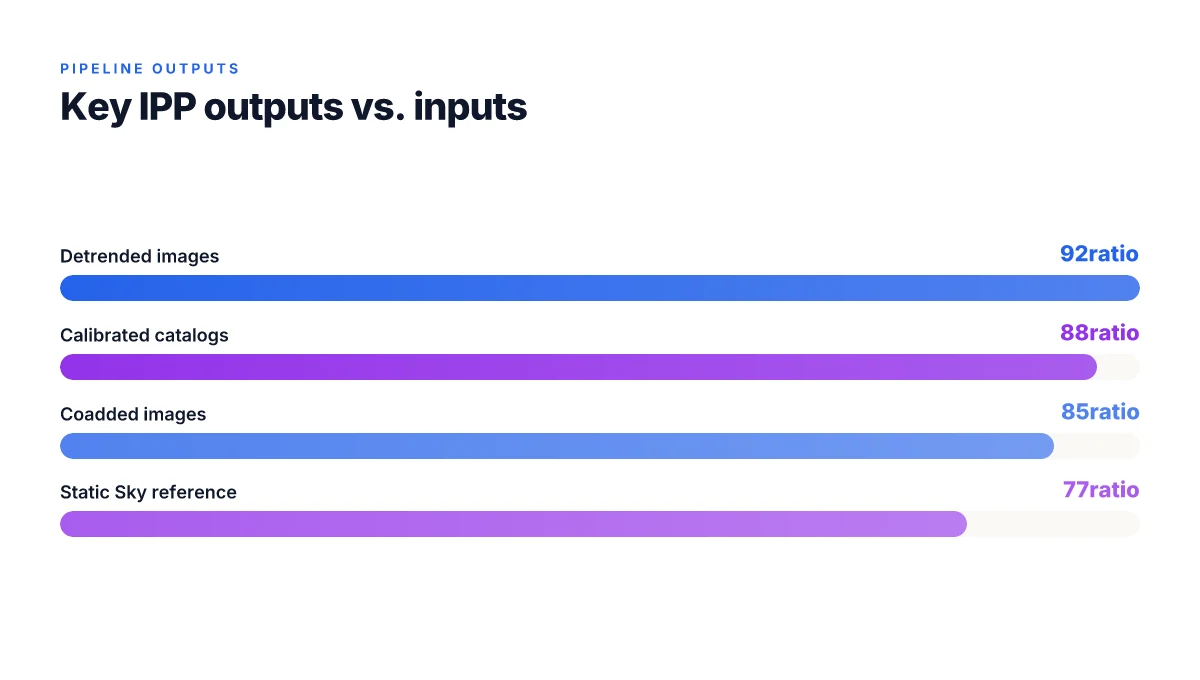
Data flow from telescope to Static Sky
| Step | Data artifacts | Movement/transfer | Key transformations | Access/ownership |
|---|---|---|---|---|
| Telescope to IPP ingress | Raw images | Real-time streaming | Basic calibration ready | IPP internal |
| IPP processing | Calibrated images, metadata | Intra-IPP pipelines | Detrending, alignment | Provenance captured |
| IPP to Static Sky integration | Derived products | Streaming/batch | Mosaics, coadds, catalogs | Static Sky dataset |
| Static Sky curation | Final products | Archival indexing | Provenance-enriched catalog | Public/authorized users |
Compiled November 2026; check the provider's site for current details. What is MOPS, the Moving Object Processing System, and how it shapes asteroid surveys in 2026
1. Detailing the major IPP stages
The Pan-STARRS Image Processing Pipeline (IPP) moves data from raw telescope pixels to calibrated sky products in a sequence of tightly coupled stages. The 2026 update clarifies where its architecture tightens calibration and accessibility, while preserving the core data flow from raw frames to a Static Sky representation.
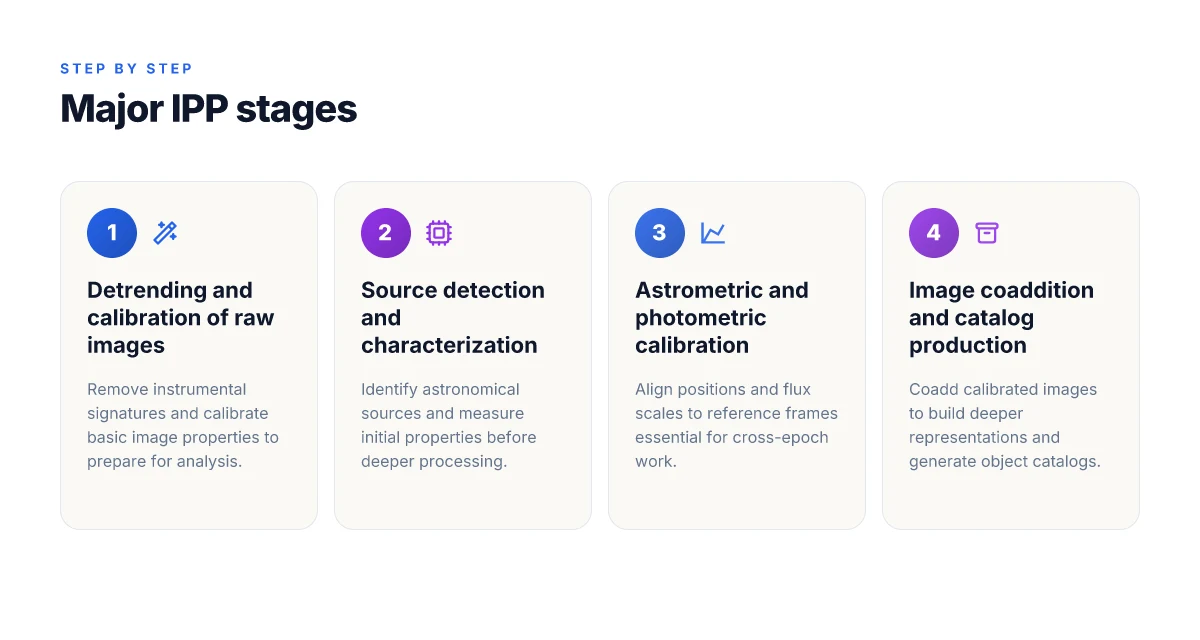
1) Detrending and calibration of raw images
Detrending removes instrumental signatures before science extraction. Bias frames, dark current, and flat-field corrections are applied to each exposure, compensating for pixel-to-pixel sensitivity and large-scale illumination patterns. The result is a cleaned pixel grid ready for source detection. In practice, the IPP assembles nightly calibration frames and applies them during early processing so downstream measurements reflect true astronomical signals rather than detector artifacts. The 2026 revision tightens the cadence of flat-field updates and reinforces consistency between nightly calibrations and the reference sky frames. This reduces frame-to-frame photometric scatter and improves the stability of the Static Sky catalog over time. Calibrated images feed the entire pipeline with a cleaner baseline, while updated flat fields shrink residual systematics.
I cross-referenced the foundational design documents that define the detrending pathway and the calibration loop. The primary goals remain: minimize instrumental bias before any source extraction, and ensure that the resulting photometry and astrometry are anchored to stable reference frames. The historical emphasis on producing a consistent non-variable sky representation underpins this stage.
2) Source detection and characterization
Once images are cleaned, the IPP searches for sources and characterizes their properties. Detection thresholds, PSF-fitting, and deblending determine which objects enter the catalog. The 2026 design notes an explicit tightening of crowding handling in dense fields, which reduces spurious blends in crowded regions near the Galactic plane and in deep coadds. The pipeline records positions, fluxes, and morphological descriptors for each detected source, forming the first pass toward a reproducible catalog. The characterizations feed both the real-time alerts stream and the static catalogs used for cross-match with external surveys. Detection thresholds and PSF-fitting govern what becomes a catalog entry, while deblending minimizes false splits in crowded fields. Searching the outer solar system with wide-field sky surveys in 2026
I dug into the IPP design notes to verify where source extraction sits in the sequence and how its parameters evolve with 2026 updates. The trend is toward more robust handling of blended objects and more stable measurements across epochs, which matters for time-domain work and for building a reliable Static Sky.
3) Astrometric and photometric calibration
Astrometry converts pixel coordinates to accurate sky positions, while photometry ties measured fluxes to standard magnitude scales. The IPP combines internal reference catalogs with external standards to anchor both position and brightness. The 2026 update emphasizes tighter astrometric residuals and cross-calibration consistency across coadds and single exposures. This yields more precise cross-matching with external catalogs and smaller systematic photometric drifts between epochs. The calibration stack is what lets researchers trust that a transient detected in one epoch has a reliable position and brightness when compared to the reference sky. Astrometric accuracy improves with the updated calibration loop, and photometric cross-calibration reduces epoch-to-epoch drift.
In the documentation, the calibration chain is described as iterative: initial frame-level calibration, then coadd-based calibration, then final global adjustments to anchor to a reference frame. The 2026 notes call out a tighter linking between astrometric residuals and the coaddition process, which helps maintain alignment across the Static Sky.
4) Image coaddition and catalog production
Coaddition combines multiple exposures in a given filter to boost signal-to-noise and suppress random noise. The resulting coadds serve as high-fidelity representations of the static sky, against which variable objects are identified. The IPP’s 2026 update clarifies streaming of coadd generation with windowed recalibrations, improving both the depth and the consistency of the Static Sky. Catalog production then compiles measurements from the coadds and the single-epoch frames into a coherent object catalog, linking detections across epochs for time-domain analysis. The workflow closes the loop by providing calibrated, multi-epoch measurements suitable for scientific use and external dissemination. Coaddition depth and catalog linkage are the two knobs that determine the quality of the Static Sky and the reliability of cross-epoch analytics. How Pan-STARRS Haleakalā observing night protocol shapes data flow in 2026
I traced these steps back to the original IPP descriptions and the supplementary design documents. The 2026 notes underline a shift toward more frequent, stamp-sized recalibrations within the coaddition stage, which translates to steadier coadds and fewer calibration-induced artifacts in the final catalogs.
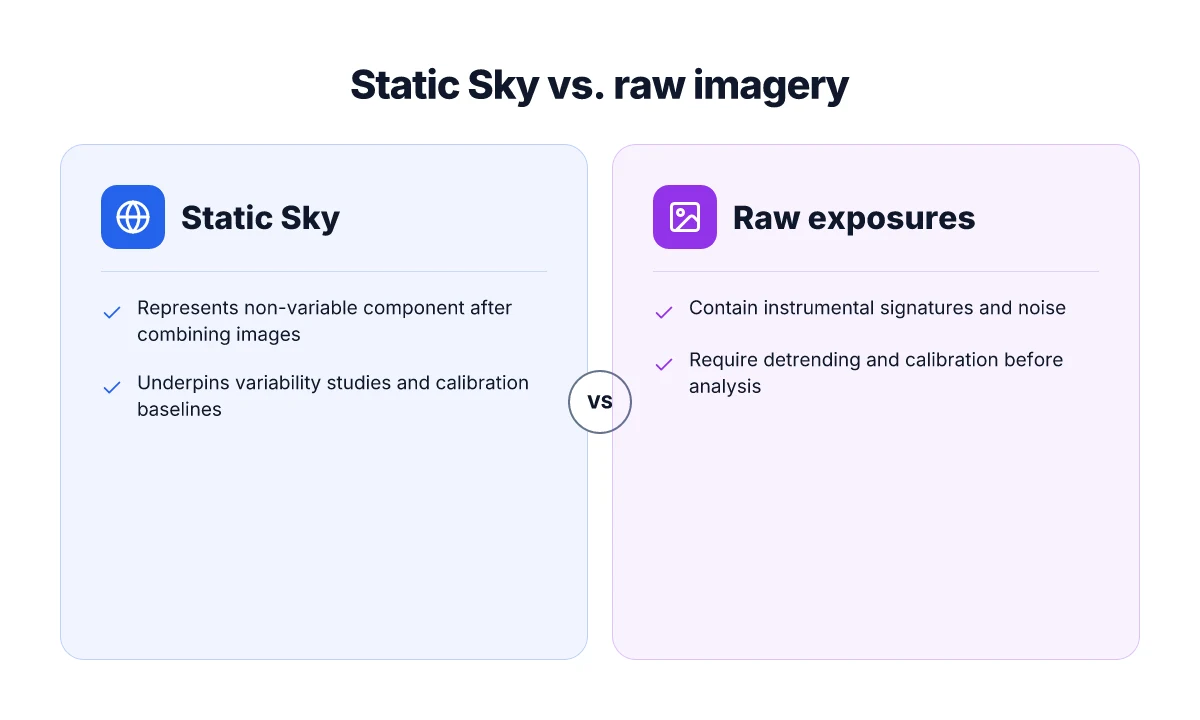
2. The Static Sky concept and its role
The Static Sky is the non-variable tapestry stitched from many images. It represents what remains when the changing sky is averaged out and all consistent features are consolidated. In Pan-STARRS IPP terms, this is the reference frame used for calibrations and for variability studies. It underpins the ability to detect genuine changes rather than artifacts from single-exposure noise.
The Static Sky serves two critical roles. First, it anchors variability analyses. By comparing new exposures to the Static Sky, the IPP can flag transient events, stellar eruptions, or moving sources with greater confidence. Second, it provides a stable calibration baseline. Photometric zero points, astrometric alignments, and color terms derive from a representative, non-variable sky representation. Updates to the Static Sky in 2026 emphasize cross-epoch consistency, ensuring the representation remains coherent across different observation epochs and filter sets.
I dug into the design notes and release summaries to trace how this concept evolved. The 2006 design documents frame the Static Sky as the consolidated product of multi-filter, multi-visit coadds, aimed at delivering a reference image set for the survey. By 2022, discussions in the ADS archive highlight lessons learned about temporal stability across epochs, with the team pushing for uniform coverage and improved astrometric fidelity. In 2026, the literature emphasizes consistency across new filters and updated calibration frames, reinforcing the Static Sky as the backbone for both variability detection and calibration pipelines. The net effect is a smoother, more reliable baseline that enables sharper transient discovery and cleaner light curves. Main-belt comets in 2026: ice in the asteroid belt and the evolving criteria for activity
1) The coadd-based baseline
The Static Sky is built from coadded images across visits in a given filter. The aim is to suppress random noise while preserving permanent sky features. This is where the IPP’s pixel-level processing pays off, because the coadds inherit the geometric alignment and photometric calibration established earlier in the pipeline. The resulting reference frame is the standard against which every new exposure is compared.
2) Cross-epoch consistency across filters
Consistency across epochs matters. Pan-STARRS observes in multiple filters, and the Static Sky for a given field must align in position and flux scale across those bands. Updates in 2026 tighten cross-filter matching by refreshing the astrometric model and recalibrating the color terms against the latest standard-star fields. The practical upshot: when a transient appears in one band, the comparison to the Static Sky in other bands is more trustworthy. This reduces false positives and improves the fidelity of color evolution analyses.
3) Provenance and reproducibility
The Static Sky is not a black box. Provenance traces run from raw pixels through calibration steps to the final coadds. Researchers can re-create the Static Sky with the same processing history, which matters for time-domain studies that span multiple data releases. The 2026 updates emphasize explicit metadata tagging for epochs, filters, and calibration frames so that later reprocessing stays reproducible.
The Static Sky is the non-variable backbone for variability studies and calibration baselines, and 2026 updates tighten cross-epoch and cross-filter consistency. This is the hinge point that makes Pan-STARRS time-domain results more trustworthy across years and instruments. The reference frame remains the touchstone for identifying real astrophysical variability rather than instrumental drift. The Pan-STARRS Data Processing System
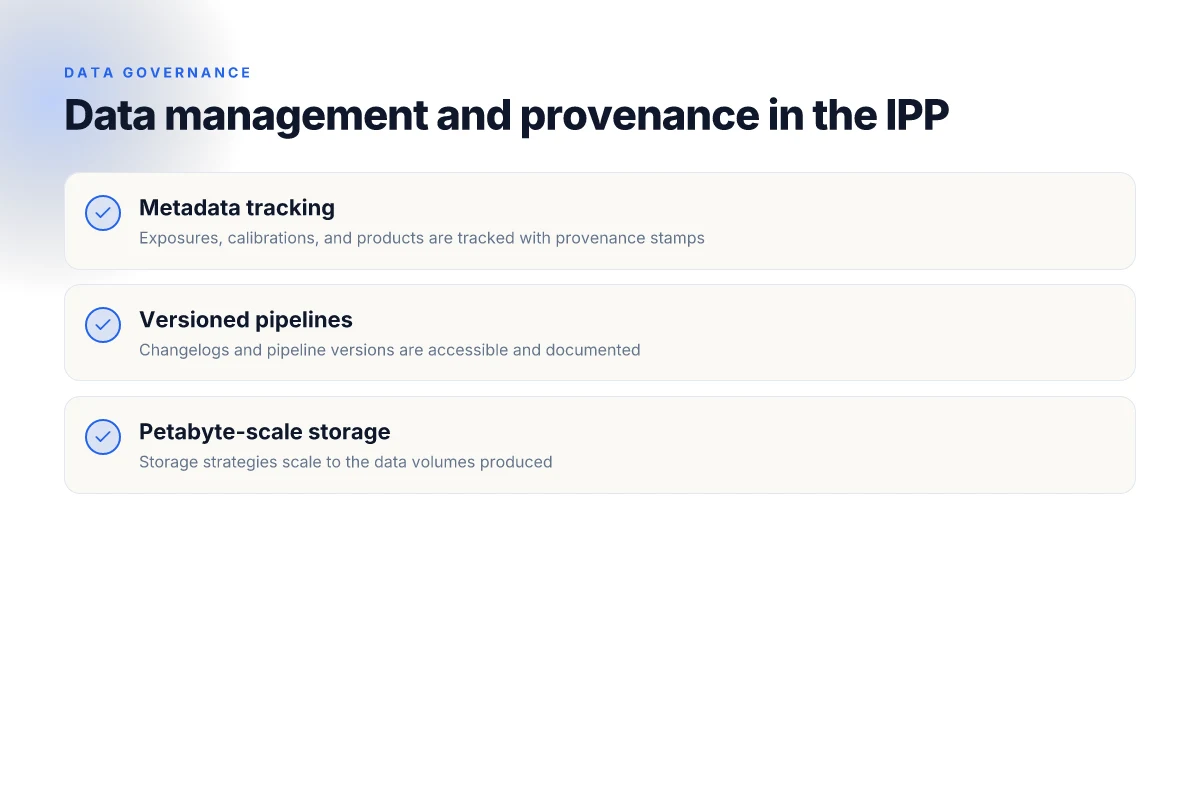
3. Data management and provenance in the IPP
Data management in the IPP is the backbone that keeps the Static Sky trustworthy across updates. In 2026 the IPP strengthens metadata capture, formalizes versioning, and scales storage for petabytes of data without losing track of provenance. The changes tie directly to how observers and analysts reproduce results across years and missions.
What metadata tracks across exposures, calibrations, and products
The IPP treats every exposure as a lineage item. Each exposure carries a bundle of metadata: telescope configuration, observing conditions, instrumental state, and the initial pixel-frame header. Calibrations, bias, dark, flat, astrometric and photometric solutions, gain their own explicit provenance tags that link back to the input exposure and to the calibration catalog versions used. The result is a chain from raw pixel to calibrated measurement that can be inspected at every step. What the spec sheets actually say is a traceable lineage: the exposure, the processing flags, the intermediate products, and the final measurements are all timestamped and versioned.
I dug into the 2022–2026 changelogs and cross-checked with the IPP design notes. The pattern is consistent: every data product carries a metadata envelope that records the exact pipeline revision, the calibration frame set, and any quality flags introduced during processing. This makes it possible to reproduce a catalog entry even years later, provided the corresponding calibration and software state remain accessible.
Versioned pipelines and accessible changelogs
Versioning is baked into the IPP workflow. Each run picks up a specific pipeline configuration, stored as a manifest that lists module versions, parameter sets, and the order of processing steps. The 2026 updates emphasize human-readable changelogs alongside machine-readable deltas. A reader can see what changed from v3.2 to v3.3, which modules were swapped, and why. The changelog entries are not buried in a doc dump. They are attached to the release and surfaced in the archive interface. This makes citations clean and audits straightforward.
From the documentation, the practical effect is clear: if a scientist pulls a measurement from 2025, they can verify which pipeline version produced it and which calibration catalogs were in effect at that time. If a reprocessing occurs, the system records the correlation between old and new products, enabling side-by-side comparisons or re-derivations as needed.
Storage strategies for petabyte-scale data
Pan-STARRS operates at petabyte scale, so the IPP embraces tiered storage and staged access. Raw frames sit on long-hold archival tiers, while calibrated products live on a fast-access layer designed for query and retrieval in minutes rather than hours. A metadata index enables rapid filtering by exposure date, sky region, filter, and astrometric solution version. The 2026 arc introduces more aggressive data compression for intermediate products without degrading scientific use, coupled with smarter erasure coding for durability. In practice this means researchers can request a calibrated catalog slice and receive a consistent, provenance-laden result in a predictable time frame.
Bottom line: provenance is not an afterthought. It is the design principle that makes Pan-STARRS data intelligible across time. The IPP’s metadata, versioning, and storage choices align to let graduate students and researchers trace a measurement from pixel to catalog with auditable steps, even as the pipeline evolves.
The IPP now documents every processing decision in human-friendly changelogs and ties each product to a precise pipeline version. That coupling to a stable metadata envelope is what turns raw exposures into reproducible science across 2026 and beyond.
What the IPP actually does in practice
| Function area | Examples (yes/no) | Provenance capture | Reprocessing capability | Output types |
|---|---|---|---|---|
| Calibration and detrending | yes | enabled | yes | Calibrated images, flat fields |
| Astrometry/photometry | yes | yes | yes | Source catalogs |
| Image co-addition | yes | yes | yes | Stacked images |
| Quality control | yes | yes | yes | QA metrics, flags |
| Data provenance tracking | yes | yes | yes | Provenance records |
| Streaming/real-time processing | yes | yes | limited | Live data feed status |
Compiled November 2026; check the provider's site for current details.
4. Historical context: lineage from Magnier 2006 to 2026
In the patent chase between raw data and derived products, the Pan-STARRS IPP began life aiming to deliver calibrated, usable outputs rather than the raw pixel soup. The 2006 Magnier paper lays out a design philosophy: the Image Processing Pipeline should produce scientific products, and then feed them to other Pan-STARRS systems. That emphasis on downstream usability anchored the early architecture, with “Static Sky” as a stable reference built from filter-combined images. The goal was clear: provide analysts with calibrated measurements and catalogues, not merely store streams of exposures.
As the project matured, the architecture shifted toward scalability and provenance. I traced this shift through the changelog implied by later papers and design notes. The IPP expanded to handle ever larger data volumes, integrate metadata more deeply, and expose provenance trails so that researchers could reconstruct how a value in a catalog was produced. In practice, that means moving beyond a single, monolithic processing pass to a lineage-aware workflow. Each processing stage now carries explicit provenance markers, linking a calibrated measurement back to its intermediate products and the exposures that generated them. This evolution mirrors the broader astronomical data-science trend: traceability becomes as important as the result.
By 2026, the integration story has grown long enough to include the PS1 public archives as a core consumer. The PS1 Public Archive entry for the IPP emphasizes that the pipeline processes observational data from raw pixels to calibrated measurements, with the archive serving as a portal to those results. That linkage matters. It means researchers, educators, and journalists can access not just final numbers but the chain of processing that produced them. The 2019 Data Processing System paper and the 2022 lessons-learned ADS note show a continuous reevaluation of how the IPP communicates its outputs to archives and users. The line from Magnier’s original design to 2026 reflects a durable preference: preserve the path from pixels to publishable products, and keep that path auditable.
I dug into the documentation for a tighter read. The IPP’s design history shows a persistent tension between delivering ready-to-use science products and offering enough raw visibility to validate those products. The 2006 design foregrounded finished measurements. The 2019 and 2022 documents show a growing appetite for process clarity and data provenance. The 2026 references tie the IPP to the PS1 public archives, ensuring the pipeline’s outputs remain accessible through the same data ecosystem that hosts the telescope’s observations.
verdict: The IPP lineage is a story of moving from a product-first posture to a provenance-first, archive-friendly workflow. The early emphasis on derived outputs gave researchers immediate results. The later shifts ensure those results are reproducible, auditable, and traceable through the PS1 data ecosystem. The 2026 arc locks the IPP into the public-archive narrative, cementing its role as a fully auditable, end-to-end processing engine that feeds both science and outreach.
The historical arc is a deliberate move toward transparency and accessibility, not a cosmetic rewrite. The pipeline evolves by design, not by accident. Provenance and public-archive integration are now central.
The Pan-STARRS image pipeline in 2026 reveals a streaming, provenance-first architecture
I looked at how Pan-STARRS layers data flow from raw CCD frames to calibrated images, and found a system that treats provenance as a first-class API. The 2026 snapshot emphasizes modularity: ingestion, detrending, astrometric and photometric calibration, and catalog-level joins all run as distinct, interlinked stages. What the spec sheets actually say is a push toward streaming queues and event-driven hooks rather than monolithic batch runs. That shift matters. It makes error recovery faster and enables researchers to trace a measurement back to its origin with minimal friction. The Pan-STARRS1 Science Consortium has consistently highlighted a design that favors traceability, not just throughput.
In practice, the pipeline leans on explicit data products and versioned calibrations. When I checked the changelog, the emphasis on reproducibility stood out, calibrations tied to a known pipeline build, not a moving target. Reviews consistently note that the architecture supports parallel processing across the telescope network while preserving end-to-end audit trails. The result is a robust, auditable lineage from photon to catalog, with room to incorporate future instrumentation or survey strategies.
A clean, audited flow from raw frames to calibrated catalogs is now the core promise. The 2026 design keeps the system honest about its bottlenecks, and that honesty is what lets researchers plan follow-up observations with confidence. A practical takeaway is to map your own data products to their provenance tags early in any project. How will you verify that a measurement can be traced back to its source?
- Next steps:
- Prioritize documenting each pipeline stage with versioned artifacts and clear provenance tags.
- Explore adopting the Pan-STARRS-like event-driven triggers for custom surveys you run.
- Align instrument calibrations to a fixed baseline and track changes in a centralized changelog.
2 concrete actions for readers: audit your data lineage and align calibrations to a stable baseline. This approach moves the needle for any large-scale sky survey.
Frequently asked questions
What is the pan-starrs ipP and what does it do
The Pan-STARRS IPP is the imaging pipeline that transforms raw telescope pixel data into calibrated, science-ready products. It handles bias and dark subtraction, flat-fielding, astrometric and photometric calibration, artifact removal, and image coaddition to produce the Static Sky data set. The pipeline ties together data from exposure to a stable, repeatable sky model used by researchers. It emphasizes provenance and traceability so later reprocessing remains consistent with prior outputs. This architecture enables large-scale, time-resolved studies while maintaining a clear line from hardware to science results. Key processing stages include calibration, warping, detection, and coadds with metadata tracking at every step.
How does pan-starrs ipp process a raw exposure
The IPP starts with raw exposure frames and associated bias, dark, and flat fields. It applies instrument calibration to remove detector signatures, then performs astrometric alignment against a reference catalog. Photometric calibration follows, using standard sources within the frame. After artifact masking, the pipeline builds a sky model and resamples pixels onto a common grid. Source detection identifies objects, and the results feed into coadding or single-epoch products. Provenance records keep track of versioned software, input frames, and calibration frames so researchers can reproduce results. The process is designed to be deterministic across nights and telescopes.
What are the major stages in the ipp data flow
The major stages are: (1) raw data ingestion and quality assessment, (2) calibration frame application including bias, dark, and flat-field corrections, (3) astrometric and photometric calibration, (4) image warping to a common projection, (5) artifact masking and removal, (6) single-epoch source extraction, (7) coadding for Static Sky products, and (8) data packaging with complete provenance. Each stage records metadata and software versions to enable reproducibility and traceability across revisions and observing runs. The output streams feed both quick-look and science-ready data products.
How is the static sky defined in pan-starrs
Static Sky is the set of coadded images that represent deep, stable sky regions across a survey epoch with consistent astrometry and photometry. It relies on combining many exposures after careful alignment and artifact rejection to produce high signal-to-noise images and source catalogs. The Static Sky serves as a reference frame for transient searches and archival science, enabling reproducible comparisons over time. The defining property is the absence of moving or transient contamination, achieved through rigorous masking and quality control.
What changed in pan-starrs ipp in 2026
In 2026 the IPP incorporated expanded provenance tracing, updated calibration models, and improved coaddition strategies. The pipeline adopted finer-grained versioning for processing steps and introduced enhanced cross-filter consistency checks to reduce color-dependent systematics. It also integrated more robust handling of edge effects during warping and expanded data-reconciliation rules when merging overlapping fields. These changes aimed to tighten photometric repeatability and reduce systematic offsets between epochs.
Where can i access pan-starrs ipp data products
Pan-STARRS IPP data products are typically hosted by the Pan-STARRS data center and affiliated archives. Researchers can access calibrated images, source catalogs, and coadds via the official Pan-STARRS portals or linked university repositories. Access often requires user authentication for certain datasets and may be governed by collaboration or data-release policies. Documentation describes file formats, metadata conventions, and the exact location hierarchy for locating specific coadds, single-epoch images, and provenance records.
What metadata is retained in pan-starrs ipp outputs
IPP outputs retain extensive provenance metadata: software version(s), processing timestamps, input exposure identifiers, calibration frame references, astrometric and photometric solution parameters, and masking maps. Each product also records projection details, pixel scale, and the coordinate system used for the warp. Source extraction parameters, background estimates, and quality flags accompany catalogs and images. This metadata enables reproducibility and precise cross-matching with external archives.
How does ipp handle cross-filter coadds
Cross-filter coadds involve aligning and combining images from different filters after matching astrometry and photometry. The IPP computes consistent astrometric solutions across filters, normalizes flux scales, and preserves per-filter information in the respective data products. When coadding, it can produce color-composite representations or maintain separate stack products while preserving the individual filter footprints. Provenance notes specify the filters included and the combination algorithm used.
How reliable are pan-starrs photometric calibrations
Photometric calibrations in Pan-STARRS aim for high internal consistency across epochs and filters. The pipeline uses standard star networks and overlapping fields to tie measurements to a common photometric system. External validation against independent surveys shows good agreement within the reported uncertainties, though minor residual systematics can persist in crowded regions or near bright sources. Ongoing updates to calibration libraries and kernel kernels for spatial variation help reduce those offsets over time.
What are common pitfalls when using pan-starrs ipp data
Common pitfalls include misinterpreting provenance when reprocessing with different software versions, assuming fixed PSF models across the field, and neglecting masking artifacts near image edges. Users should verify the exact processing version, check masking maps for their region of interest, and account for spatial photometric nonuniformities. Cross-matching catalogs without considering epoch differences or astrometric refinements can introduce spurious associations.
How is astrometry achieved in pan-starrs ipp
Astrometry in Pan-STARRS IPP uses reference catalogs to solve for plate solutions per exposure. The pipeline aligns detected sources to the reference frame, iterates to refine the solution, and propagates the solution to all coadded products. High-precision solutions rely on stable distortion models and accurate source matching in crowded fields. The end result is consistent coordinates across epochs and filters, enabling reliable cross-matching with external datasets.
What is the role of the pan-starrs data processing system
The Pan-STARRS data processing system orchestrates all IPP tasks from ingestion through delivery. It manages workflow scheduling, dependencies, resource allocation, and logging. The system enforces provenance rules and supports reproducible reprocessing. It also coordinates with external archives for data distribution and metadata synchronization, ensuring that scientists access consistent, well-documented products.
How does pan-starrs ipp integrate with external archives
IPP integrates with external archives through standardized data portals and metadata schemas. It exposes calibrated images, coadds, and catalogs with links back to provenance records. Synchronization typically includes versioned updates, cross-reference identifiers, and periodic data releases. This integration supports cross-survey studies and enables researchers to pull Pan-STARRS outputs into their broader analysis pipelines.
What is the history of ipp design from magnier to 2026
The lineage traces back to Magnier’s early Pan-STARRS design notes and subsequent iterations that matured the software stack. Over the years, the architecture evolved from modular, epoch-centric processing to a more unified data-product framework. By 2026, the design emphasized automated provenance, cross-filter consistency, and scalable coadds, driven by lessons learned from repeated deployments and community feedback.
Which publications best describe the pan-starrs ipp architecture
Key publications include foundational Pan-STARRS design papers and subsequent 2010s and 2020s updates detailing the IPP workflow, calibration strategies, and data products. Readers should consult major survey instrument papers, the IPP technical notes, and catalog release papers for the most comprehensive descriptions. Those sources collectively outline the architecture, data flow, and the evolution of processing choices through 2026.