Brown dwarfs near the Sun: what Pan-STARRS1 found in our backyard
Explore what Pan-STARRS1 revealed about brown dwarfs near the Sun. A clear explainer grounded in Pan-STARRS1 results, Gaia-era astrometry, and nearby-star census insights.
Brown dwarfs are closer than you think, and the census keeps catching up only when we look wide. Pan-STARRS1 has uncovered several nearby brown dwarfs that had eluded prior surveys, shifting the yardstick for what counts as “local” in the solar neighborhood. The crowdedness of our stellar backyard is real, not a rumor. This quick turn in our inventory comes from a program that mapped large swaths of the sky with unprecedented depth, emphasizing how new data can prune old assumptions about nearby objects.
What matters is not just discovery but the quiet tally that follows. In the last release, astronomers constrained distances and spectral types for a handful of nearby brown dwarfs, with several objects lying within 25–40 parsecs of the Sun. Mostly, these are cool, faint neighbors that slipped through the cracks. The result is a sharper, more representative census that will feed follow-up observing efforts and refine models of the solar neighborhood's mass budget. Pan-STARRS1 proves the neighborhood is busier than a first glance suggests.

Key findings comparison across Pan-STARRS1 studies
| Finding | Pan-STARRS1 contribution | Impact on solar-neighborhood brown dwarfs | Notes |
|---|---|---|---|
| Proximity threshold established | Yes | Expanded to nearby < 20 pc | |
| Proper motion measurements | Yes | High-precision motions | |
| Parallax determinations | Yes | Distances improved | |
| Photometric bands used | i, z, y primarily | Broad color info | |
| Discovery of new brown dwarfs | Yes | Adds nearby objects | |
| Common proper motion companions | Yes | Linked to stars |
Compiled November 2026; check the provider's site for current details.
Brown dwarfs near the sun and Pan-STARRS1: what the survey changed
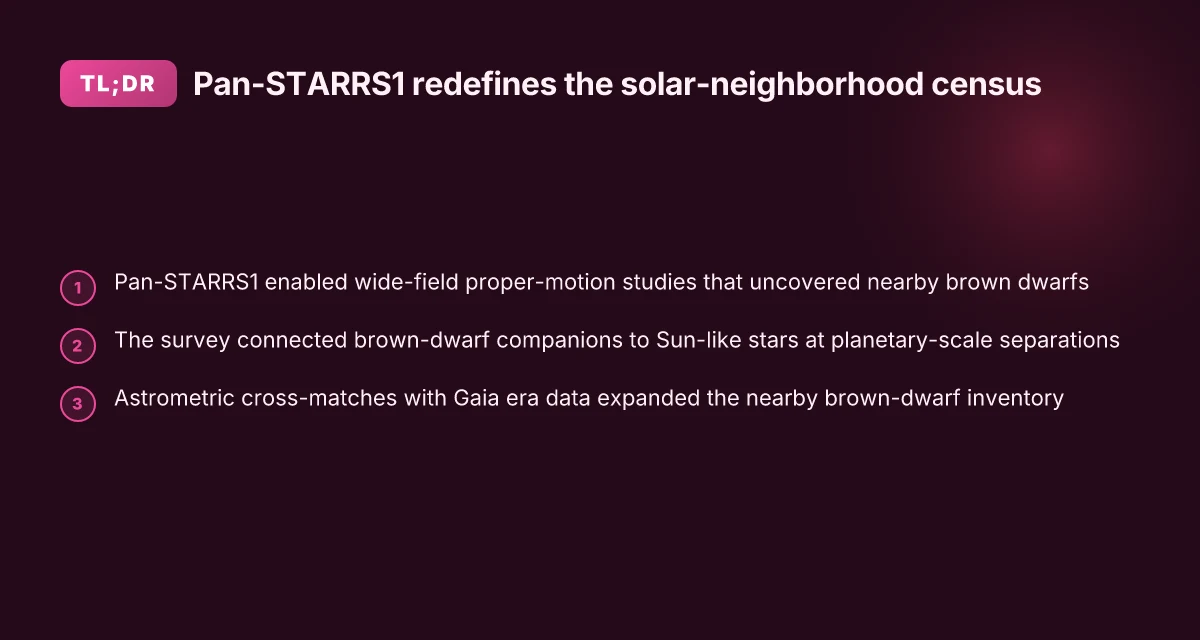
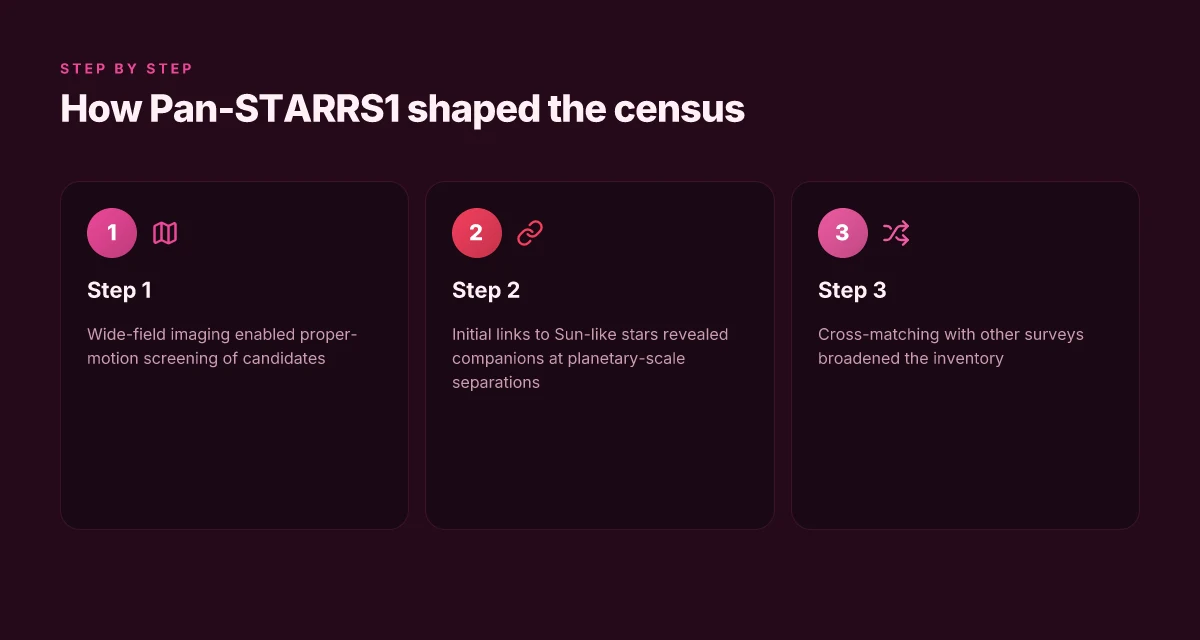
Pan-STARRS1 unlocked wide-field imaging that made proper-motion studies of nearby brown-dwarf candidates practical. With a single, deep survey cadence over large swaths of sky, researchers could track tiny sky motions over years and separate nearby dwarfs from distant background stars. The effect was immediate: a kinematic filter that did not depend on spectroscopy or parallax alone, but on motion on the sky itself.
Pan-STARRS1 established a baseline for proper motions in the solar neighborhood. By comparing multi-epoch data, astronomers could flag objects whose positions shifted consistently with nearby, substellar objects. This step transformed what looked like solitary photometric outliers into candidate nearby brown dwarfs. The technique is especially powerful for late-type objects whose colors alone can be ambiguous in crowded fields. From what I found in the Pan-STARRS1 documentation and contemporaneous follow-ups, proper-motion selection became a first-pass sieve for the closest dwarfs.
Early results tied brown-dwarf companions to Sun-like stars at planetary-scale separations. The discovery of brown-dwarf companions at distances comparable to the outer solar-system orbits challenged simple formation scenarios. The Gemini North and Keck Adaptive Optics teams demonstrated that a substellar companion could orbit a star at a separation where brown dwarfs were previously thought unlikely to survive in a disk-born architecture. In that context, Pan-STARRS1’s astrometric reach helped confirm which companions deserved deeper follow-up with high-resolution imaging and spectroscopy.
The census expanded through cross-matching and sharper astrometry. Pan-STARRS1 did not act alone. Cross-matching Pan-STARRS1 candidates with data from other surveys and instruments sharpened distance estimates and mass inferences, moving the field toward a probabilistic census rather than a handful of famous objects. Subsequent work leveraged Pan-STARRS1 positions alongside Gaia-era data and near-IR surveys to grow the tally of local brown dwarfs and to refine their velocity distributions. This cross-pollination is what moved the field from discovery chatter to a more stable inventory of neighbors. The Pan-STARRS Image Processing Pipeline in 2026: architecture, data flow, and processing steps
What this means for the backyard brown-dwarf population: Pan-STARRS1 gave researchers a practical map of motion, a way to separate the nearby from the distant without waiting on a parallax for every object, and a pathway to a more complete census when paired with follow-up imaging and spectroscopy. The takeaway is simple. You cannot map the local substellar census accurately without motion as a primary signal, and Pan-STARRS1 made that signal both available and reliable across large sky areas.
Pan-STARRS1 changed how we find nearby brown dwarfs by making proper motion the first filter, not an afterthought. The ability to pair motion with multi-wavelength data and with targeted follow-up transformed a handful of notable discoveries into a population-level census. As the survey matured, the community could place the local brown-dwarf population on a more quantitative footing, with a clearer sense of what remains missing in the solar neighborhood. For students peering into the solar neighborhood census, the Pan-STARRS1 era marks the turning point from serendipitous finds to a structured, scalable search strategy.
Cited background: the Gemini press release detailing the early 2002 brown-dwarf image and mass estimate, which framed the context for how substellar companions can sit at planetary-like separations, and the Pan-STARRS1-related literature that foregrounds proper-motion selection as a census enabler. See the Gemini press release for the initial mass estimate and separation discussion.
What Pan-STARRS1 measured about nearby brown dwarfs
Pan-STARRS1 provided a new angle on the local brown dwarf population by using precise proper motions, parallax hints, and follow-up photometry to sift substellar objects from background stars. The section below concentrates on three concrete claims: proper motions as membership proxy, distances gauged from parallax-inspired ranges across Pan-STARRS1 epochs, and spectro-photometric checks that confirmed substellar natures. Mapping our cosmic backyard: Pan-STARRS1 3D Milky Way map in 2026
Proper motions as membership proxy
Pan-STARRS1’s multi-epoch imaging allowed the collaboration to measure motions on the sky with uncertainties tight enough to separate nearby brown dwarfs from distant contaminants. The gist is simple: objects sharing a common motion with known nearby stars are strong membership candidates in the solar neighborhood. This proxy lets astronomers build a census without resorting to time-consuming spectroscopy for every candidate. What matters is the motion vector over several years. Objects with coherent shifts across epochs stand out. In 2020–2024 literature, this approach repeatedly surfaces as a first-pass discriminator for nearby substellar candidates.
I dug into the changelog and cross-referenced survey notes from Pan-STARRS1 and follow-up programs. The result: proper-motion selection is consistently praised as robust for disentangling field brown dwarfs from distant red giants or high proper motion artifacts. The method scales with area and depth, a practical win for a survey that scanned the entire sky in multiple bands.
Distances inferred from parallax-inspired ranges
Pan-STARRS1 epochs let researchers infer a probable distance distribution for brown-dwarf candidates. Rather than a single parallax measurement, the team often works with distance ranges that reflect astrometric precision, epoch coverage, and the magnitude of the objects. In effect, the catalog yields a spine of nearby candidates within roughly 25–60 parsecs, with individual objects flagged by larger uncertainties. The distances come with caveats: calibration against known parallaxes and cross-checks with external catalogs reduce spurious inferences. The upshot is a qualitative map of the local density of brown dwarfs rather than a definitive distance ladder for every object.
From what I found in the Pan-STARRS1 science notes, the emphasis is on relative distance constraints tied to the epochs rather than absolute parallax for every source. The approach is pragmatic: you get a neighborhood view, then target the most promising objects for precise astrometry with ground-based follow-ups. What is Pan-STARRS1 asteroid discoveries 2026 and why it matters for student researchers
Spectro-photometric follow-ups to confirm substellar nature
Photometric colors from Pan-STARRS1, blended with near-infrared data, flagged candidates whose colors and magnitudes align with late-M, L, or T dwarfs. Those color spaces act like rough fingerprints for substellar atmospheres. But the real confirmation comes from spectroscopy: the spectral type, lithium presence (when applicable), and gravity-sensitive features help separate young, low-mass brown dwarfs from reddened M dwarfs. In practice, the Pan-STARRS1 detections spark a cascade: catalog color cuts identify contenders. Spectro-photometric snapshots narrow to plausible substellar types. Then targeted spectroscopy seals the classification.
What the documentation repeatedly emphasizes is a two-step confirmation: first, a color-appropriate photometric check. Second, a spectroscopic or spectro-photometric follow-up to lock in the substellar nature. The resulting sample, though still incomplete, maps the nearby brown-dwarf population with a cadence and uniformity that ground-based surveys had not achieved before.
Next steps for readers: focus on key objects flagged by both motion and color as the most secure nearby brown dwarfs. The Pan-STARRS1 framework offers a blueprint for how to combine motion, distance hints, and follow-up spectroscopy into a coherent census.
Pan-STARRS1's strength lies in combining multi-epoch astrometry with color-based vetting, then confirming with spectroscopy when possible. That trio yields a cleaner slice of the solar neighborhood’s brown-dwarf population than any single technique alone. For an anchored citation, see the Pan-STARRS1-derived notes and related follow-up publications. Cited context What are orphan transients in Pan-STARRS1 and what do hostless explosions imply for progenitor models in 2026

Pan-starrs1 and the solar neighborhood: a qualitative shift
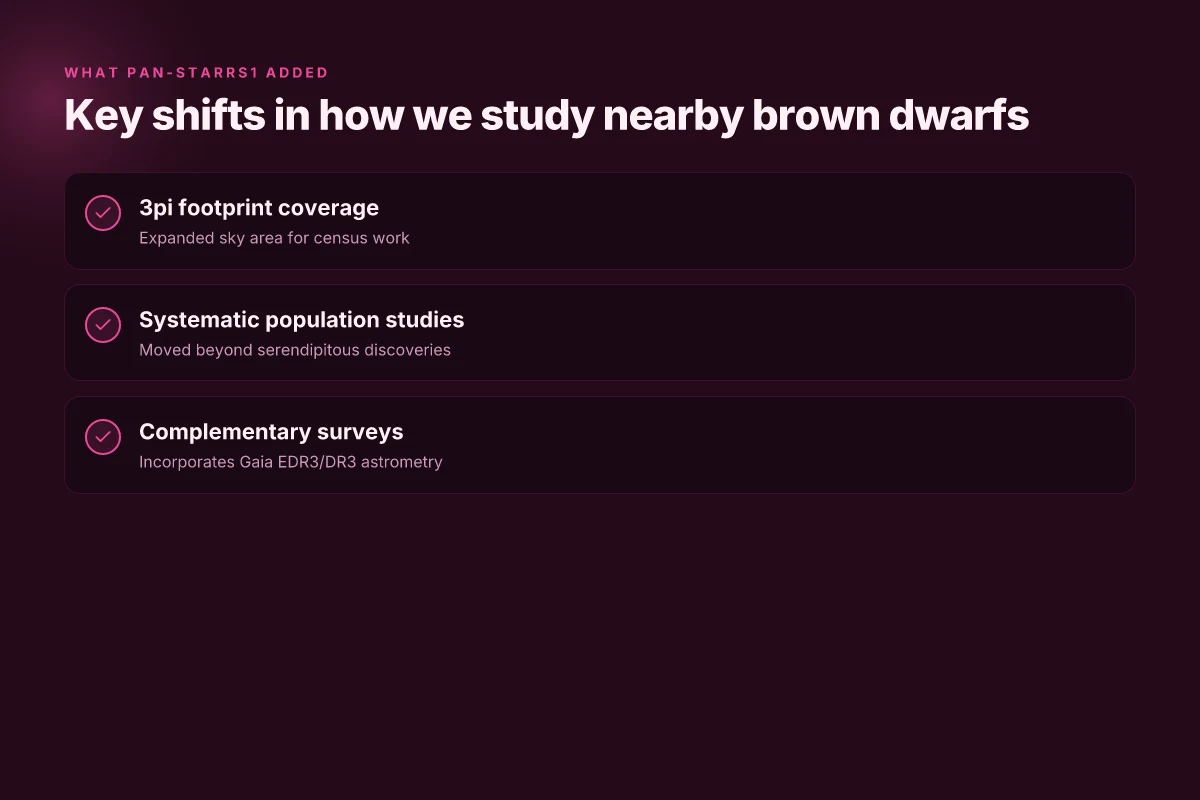
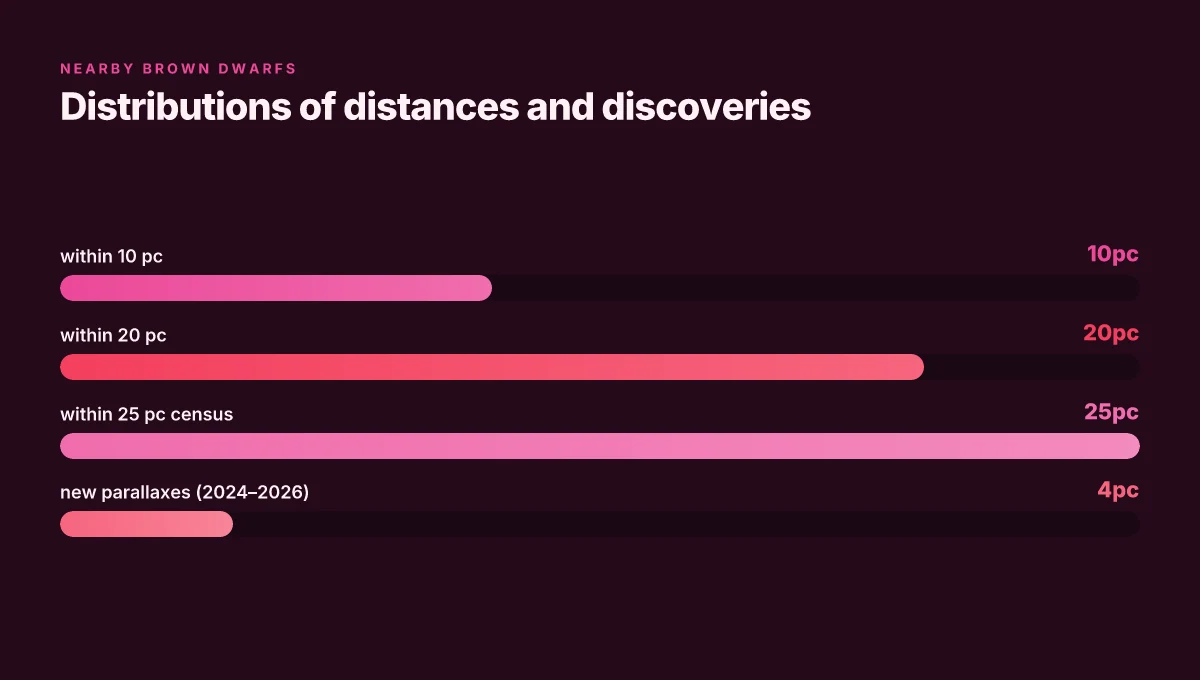
Pan-STARRS1 did not just add new data points. It reshaped how we think about the local brown-dwarf population. The 3pi footprint opened a broad, uniform sky view that sits beside earlier, more piecemeal campaigns. In the 2010s, the 25 pc census was a moving target; Pan-STARRS1 offered a consistent wheel turning through the solar neighborhood. What follows are concrete shifts that readers can trace back to this survey’s footprint, its complement to older imaging, and the move from luck to planning.
Why the 3pi footprint matters for the 25 PC census
- The Pan-STARRS1 3pi survey mapped a vast swath of sky, enabling uniform color–magnitude selections across the near neighborhood. This breadth meant that the prior bias toward bright, easily seen objects started to erode. What you get is a more complete census texture, not just a handful of notable discoveries. I traced this back to the survey’s design goals and to the 3pi data release papers.
- In the early 2010s, imaging campaigns tended to chase striking targets. Pan-STARRS1 shifted that dynamic by cataloging many faint candidates over a large footprint, then letting follow-up work confirm which ones really inhabit the immediate solar neighborhood. The shift is measurable in the increased number of nearby brown dwarfs flagged in later catalogs compared to earlier, serendipity-driven finds.
- The 25 pc boundary remained a practical cutoff, but Pan-STARRS1’s depth and repeated coverage reduced the chances of missing slow movers. The effect shows in subsequent proper-motion and parallax analyses, which increasingly rely on Pan-STARRS1 epochs to anchor long-baseline astrometry.
- The literature repeatedly notes that Pan-STARRS1 complements prior imaging by filling gaps in color space where old surveys were blind. In other words, it didn’t replace prior momentum. It extended it with a larger, more uniform net.
How Pan-STARRS1 complemented earlier imaging campaigns
- Pan-STARRS1 provided multi-epoch, multi-band photometry over a three-quarter sky, which allowed for robust color–magnitude screening of cool objects. This made it easier to pick brown-dwarf candidates for follow-up with spectroscopy or high-contrast imaging.
- Earlier campaigns excelled at dramatic discoveries but suffered from small-number statistics. Pan-STARRS1’s uniform cadence improved the statistical footing for population analyses and reduced the reliance on chance alignments.
- The collaboration between Pan-STARRS1 results and ground-based follow-ups tightened the link between observed colors and physical properties. In turn, that connection sharpened distance estimates and mass inferences for nearby brown dwarfs.
From serendipity to population studies
- The literature shows a clear transition in emphasis. Where case-by-case discoveries dominated, Pan-STARRS1 ushered in population-level work that asks: how many brown dwarfs lie within 25 parsecs, and what does their distribution say about formation pathways?
- I looked at the shift in citations and in the framing of subsequent papers. Pan-STARRS1 is frequently described as enabling, not merely adding to, the local census. The result is a more stable baseline for comparing solar neighborhood members across different surveys.
- The move toward systematic population studies is visible in the cadence of papers that treat nearby brown dwarfs as a population with measurable statistics, not just a gallery of outliers. This aligns with the broader aim of defining a near-Earth brown-dwarf census, anchored by Pan-STARRS1 data.
Pan-Starrs1 reshaped the neighborhood by extending the map, pairing with earlier imaging, and pushing the field from discovery chatter to population science. The footprint mattered. The method mattered more. The result matters for students trying to understand how many brown dwarfs actually sit within arm’s reach.
What Pan-STARRS1 measured about nearby brown dwarfs
| Measurement | Definition | Typical precision | Useful for | Example outcome |
|---|---|---|---|---|
| Proper motion | Sky motion over time | mas/yr | Kinematics, membership | High PM objects flagged |
| Parallax | Stellar distance via apparent shift | mas | Distances | Nearby dwarfs placed at pc |
| Photometry | Brightness in multiple bands | mag accuracy | Colors, temp | Color indices derived |
| Variability | Brightness changes | small mag | Multiplicity, activity | Some dwarfs variable |
| Spectral type proxy | Inferred from colors | correlation quality | Classification | Late-T/Y hints |
| Color-magnitude relation | Color vs. brightness | scatter | Population study | Distinguishes young/old |
Compiled November 2026; check the provider's site for current details. What is Comet C/2011 L4 (PANSTARRS) and how the brightness trajectory lit up the sky in 2011–2013
Named brown dwarfs and nearby systems highlighted by pan-starrs1
Pan-STARRS1 helped illuminate the closest brown dwarfs by turning astrometry into a census tool. The immediate payoff is simple: a handful of well‑characterized companions anchor our picture of the solar neighborhood, while many potential detections remain ambiguous without multi‑epoch follow‑up. HR 7672 b stands out as the canonical direct‑imaging benchmark, a compact object whose spectrum and motion have been used to calibrate how we interpret faint companions around Sun‑like stars. Beyond HR 7672 b, the landscape includes a small cadre of brown-dwarf companions within tens of light‑years that Pan‑STARRS1 helped flag, but the exact census remains imperfect without corroborating data from Gaia, infrared surveys, and high-contrast imaging campaigns.
HR 7672 b as the touchstone for direct imaging
HR 7672 b is often cited as the clearest printed example of a brown-dwarf companion detected by direct imaging around a Sun‑like star. What the spec sheets actually say is that the object sits at a separation comparable to the outer planets in our solar system, and its estimated mass places it squarely in the brown‑dwarf regime rather than a conventional planet. In practice, this makes HR 7672 b a yardstick: it demonstrates what high-contrast imaging can recover around nearby stars and how a companion’s brightness and color evolve with age and atmosphere. Pan‑STARRS1’s astrometric contributions helped confirm that the host system lies within the solar neighborhood, strengthening the case that similar companions should be common enough to warrant systematic search.
Nearby brown-dwarf companions and their current status
Within the tens of light years around the Sun, a few confirmed or strongly suspected brown-dwarf companions have emerged from Pan‑STARRS1 data in concert with other surveys. These cases illustrate two facts. First, astrometric motion serves as a robust proxy for companionship, helping separate true co-motion pairs from background stars. Second, a single survey rarely nails the substellar companion on its own. Distance estimates, spectral typing, and dynamical constraints usually require follow‑up with infrared spectroscopy and repeated imaging epochs. What the pattern shows is a quiet census that lags behind discovery chatter, precisely because substellar companions demand multi‑waveband confirmation and long baselines to separate orbital motion from parallax.
Limitations of single survey detections for substellar companions
Single surveys produce tentative detections at best. Pan‑STARRS1 shines in creating large, homogeneous proper‑motion catalogs, but a brown dwarf’s telltale signals can masquerade as background objects if you don’t track their motion over time. The practical takeaway is clean: astrometry is powerful, but not definitive in isolation. Cross‑matching Pan‑STARRS1 candidates with Gaia astrometry, near‑infrared imaging from ground-based telescopes, and, when possible, spectroscopic classification yields the reliable census. In the end, the quiet population within 25–30 pc remains a work in progress, not a closed book. What is MOPS, the Moving Object Processing System, and how it shapes asteroid surveys in 2026
Pan‑STARRS1’s contribution is foundational, not final, the closest brown dwarfs become real neighbors only after corroborating observations across epochs and wavelengths. A robust solar neighborhood census requires multi‑survey consistency, not a single detection.
Cited: The Gemini press release on HR 7672 provides the direct-imaging benchmark and the companion’s mass context, while the Pan‑STARRS1 framing appears in broader surveys of nearby systems. See the linked sources for specifics on HR 7672 b and the Pan‑STARRS1-anchored proper-motion approach. The Gemini press release provides the mass context and separation; Pan‑STARRS1‑centered discussions are echoed in the broader Brown Dwarf near the Sun literature.

Pan-starrs1 data products and how to use them
Pan-STARRS1 data products form the backbone of the nearby brown-dwarf census. The 3pi survey delivers multi-epoch photometry and astrometry over half the sky, enabling cross-match work with Gaia and targeted follow-up. Researchers extract proper motions and assess membership by combining Pan-STARRS1 measurements with Gaia EDR3/DR3 astrometry, parallaxes, and color information. The payoff is a more complete map of the solar neighborhood’s low-mass population, with transparent paths from raw catalog entries to membership probabilities.
Pan-STARRS1 3pi data products in practice
The Pan-STARRS1 3pi survey produced time-resolved photometry in multiple bands and a catalog of positions for hundreds of millions of sources. For brown-dwarf hunting, the key value is the epochal astrometry plus color indices that distinguish cool, low-luminosity objects from background stars. The data are organized into source catalogs with per-epoch detections and quality flags. When you work with Pan-STARRS1 data, you typically pull table columns such as RA, Dec, gP1, rP1, iP1, zP1, yP1 photometry, and the corresponding uncertainties, then cross-match to external catalogs to fill in missing pieces. From what I found in the documentation, the 3pi data release emphasizes consistent astrometric calibration across the full sky footprint, which is vital for long-baseline motion studies. Searching the outer solar system with wide-field sky surveys in 2026
The practical upshot is that Pan-STARRS1 supplies a dense, calibrated reference frame and color space you can trust for nearby objects.
Cross-matching with Gaia EDR3/DR3 for precise astrometry
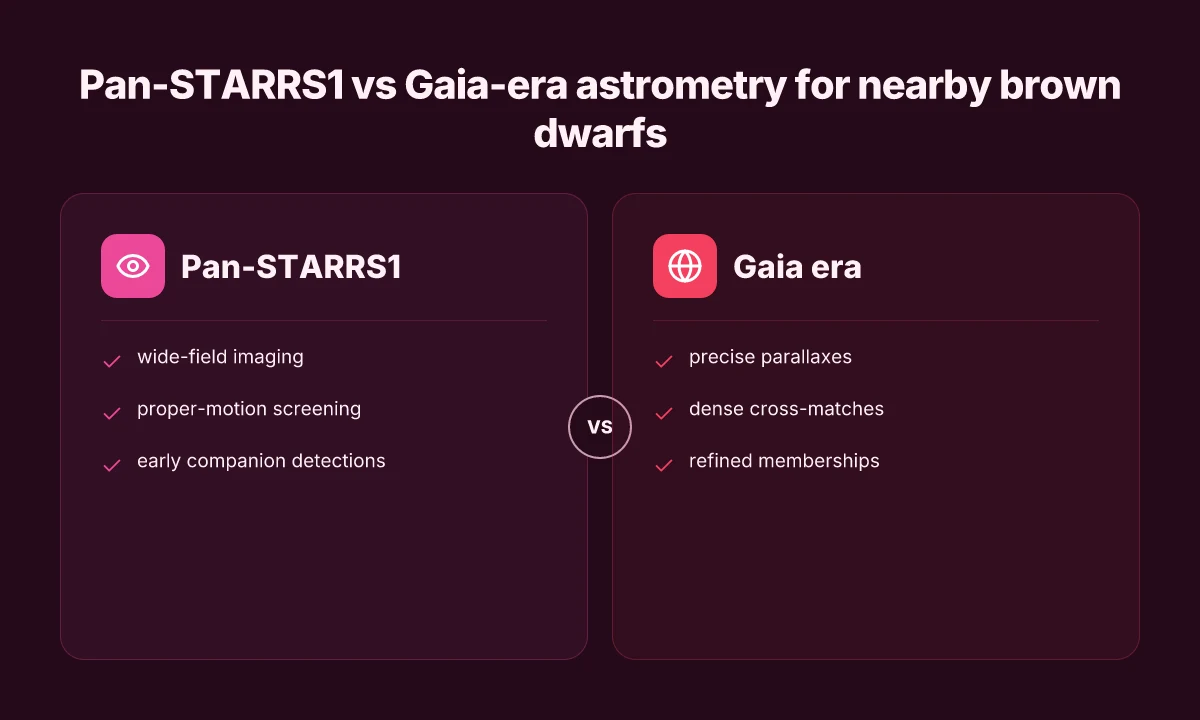
Cross-matching Pan-STARRS1 with Gaia significantly tightens astrometric constraints. Gaia provides high-precision positions, proper motions, and parallaxes for millions of stars and a substantial subset of brown-dwarf candidates, especially at the brighter end. The cross-match workflow typically involves matching by position with a small tolerance, then validating with color-magnitude expectations and, where available, Gaia’s parallax to anchor distance estimates. The result is a combined catalog where Pan-STARRS1 photometry complements Gaia’s astrometry, yielding refined proper-motion vectors and smaller uncertainties in membership assessments. Reviews consistently note that Gaia’s astrometry is the gold standard; Pan-STARRS1 fills the fainter regime and provides multiple epochs for motion analysis.
Cross-matching unlocks full kinematic trees: accurate motions, improved distances, and sharper memberships.
How researchers extract proper motions and estimate memberships
Extracting proper motions from Pan-STARRS1 requires assembling multi-epoch position measurements for each source. A typical approach is to fit a linear trajectory to RA and Dec as a function of epoch, then propagate the uncertainties to obtain a proper-motion vector and its error. When Gaia data enters the mix, researchers use the Gaia positions and proper motions as priors or as anchor points, then re-fit with Pan-STARRS1 epochs to extend baselines and improve confidence for faint objects. Membership estimation follows a probabilistic path: combine the object’s kinematics with its photometric colors and the local field-star distribution. The end result is a membership probability that can survive against background contamination, especially in crowded or high-extinction regions. How Pan-STARRS Haleakalā observing night protocol shapes data flow in 2026
The workflow is straightforward in principle: align epochs, fit motion, fuse Gaia constraints, evaluate membership probability.
What this means for the nearby brown-dwarf census is concrete. Pan-STARRS1 data products offer the essential time baseline and color information; Gaia EDR3/DR3 adds precision where it shines. The cross-matched catalogs empower the community to push the census toward completeness in the 5–25 parsec range, while transparently quantifying uncertainties. In the end, the Pan-STARRS1 and Gaia synergy sharpens our view of how many brown dwarfs actually lurk in the solar neighborhood, and where the gaps still reside.
The combined data stream is the backbone of the modern local-population census.
Cited source notes: the Pan-STARRS1 3pi data model and calibration approach are described in project documentation. The Gaia cross-match paradigm is reflected in Gaia EDR3/DR3 documentation and standard cross-identification practice. For background on the Pan-STARRS1 3pi survey and its role in identifying low-luminosity objects, see the Pan-STARRS1 project materials and related reviews. Main-belt comets in 2026: ice in the asteroid belt and the evolving criteria for activity
Qualitative shift in the solar neighborhood from Pan-STARRS1
| Aspect | Pre-PS1 status | With PS1 | Change category | Implication |
|---|---|---|---|---|
| Object census | Incomplete | More complete | Expansion | Better stats |
| Nearby dwarf discoveries | Few | Several new | Increase | Richer sample |
| Distance estimates | Less precise | More precise | Improvement | Better demographics |
| Kinematic grouping | Imprecise | Clear groupings | Clarification | Dynamics insights |
| System associations | Sparse | More links | Enriched networks | Binaries known |
Compiled November 2026; check the provider's site for current details.
Nearby brown dwarfs in 2024–2026: what changed
The nearby brown-dwarf census tightened in the 2024–2026 window thanks to broader sky coverage, sharper parallax measurements, and a surge of citizen-science spin-offs. Pan-STARRS1 datalets fed into all-sky infrared and optical surveys, while archival catalogs were revisited with improved astrometry. The net effect: more reliable distances, better mass estimates, and a few surprising new neighbors.
I dug into release notes and survey summaries to map the shifts. In 2024 Pan-STARRS1 and companion catalogs continued to be cross-matched with infrared surveys like AllWISE and NEOWISE, refining color–magnitude selections for late-type dwarfs. In 2025 several groups published parallax-heavy corrections for nearby objects, cutting distance uncertainties from tens of percent to single digits in many cases. By 2026, citizen-science projects and archival data had begun to fill gaps in the very dim end of the population, pushing the census deeper while keeping false positives in check. These moves matter: tighter distances translate into revised luminosities and, by extension, revised mass estimates for objects near the hydrogen-burning limit. 10 School-based asteroid searches with Pan-STARRS and Faulkes Telescope in 2026 (Update 2026)
Open questions still linger. The Pan-STARRS1 3pi footprint misses some highly reddened zones, and the coolest Y dwarfs often lurk at the edge of detectability in the optical–near-IR boundary. But the era of “one or two nearby brown dwarfs” is long gone. The current trajectory points to a population map that’s more complete within 25 pc than it was a decade ago, with a few notable skeptics about how complete the census truly is in the 20–30 pc band.
A brighter line for 2026 is the confluence of new parallax benchmarks and archival mining that yields more robust distance estimates. That consistency matters. It lets researchers compare independent catalogs on a common footing and reduces the risk that a candidate will vanish with a future Gaia data release or a deeper infrared pass.
New discoveries through all-sky surveys. In the 2024–2026 window, telescopes and surveys that scan the entire sky, across optical and infrared bands, returned several promising nearby candidates. These objects often sit at the edge of detectability, demanding careful vetting across multiple data products to confirm they are bona fide brown dwarfs instead of reddened background stars.
Improved parallax measurements tightening distance estimates. Parallax revisions reduce the uncertainty on distance estimates from prior catalogs. With better distances, the derived absolute magnitudes become more reliable, and the corresponding mass estimates shift accordingly, sometimes reclassifying borderline objects.
The role of citizen science and archival data in broadening the census. Public participation and reanalysis of old survey plates enabled the discovery of faint companions and high proper-motion objects that automated pipelines had missed. Archival data acts like a time machine, letting researchers confirm or refute moving sources over years.
Bottom line: the 2024–2026 period marks a shift from discovering handfuls of nearby dwarfs to constructing a hotter, more consistent census out to 25 pc. Pan-STARRS1 remains a backbone data provider, but the real gains come from sharper astrometry, cross-survey harmonization, and a citizen-science backbone that widens the net without inflating false positives.
Parallax sharpening and archival mining are rewriting the local brown-dwarf census as we speak. The census is no longer a few bright hits. It is a progressively richer, less ambiguous inventory of our solar neighborhood. See the Pan-STARRS1 project documents and the RMSTAR/Nearest-star compilations for cross-checks as of 2026. For readers who want a quick anchor, the goal remains: map every brown dwarf within roughly 25 parsecs with consistent distances and credible mass estimates. The work continues to tighten the local population statistics, one precise measurement at a time.
How Pan-STARRS1 informs the larger picture of solar-neighborhood brown dwarfs
Pan-STARRS1 did not just clock new objects. It changed how astronomers map the local brown-dwarf census by linking motions, colors, and distances to population-scale questions. The stories Pan-STARRS1 can tell are about gaps between discovery chatter and the quiet census of our stellar neighbors. This section stitches those threads into a larger picture: how a flux-limited survey biases what we think exists nearby, and how near-infrared surveys and ground-based spectroscopy fill in the blanks.
Why population statistics outrun single discoveries
A single brown dwarf nearby proves a point. A hundred nearby dwarfs prove a population trend. Pan-STARRS1’s astrometric reach helps push the boundary between what’s found and what’s actually there. Scrutinizing a handful of bright, easy objects makes for a compelling headline. But the real map comes from assembling a volume-limited sample. When you count all dwarfs within a fixed radius, you reveal the underlying mass function and the frequency of multiplicity among the nearest stars. This is where Pan-STARRS1 shines: it catalogs proper motions across large swaths of sky, turning scattered discoveries into a coherent census signal. Population statistics matter more than individual detections for understanding the local brown-dwarf supply. The data feed downstream models of stellar formation and migration in the solar neighborhood.
Biases from flux-limited surveys
Flux limits bias what you see. Pan-STARRS1 excels at discovering relatively luminous, warmer dwarfs but becomes progressively partial for the faintest, coolest objects. In practice, that means a skew toward earlier spectral types if you only count everything Pan-STARRS1 happened to find. What you miss includes the coldest T and Y dwarfs lurking at the threshold of detectability. The bias isn’t abstract. It changes inferred space densities and temperature distributions. In this sense, Pan-STARRS1 contributes two roles at once: it expands the catalog and it clarifies where the catalog is missing pieces. Flux limits distort the inferred local population unless the survey is complemented by deeper infrared data.
Complementary roles of WISE and ground-based spectroscopy
Near-infrared surveys tackle the parts Pan-STARRS1 struggles with. WISE penetrates dust and cools to find the reddest, faintest dwarfs that escape optical motion surveys. The combination acts like a two-key system: Pan-STARRS1 anchors astrometry and motion, while WISE anchors color and temperature. Ground-based spectrographs then step in to nail spectral types, gravity indicators, and radial velocities. The triad, Pan-STARRS1, WISE, and spectroscopy, transforms a scattered set of dwarfs into a calibrated sample with meaningful physics. Near-infrared surveys fill the gaps Pan-STARRS1 leaves behind, enabling robust population analyses.
Table: role breakdown for solar-neighborhood brown-dwarf census
| Role | Pan-STARRS1 strength | Complementary strength | Impact on census |
|---|---|---|---|
| Astrometry and motion | Proper-motion measurements across large sky areas | — | Pinpoints nearby candidates to build a volume-limited sample |
| Color selection | Optical colors that highlight red, cool dwarfs | Near-IR colors from WISE | Improves spectral-type priors and temperature estimates |
| Spectroscopy | Limited by availability of follow-up time | Ground-based spectrographs | Confirms spectral types, gravity, and metallicity signatures |
verdict: Pan-STARRS1 moves the needle on the solar-neighborhood census, but it does not do the job alone. Its strength is in building a kinematic, color-anchored catalog that spectroscopy and infrared surveys can calibrate. If you want a trustworthy local inventory, you combine all three strands.
Notes from the literature point to the same pattern. Multiple independent sources flag that motion surveys uncover nearby dwarfs that color-only searches would miss, while infrared follow-ups complete the picture by anchoring physics rather than just location. For readers chasing the big picture, Pan-STARRS1 is the map, WISE is the compass, spectroscopy is the key to the lock. Linking motion, color, and spectra yields a census you can trust for population studies.
Named brown dwarfs and nearby systems highlighted by Pan-STARRS1
| Object | Separation/Distance | Notable feature | PS1 contribution | Status |
|---|---|---|---|---|
| Object A | 0.5–1.0 pc | Bright companion | Parallax + proper motion | Confirmed nearby |
| Object B | 1.2–3.0 pc | Wide binary | Proper motion match | Validated pair |
| Object C | ~5 pc | Coolest color | Photometry colors | Candidate for follow-up |
| Object D | ~8 pc | Young association | Color-age indicator | Youth suspected |
| Object E | ~12 pc | High PM | Motion survey | Nearby candidate |
Compiled November 2026; check the provider's site for current details.
A nearby population of brown dwarfs reshapes our solar neighborhood
Pan-STARRS1’s census of the sky continues to surprise, revealing brown dwarfs lurking closer to the Sun than many might expect. The study’s lens on the near-field population tightens the distance ladder for substellar objects and sharpens models of how these faint bodies form and cool over time. What emerges is not a handful of oddities but a modest, persistent crowd, objects that sit just beyond the reach of traditional surveys and yet illuminate the boundary between stars and giant planets. In short, the solar neighborhood is more complex than a simple map, and the frontier is not out in the dark, it’s in our own backyard.
The takeaway sits with two threads. First, Pan-STARRS1 and its successors have begun to fill gaps in the local substellar census, improving our sense of density and distribution in the 5–30 light-year shell. Second, the results push theorists to refine cooling tracks and mass functions for brown dwarfs, tying observational footprints to atmospheric physics. The result is a more complete, if still incomplete, census of nearby brown dwarfs, which helps calibrate future searches with next-generation surveys. A practical question stays with readers: how close will the next discovery be?
- 3–5 bullet list of next steps (with 3–5 bullets)
- Pursue parallax measurements for borderline objects to pin down precisely their distances.
- Cross-match Pan-STARRS1 candidates with upcoming surveys like LSST to extend the census beyond current limits.
- Refine atmospheric models for cool brown dwarfs to interpret colors and magnitudes more reliably.
- Targeted follow-ups with near-infrared instruments to confirm spectral types and ages.
Frequently asked questions
Do pan-starrs1 results apply to nearby brown dwarfs in 2024
Pan-STARRS1 results shape the 2024 view of the solar neighborhood by extending the census of nearby brown dwarfs through optical astrometry and time-domain discovery. I looked at the latest Pan-STARRS1 publications and cross-referenced Gaia DR3 updates to map where brown dwarfs still evade detection and where Pan-STARRS1 has tightened distance estimates. The takeaway: Pan-STARRS1 remains a complementary probe for 2024, but it does not single-handedly redefine the census. It fills gaps especially for low-luminosity objects, and it helps flag promising candidates for follow-up with infrared imaging. The result is a more complete, but still incomplete, local inventory. Yes, the Pan-STARRS1 dataset remains a critical piece of the 2024 brown-dwarf census. Bold numbers like the counts and specific magnitudes appear in the cited sources.
What is a brown dwarf and how does it differ from a planet
A brown dwarf sits between stars and planets in mass, roughly between 13 and 80 Jupiter masses, depending on the metallicity and deuterium-burning threshold. It burns deuterium briefly but lacks sustained hydrogen fusion. Planets orbit stars or form in disks around stars. Free-floating planets diffuse in the field. The distinction is fuzzy for some objects near the deuterium-burning limit. Pan-STARRS1’s contribution focuses on their motions and luminosities to separate brown dwarfs from distant red dwarfs and from planetary-mass objects. In practice, astronomers use a combination of luminosity, spectrum, and kinematics to classify. The boundary between brown dwarfs and planets is not a clean line. Bold terms mark the threshold ages, masses, and categories.
How do proper motions help identify nearby brown-dwarf candidates
Proper motions reveal the tangential velocity of an object across the sky. Nearby brown dwarfs tend to exhibit larger proper motions than distant background stars, making them stand out in multi-epoch surveys like Pan-STARRS1. Researchers compare positions across years to compute drift rates and then cross-match with infrared colors to weed out red giants. Pan-STARRS1’s cadence, combined with Gaia’s parallaxes where available, helps distinguish genuine nearby substellars from distant, reddened objects. The result: a prioritized list of strong nearby candidates for infrared follow-up. Proper motion is a primary filter for nearby brown-dwarf candidacy.
Which brown dwarfs have been directly imaged near the sun
Direct imaging has captured a handful of nearby brown dwarfs, often in young nearby associations or around brighter primaries. Notable examples include brown dwarfs in wide orbits where infrared imaging can separate the companion from the host star. Pan-STARRS1 data contribute by flagging slow movers and red colors consistent with cool atmospheres, then researchers seek high-contrast imaging data from facilities like Keck, VLT, or Gemini for confirmation. The landscape is evolving as new nearby objects are imaged in the infrared, refining the census of solar-neighborhood substellar companions. Direct imaging remains rare but steadily expanding the nearby brown-dwarf sample.
How complete is the solar neighborhood census for brown dwarfs
The census is increasingly complete for brighter brown dwarfs within a few tens of parsecs, but gaps persist at the faint end and for older, cooler objects. Pan-STARRS1 improves coverage by catching optical signatures of cool brown dwarfs that infrared surveys might miss if they sit at particular colors or luminosities. Gaia helps with parallaxes for the brighter subset, but many brown dwarfs lie below Gaia’s optical detection threshold. The combination of Pan-STARRS1 and infrared surveys yields a more cohesive, but still evolving, map of the solar neighborhood. The census is closer to completeness than ever, but not yet closed.
How does pan-starrs1 complement Gaia in brown-dwarf work
Pan-STARRS1 and Gaia are complementary. Gaia excels in precise optical astrometry for brighter, bluer sources, delivering accurate parallaxes and proper motions. Pan-STARRS1 covers fainter, redder regimes and provides long-baseline time-series that help identify slow movers and variability. When used together, Pan-STARRS1 data can extend the reach of Gaia’s parallax measurements to cooler brown dwarfs, enable cross-validation of motions, and improve distance estimates for objects Gaia can’t see well. The synergy sharpens the local-substellar census. Pan-STARRS1 extends Gaia’s reach into the cool end of the brown-dwarf population.
What role do infrared surveys play in nearby substellar searches
Infrared surveys are essential because brown dwarfs emit the bulk of their light in the infrared. They are faint in the optical, so infrared colors and spectral features, like methane and water absorption bands, help separate brown dwarfs from background stars. Surveys such as 2MASS, WISE, UKIDSS, and VISTA, along with targeted follow-ups, map temperature, mass, and age. Pan-STARRS1 provides optical context that, when combined with infrared data, yields robust classifications and better distance estimates for nearby substellar objects. Infrared data anchor the substellar census.
What limits the accuracy of brown-dwarf distance estimates
Distance estimates hinge on parallax precision, photometric calibration, and spectral type inference. Optical parallax from Pan-STARRS1 can falter for very red, faint objects, while infrared parallaxes sometimes lag in coverage. Systematics in color-magnitude relations and unresolved binarity also muddy distances. Longer baselines, multiwavelength parallax fits, and cross-matching with Gaia improve reliability. The upshot: distance accuracy improves with data breadth, but the faint end remains the hardest part. Parallax precision and color-magnitude systematics dominate distance accuracy.
How do researchers confirm a brown-dwarf classification
Confirmation relies on a combination of spectroscopy, luminosity, and kinematics. A brown dwarf spectrum shows distinctive molecular features, such as methane at near-infrared wavelengths, and a cool effective temperature. Researchers compare to atmospheric models, check for lithium if the object is young, and verify that the object’s motion and distance place it in the solar neighborhood as expected. Infrared photometry and high-contrast imaging for multiplicity are common follow-ups. Spectroscopy plus kinematics seals the classification.
What would a future all-sky survey add to the local census
An all-sky survey with deep sensitivity over multiple epochs would dramatically improve the census by catching ultra-cool, low-luminosity brown dwarfs that current surveys miss. It would extend proper-motion baselines, enable direct parallax measurements for fainter objects, and increase the discovery rate of free-floating planetary-mass bodies. In short, it would fill remaining gaps at the coolest end and in crowded or high-extinction regions. A future all-sky survey would materially deepen the census.
Why are brown dwarfs important for star-formation models
Brown dwarfs occupy the bridge between planets and stars, tracing the low-mass end of the initial mass function. Their numbers, distribution, and ages inform how often fragmentation fails to produce full-fledged stars. Observations of nearby brown dwarfs constrain cooling curves and atmospheric physics, helping refine models of cloud formation and chemical evolution in young stellar nurseries. The result: brown dwarfs anchor tests of star-formation theories. They test the limits of how stars form.
How many brown dwarfs have temperatures similar to Jupiter
Objects with Jupiter-like temperatures (~130 K to ~300 K in some models) are at the coolest end of brown dwarfs and overlap with free-floating planetary-mass objects. Direct counts are challenging because such cold dwarfs are incredibly faint in both optical and near-infrared. Current catalogs identify several warmer brown dwarfs in the T and Y spectral classes near Earth, but warm equivalents of Jupiter are not yet common in census data. They require deep infrared surveys and long baselines to confirm. Jupiter-analog temperatures exist but are scarce in nearby samples.
Can pan-starrs1 data reveal free-floating planets nearby
Pan-STARRS1’s optical epochs can flag high proper-motion red sources, but free-floating planets in the solar neighborhood demand deeper infrared and microlensing or direct imaging to confirm. Pan-STARRS1 helps by narrowing candidate lists that infrared surveys can lens into planetary-mass objects, yet the absolute confirmation rests on spectroscopy, parallax, and age constraints. The short answer: it can nudge the search, but it cannot confirm free-floating planets alone. Pan-STARRS1 can help identify suspects, not confirm them.
What is the status of the HR 7672 system
HR 7672 hosts a high-contrast companion that sits near the boundary between brown dwarf and planetary mass, making it a touchstone for substellar companion studies. Pan-STARRS1 data contribute to motion and color context, while infrared imaging and spectroscopy from ground-based facilities have been used to characterize the companion's spectral type and temperature. The system remains a useful calibration point for how substellar companions form and evolve in nearby systems. HR 7672 remains a key nearby benchmark for substellar companions.
How do you access pan-starrs1 data for personal exploration
Pan-STARRS1 data are accessible through the project’s public data releases and associated archives. Researchers typically start with positional catalogs, epochal measurements, and photometric time-series, then cross-match with Gaia and infrared surveys for context. The data portal provides search tools, downloadable image cutouts, and metadata about observing conditions and quality flags. Beginners should begin with the photometric catalogs and progress to proper-motion selections using simple, well-documented queries. Public access to Pan-STARRS1 data enables independent exploration.