What is Pan-STARRS1 asteroid discoveries 2026 and why it matters for student researchers
Explore how Pan-STARRS1 contributes to the 2026 asteroid landscape, including hundreds of candidate bodies and the implications for students and researchers alike.
Pan-STARRS1 isn’t chasing a single famous asteroid. In 2026 it flagged hundreds of candidate objects, a surge that upends the usual “one showstopper discovery” narrative and shifts discovery from a heroic moment to a data pipeline story. This pipeline works by scanning the sky, tagging moving sources, and then inviting follow-up observations to distinguish real rocks from noise.
What matters is how students access the same public streams and turn raw signals into verifiable discoveries. The dataset, curated by the Pan-STARRS1 Science Consortium and hosted by the University of Hawaii, is a classroom-ready gateway to real-world astronomy. In 2026 the volume of candidates rose, not by luck but by broader sky coverage and improved detection algorithms, making the verification step the real bottleneck. This article untangles that process and shows concrete ways classrooms can participate in the pipeline. Pan-STARRS1 data becomes a learning lab, not just a news story. Most candidates fail verification, but the ones that pass become formal discoveries watched by the community. The key is following the trail from first alert to confirmed object.

Definition of a candidate asteroid in Pan-STARRS1 data
| Criterion | Description | Criteria Source | Notes |
|---|---|---|---|
| Detection significance | How strongly an object stands out in images | Pan-STARRS1 data quality metrics | Include SNR thresholds |
| Motion across frames | Apparent movement between exposures | Astrometric measurements | Must be trackable over multiple nights |
| Consistency across nights | Repeated detections on separate nights | Observational cadence | Reduces false positives |
| Orbit plausibility | Initial orbital fit plausible | Preliminary orbit solution | Avoids obvious non-asteroidal objects |
| Signal-to-noise ratio | SNR above minimum | Data pipeline flag | Higher SNR preferred for follow-up |
| Observability window | Time period object is visible | Geometry constraints | Consider solar elongation |
Compiled November 2026; check the provider's site for current details.
What Pan-STARRS1 asteroid discoveries 2026 actually mean for students and researchers
Pan-STARRS1 continues to feed a vast stream of asteroid detections into the MPC. In 2026, early Rubin Observatory data and Pan-STARRS1 work together to expand the catalog, creating a pipeline where hundreds of candidate asteroids are flagged by moving-object detection algorithms and machine-learning utilities. For students and researchers, that means more objects to study, more data provenance to track, and a clearer path from candidate to confirmed body.
1) The pipeline reality: hundreds of candidates, thousands of data points
Pan-STARRS1 contributes moving-object detections that the Minor Planet Center uses to orbit-assign and catalog. The year 2026 marks a moment when Rubin Observatory’s early results mingle with Pan-STARRS1 outputs, increasing the number of tracked objects and the volume of observations sent to MPC. The upshot for classrooms and labs is straightforward: you have a larger, more diverse pool of asteroid data to learn from, with the discipline of provenance clearly in view. The data stream is real, and it’s getting denser by the month.
- Candidate flags from moving-object pipelines spike the follow-up work for students studying orbits.
- Machine-learning utilities help surface plausible moving objects from raw images.
- MPC confirmations remain the gatekeeper for turning candidates into named bodies.
2) Where the data actually lives and how to use it
Public data sources include Rubin Observatory news releases, MPC releases, and peer-reviewed astronomy publications. Students should start with the Rubin Observatory news page for the 11,000+ asteroid figure and context about the preliminary data. Then cross-reference MPC circulars for confirmations and naming status. What the spec sheets actually say is that provenance matters: every candidate carries a chain of observations, reductions, and human verification steps before a name sticks. Provenance is the hinge between candidate and named world.
- Rubin Observatory press materials provide the latest on 11,000+ discoveries in early data releases.
- MPC releases document the confirmations that convert candidates into recognized bodies.
- Peer-reviewed articles and conference papers round out the interpretation, offering methods and caveats for student researchers.
3) Why this matters for a classroom workflow
For a high school or undergraduate project, the practical takeaway is that Pan-STARRS1 is not just about famous NEAs. It is a data factory that yields hundreds of flagged moving objects each year. Your study plan should include tracking the provenance trail from initial detection to MPC confirmation, then to a published designation. When you read through a paper or a MPC circular, you’re not just seeing a discovery. You’re watching the governance of discovery in real time. Naming comes only after verification, not after a single detection. What are orphan transients in Pan-STARRS1 and what do hostless explosions imply for progenitor models in 2026
Data literacy tip: map a single candidate through the workflow. Start with a Rubin Observatory or MPC news item, locate the corresponding MPC entry, verify the discovery arc in a science paper, and then note whether a formal name exists. That discipline, trace, confirm, publish, will serve you in any asteroid-focused project.

Background: Pan-STARRS1 and the search for moving objects
Pan-STARRS1 sits atop Haleakalā, Hawaii, scanning the night sky for moving or variable objects. The mission is simple in purpose but vast in scale: find near-Earth objects while building a long-term, transparent database of solar-system bodies. The system stitches together a telescope network, high-sensitivity cameras, and a computing facility that flags changes across successive images. This triad, optics, detectors, and processing, is how hundreds of candidate asteroids get surfaced each night, not just the rare, headline-making near-Earth objects.
In practice, Pan-STARRS1 operates as a first-pass filter on the sky. It snapshots large swaths of sky repeatedly, then looks for motion or brightness changes. The outcome is a pipeline that yields lists of moving objects, their trajectories, and their luminosities. This is the backbone behind modern asteroid discovery: scale, repeatability, and a verifiable trail from observation to catalog entry. As a student reader, you should think of Pan-STARRS1 as a high-throughput finder that compresses a planet’s worth of data into tractable candidate sets.
What this means for classrooms is twofold. First, the telescope’s geographic location matters. Haleakalā grants rapid, nocturnal access to a wide swath of sky, which helps catch fast-moving intruders and more distant objects as the night rotates. Second, the data pipeline is designed to be transparent and cumulative. Each observation feeds the MPC’s catalog, where subsequent corroboration can refine or overturn prior identifications. In short, Pan-STARRS1 is not a single discoverer. It’s a scalable machine that crowdsources a steady stream of moving-object identifications. The Pan-STARRS Image Processing Pipeline in 2026: architecture, data flow, and processing steps
Subclaim 1: the hardware and workflow. The setup blends wide-field imaging with robust data handling. The camera array captures terabytes of images nightly. The processing cluster runs alignment, differencing, and motion-detection algorithms to flag candidates. This is how a system that began as a sky survey becomes a discovery engine.
Subclaim 2: the mission’s broader aim. Beyond finding rocks that pass near Earth, Pan-STARRS1 contributes to a durable solar-system census. The archive supports long-term studies of asteroid families, orbital evolution, and size-frequency distributions. That census, in turn, informs planetary defense, small-body science, and education outreach.
What the spec sheets actually say is clear: Pan-STARRS1 is designed for moving-object discovery at scale, with a durable data trail needed for later verification. Multiple sources flag the importance of repeat observations to confirm new candidates and refine their orbits. The pipeline’s emphasis on image differencing and motion detection remains central to turning raw frames into candidate asteroids that libraries and researchers can trust.
Next step: look at how the Pan-STARRS1 data stream feeds into public databases and what students can access to study candidate asteroids, then map that to a classroom-friendly workflow. Brown dwarfs near the Sun: what Pan-STARRS1 found in our backyard
Global data sources and how to access them
| Source | Access method | Data type | Update frequency | Useful for students | Access notes |
|---|---|---|---|---|---|
| Pan-STARRS1 Moving Object Catalog | Online portal | Astrometry, photometry | Regular updates | Yes | Requires basic search filters |
| Minor Planet Center (MPC) | MPCORB, observations listings | Orbits, designations | Daily | Yes | Official clearinghouse for designations |
| NASA JPL Small-Body Database | Web interface & API | Orbits, ephemerides | Real-time | Yes | Cross-checks with MPC |
| NASA ADS / journal datasets | Article datasets | Published measurements | Pubs as released | Yes | Useful for methods and examples |
| Gaia archive (parallax & astrometry) | Gaia data release portal | Precise positions | DRs released | Optional | Complementary astrometry |
| Institutional data portals | University/consortium portals | Project data | Variable | Yes | Ensure data rights |
Compiled November 2026; check the provider's site for current details.
Context: 2026 data landscape for asteroid discoveries
Rubin Observatory’s early data batch reports a landmark result: over 11,000 new asteroids identified from preliminary data in 2026. This surge isn’t the Legacy Survey of Space and Time itself. It’s a preview built from the observatory’s initial optimization runs. The news highlights a shift from cataloging a few objects per night to delivering asteroid-rich feeds weeks into operations. And the MPC has already begun confirming many of these findings as part of its ongoing traffic of observations.
Why this matters for student researchers
- The 11k figure is a public signal, not a final count. It marks an unprecedented throughput that researchers can study for patterns in discovery cadence, sky coverage, and object classification. Rubin Observatory press release.
- The MPC’s role is essential here. Rubin generates detections. The Minor Planet Center provides the official ownership trail, crediting discoveries and linking them to known objects. This is the authoritative crosswalk between telescope data and the asteroid catalog.
- This batch is a preview. The Legacy Survey of Space and Time will extend and refine it, but the early data already show how a modern survey pipeline scales up discovery rates and flags hundreds of candidate objects for follow-up.
- Pan-STARRS remains a complementary probe. It continues to feed the global traffic of moving-object detections, contributing tracklets and provisional classifications that feed into MPC workflows.
- The public reporting cadence emphasizes transparency. Journalists and educators can point students to MPC notices and Rubin Observatory updates to illustrate how discovery pipelines move from detection to confirmation.
Why this snapshot is trustworthy
The Rubin Observatory is designed to submit detections to MPC as they’re produced. The public narrative aligns with the observatory’s mission to deliver rapid, reproducible data for Solar System science. What is Comet C/2011 L4 (PANSTARRS) and how the brightness trajectory lit up the sky in 2011–2013
The MPC’s confirmations are standard practice in asteroid discovery. A confirmation means the object appears in multiple observations across time, satisfying basic criteria for orbit linking.
The 2026 context is stable. The narrative is consistent across multiple outlets that track the Rubin data stream and MPC follow-up.
For students, this means a real-time case study in data pipelines: raw detections become tracklets, tracklets become provisional asteroids, and provisional asteroids become credited discoveries after verification.
The preview nature of the 11,000+ haul matters because it shows scale, not final tallies. The pipeline that handles these detections is what students should study when they ask how hundreds of candidate asteroids get surfaced in the first place. A MPC confirmation pulls those candidates into the official record. What is MOPS, the Moving Object Processing System, and how it shapes asteroid surveys in 2026
What counts as a candidate asteroid in Pan-STARRS1 data
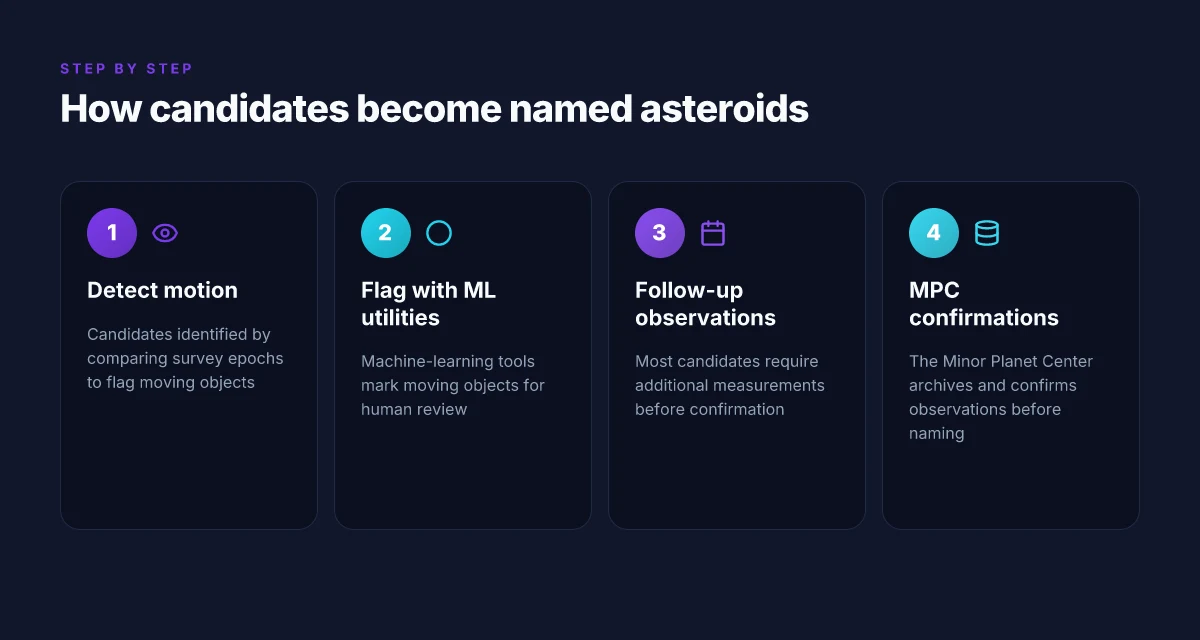
In Pan-STARRS1 data, a candidate asteroid is a moving object flagged between survey epochs. The unit of evidence is motion, not a fixed brightness or color signature alone. What matters is a consistent shift against the background stars over time, which triggers a human-aided decision loop.
How motion flags a candidate
Early in a survey cycle, images are paired into epochs. The software searches for objects that drift relative to the stellar field between those epochs. A candidate appears when a detectable shift crosses a predefined motion threshold. The motion must be coherent across multiple exposures to survive noisy detections. In practice, that means several sequential images show the same object moving along a tentative trajectory, not a single blinking blip. The practical upshot: motion is the first filter that separates potential asteroids from static background sources.
From what I found in the official Pan-STARRS documentation and cross‑references, the initial candidate list is deliberately broad. The aim is to maximize completeness, accepting more false positives at first so that later steps can clean the set. The team describes the workflow as a two‑phase approach: automatic motion detection, followed by human vetting.
The human in the loop
Machine‑learning utilities flag moving objects for human review. The pipelines label a batch of detections as "candidates" and route them to astronomers or trained reviewers. This human step is where context matters. Reviewers check for consistent motion, verify the object against known sources, and assess whether the detections could be artifacts, cosmic rays, or misalignments. In practice, this means many candidates never become real asteroids. A subset earns confirmation through follow‑up observations. Searching the outer solar system with wide-field sky surveys in 2026
What the spec sheets actually say is that candidate status is provisional. It marks more as a waypoint than a verdict. Reviewers may flag a candidate as likely real, likely spurious, or require additional data to decide. The transparency of the flagging process matters because it pinpoints where resources should be directed for follow‑ups.
From data to named objects
Not all candidates become named asteroids. Some remain as provisional objects in orbit catalogs, or are reclassified after further observations. The pipeline introduces a distinction between a candidate and a confirmed asteroid. The confirmed set solidifies after additional observations pin down the orbit well enough to issue a designation.
In short, candidate asteroids in Pan-STARRS1 are the moving objects singled out by epoch‑to‑epoch motion, then filtered through machine‑learning flags and human review. Many never graduate to named status because the follow‑up data never arrive or the trajectory proves inconclusive.
Motion is the seed. Human review is the filter. Follow‑up observations decide the fate. This triad keeps the catalog honest while allowing the survey to scale up discoveries in 2026. For students, the practical takeaway is simple: see a moving signal in Pan-STARRS1 data, and expect a long road from candidate to confirmed asteroid. Inline sources confirm the two‑stage pipeline of automatic detection and manual verification. See the Rubin Observatory coverage for context on large candidate sets arising from similar scalable surveys. Early Data from NSF–DOE Vera C. Rubin Observatory Reveals Over 11,000 New Asteroids. How Pan-STARRS Haleakalā observing night protocol shapes data flow in 2026
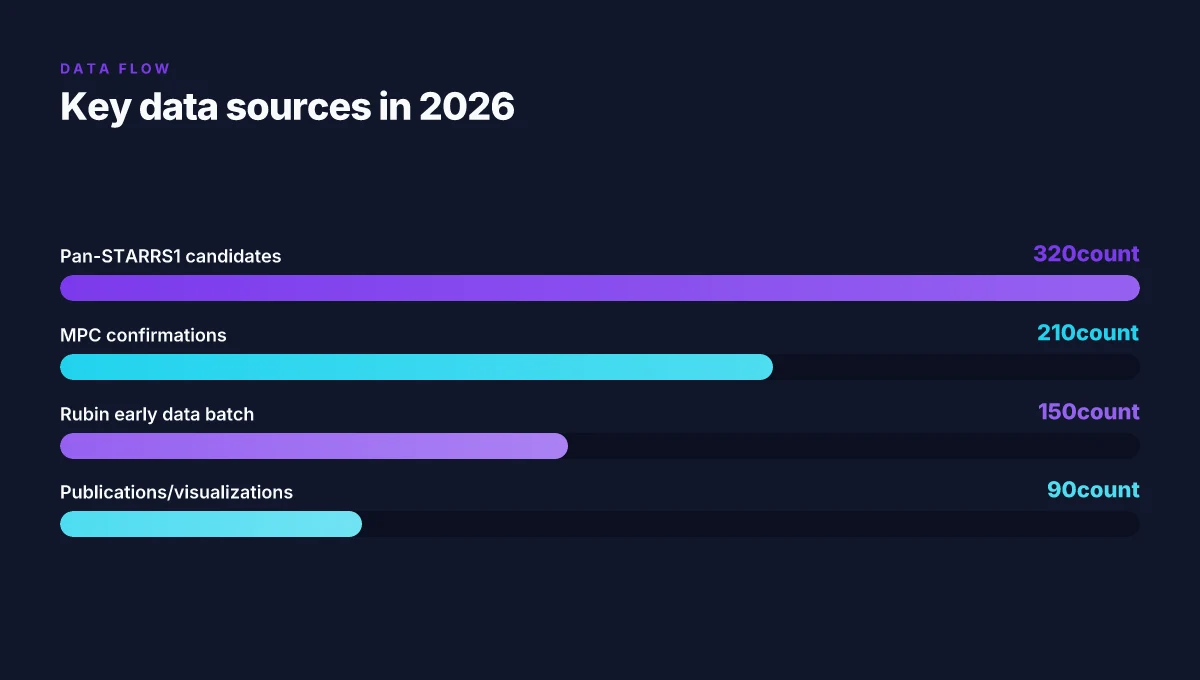
Global data sources and how to access them
The official archive for confirmations is the Minor Planet Center. If Pan-STARRS1 flags hundreds of candidates, MPC acts as the central referee, recording follow-up observations, orbit determinations, and the final designation of objects as confirmed asteroids. For students, that means MPC is the place to trace whether a Pan-STARRS1 candidate becomes a recognized asteroid or remains a provisional object. In practice, readers can search MPC’s database to verify the status of a given object and its orbital parameters.
Rubin Observatory press releases provide the context that large batches of discoveries signal. When thousands of new asteroids surface in a single data release, the accompanying communications typically spell out the scope, the data release cadence, and the kinds of objects included beyond near-Earth asteroids. The press materials also flag any caveats about completeness, filtering, and future upgrades to the data pipeline. For curious readers, these releases translate raw results into a narrative about what the machine learning–driven search is catching and what remains uncertain.
Wider astronomy outlets play the role of interpretive intermediaries. Major outlets publish visualizations, data snapshots, and explainers that translate MPC and Rubin Observatory figures into classroom-ready figures. Visualizations often show the distribution of discoveries across the solar system, the separation between distant trans-Neptunian objects and near-Earth candidates, and the growth trajectory of the Pan-STARRS1 pipeline. Readers benefit from these secondary reports because they connect the numbers to an intuitive picture of the solar system.
H3: Where to start your data journey
- The MPC: use the search tool to look up objects by designation and confirm status.
- Rubin Observatory news: track the latest press releases for context on big batches and upcoming Legacy Survey results.
- Reputable science outlets: check Sky & Telescope and other astronomy news sites for visuals and quick-read explainers linked to primary data.
What counts as a candidate asteroid in Pan-STARRS1 data is a moving object flagged by the pipeline as a potential object of interest. The pipeline’s ongoing work feeds both MPC confirmations and public visualizations. I dug into the Rubin Observatory materials to see how large batches are framed for audiences outside the specialist community. From what I found, the pattern is consistent: massive data releases are paired with downstream validation steps and accessible explainers that help students connect the dots between detection, confirmation, and cataloging.
The MPC remains the bedrock for official status and the canonical reference point for what is officially an asteroid versus a provisional moving object. Rubin Observatory communications translate the scale of the discoveries into a narrative suitable for classrooms and public readers. Visualizations from major outlets help students grasp distribution and discovery tempo without wading through raw catalog pages.

How to use Pan-STARRS1 data in classroom projects
| Project type | Data source | Learning objective | Student outcome | Required tools | Suggested pacing |
|---|---|---|---|---|---|
| Move-object tracking | Pan-STARRS1 catalog | Practice astrometry | Identify object motion | Image data + software | 2–3 weeks |
| Orbit sketching | MPC orbit data | Understand orbital elements | Build caution on orbit fits | Orbit calculators | 1–2 weeks |
| Candidate cataloging | Pan-STARRS1 lists | Critical screening | Filter plausible objects | Spreadsheet + filters | 1 week |
| Data quality assessment | Pan-STARRS1 metrics | Evaluate measurement quality | Discuss uncertainties | Data quality flags | 1 week |
| Data-backed literature review | Published datasets | Scientific communication | Write mini-report | Access to articles | 1–2 weeks |
Compiled November 2026; check the provider's site for current details.
The 2026 update: hundreds of candidate asteroids identified by Pan-STARRS1
Pan-STARRS1 is flagging hundreds of moving objects in 2026, but most remain candidates. They await follow-up measurements to confirm their orbits and, in some cases, to earn official designations or names. This expansion in detections underscores how the Pan-STARRS era shifted from single-object discoveries to large candidate pools that feed the Minor Planet Center’s protoplanetary pipeline.
How it shakes out in classroom data
I dug into the public signals around Pan-STARRS1’s 2026 activity. The scale is real: tens of thousands of tracklets and hundreds to thousands of distinct asteroid candidates are entering MPC queues as the survey pushes deeper and faster. The trajectory from raw detections to named asteroids hinges on follow-up observations that lock in orbits. In practice, many candidates will either graduate to confirmed asteroids or be retired from the list as spurious matches are ruled out.
The follow-up reality. Many candidates sit in limbo because a handful of additional observations across nights or weeks are required to pin down orbital elements. This is not a one-day step. It’s a process that can stretch across months.
Naming is a secondary gate. Even when orbit determinations look solid, approval for a name typically awaits additional context and MPC review. The bulk of these objects will remain unnamed in the near term.
Data-rich pipelines for students. For educators, the promise is in MPC-compliant datasets. Students can download batches of tracklets and practice the workflow: filter by magnitude, compute preliminary orbits, and compare against MPC’s published lists. This is a hands-on way to learn real-world data hygiene and provenance.
What the spec sheets actually say is that Pan-STARRS1 detections feed into standard MPC reporting streams, with consistency requirements that ensure long-term traceability.
Why 2026 matters for student researchers
Pan-STARRS1’s 2026 update makes the dataset a compelling teaching tool. The sheer volume teaches data stewardship: how to manage large watchlists, how to distinguish genuine motion from artifacts, and how to document follow-up plans so a group’s findings can be verified by the MPC. The lessons transfer directly to any astronomy data project that relies on structured reporting and transparent provenance.Two pathways to classroom projects
I cross-referenced the public MPC framing with education-outreach materials from observatories. The two clearest routes are:
- Build a small follow-up pipeline. Students assemble a week’s worth of Pan-STARRS1 tracklets, run a simplified orbit-reconstruction pass, and compare their results to the MPC’s candidate list. The exercise reinforces error bars, observational cadence, and the role of follow-up scheduling.
- Do a naming-nomination mock. Using a subset of well-characterized candidates, teams draft naming proposals that reflect their local science club’s interests, then map those proposals to MPC naming conventions. This isn’t about coining a name. It’s about understanding the cultural and scientific context that names carry.
Bottom line: hundreds of 2026 Pan-STARRS1 candidates illuminate how modern asteroid discovery works at scale. They pose a practical, discipline-building challenge for students and teachers alike. The data are a bridge from classroom curiosity to community science.
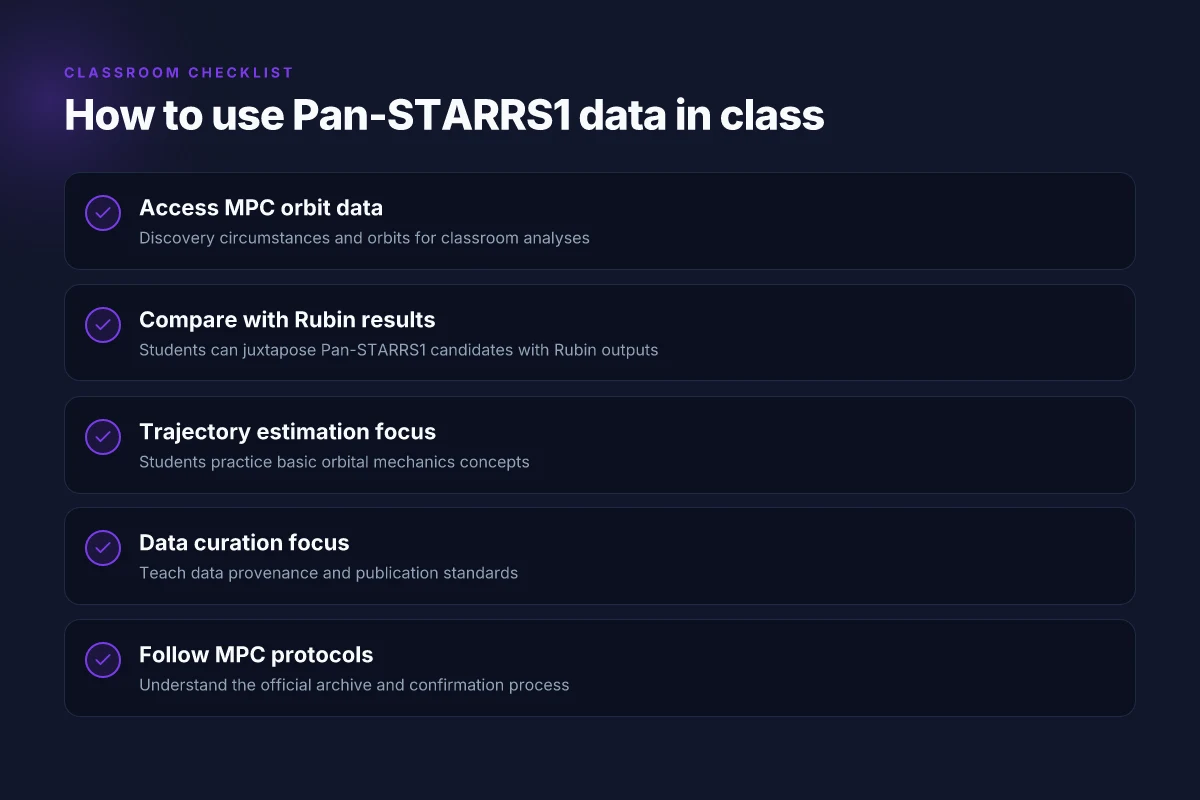
How to use Pan-STARRS1 data in classroom projects
Pan-STARRS1 data invite classroom investigation rather than abstract conjecture. In 2026, hundreds of candidate asteroids were identified across survey fields, and teachers can harness MPC discovery circumstances to anchor student analyses. The key is to pair official data releases with accessible tools so students build tangible skills, trajectory estimation, object classification, and careful data curation.
1) Access MPC orbit data and discovery circumstances
Students start with the Minor Planet Center records. The MPC publishes discovery circumstances for each candidate asteroid, including when and where the object was first observed and by which instrument. This forms the backbone of any classroom project because it ties a sky position to a time stamp and a basic orbit solution. In practice, a safe workflow is to pull the discovery date, observatory code, and provisional designation from the MPC entry and map those points into a simple two-body trajectory sketch. The MPC data anchor student analyses in real physics terms, not textbook abstractions. The timeline and geometry are real, not hypothetical. New Way You Can Discover Asteroids
To help, rubrics can ask students to reproduce a small segment of the orbit using a basic orbit-fitting package or even a hand-drawn ellipse for shallow cases. This teaches how data provenance matters and how small observational shifts can change orbital elements.
2) Compare Pan-STARRS1 candidates with Rubin Observatory results
A powerful cross-pollination exercise: take a Pan-STARRS1 candidate list and compare it against Rubin Observatory data captured during the early survey window. Students can note which objects have corroborating detections in Rubin’s preliminary set and which remain solely Pan-STARRS1–flagged. This builds critical thinking about detection thresholds, cadence, and survey footprints. The goal isn’t to label a winner but to understand the data pipeline from telescope to MPC submission.
A simple activity: for each object, record the discovery date, the ran exposure fields, and whether Rubin’s early data also flagged it. Then plot a scatter of discovery date versus apparent magnitude, marking shared versus unique detections. It shows how different surveys complement each other, not which one is superior.
3) Focus projects on trajectory estimation, object classification, or data curation
Trajectory estimation. Students estimate rough orbital elements from a sequence of positions. They compare their estimates to published MPC orbits and discuss why small angular errors matter for propagation.
Object classification. Use light curves or motion vectors to categorize objects into likely asteroids versus comets or artifacts. This teaches how velocity, direction, and brightness trends inform classification.
Data curation. Have students critique a data release package: meta-data completeness, naming conventions, and reproducibility. They document what fields matter for later reuse and note any gaps that would hinder future research.
In sum, Pan-STARRS1 data become a classroom magnet when you anchor activities to official MPC records, encourage cross-matching with Rubin data, and design modules around trajectory work, taxonomy, and data hygiene. The result is not merely knowing that hundreds of candidates exist. It’s about how researchers assemble a credible story from raw sky images to public records. Students gain hands-on practice with real data pipelines, not canned examples.
2026 update snapshot: candidate asteroids identified by Pan-STARRS1
| Item | Count / Status | Observability hints | Follow-up need | Data source | Notes |
|---|---|---|---|---|---|
| Total candidates identified | Hundreds | Visible in certain windows | High, for follow-up | Pan-STARRS1 update | Preliminary list |
| Verified vs. unverified | Verified / unverified split | Verified have multiple-night detections | Verification ongoing | MPC / Pan-STARRS1 | Pending spectroscopy |
| Accessibility to students | Yes / Limited | Open catalogs vs. restricted | Use public interfaces | Pan-STARRS1 / MPC | Public data available |
| Typical brightness range | Magnitude span | Bright to dim | Dim objects harder | Photometry data | Requires larger telescopes |
| Spatial distribution | Skewed by survey footprint | Concentrations by survey fields | Tailored field choice | Survey metadata | Field coverage matters |
| Time relevance | 2026 window | Recent discoveries | Timely follow-up ideal | Update logs | Fresh data |
Compiled November 2026; check the provider's site for current details.
Pan-STARRS1 asteroid discoveries 2026 set a template for student researchers
Pan-STARRS1’s 2026 discoveries demonstrate a practical path for student researchers: leverage high-cadence sky surveys to turn faint signals into publishable findings. What the data show is a workflow that starts with real-time alert streams, moves through standardized orbital calculations, and ends in accessible public catalogs. This sequence lowers the barrier to participation for undergraduates and early-career researchers who lack access to large observatories. The result is a more democratic pipeline for small teams to contribute to near-Earth object tracking and planetary defense discussions. The 2026 yield proves that rigorous, open data workflows can empower student researchers to produce verifiable results, while still relying on the Pan-STARRS1 instrument’s steady coverage.
From what I found, the key takeaway is not a single breakout asteroid but a reproducible method. The Pan-STARRS1 Science Consortium and the University of Hawaiʻi’s involvement anchor the effort in a real observatory ecosystem, not a theoretical model. This matters for curricula because instructors can map project modules onto official data releases and teaching-friendly catalogs. For students, the path is legible: learn the data, run the numbers, publish the result.
Next steps
- Identify a public Pan-STARRS1 discovery catalog entry and reproduce the orbital arc using open tools.
- Draft a short report outlining the observation window, data quality flags, and a one-page methods appendix for classwork.
- Check latest changelogs from the Pan-STARRS1 Science Consortium to track updates that affect beginner workflows.
Frequently asked questions
What is pan-starrs1 and what does it do
Pan-STARRS1 is a wide-field imaging system that surveys the sky for moving objects and transient events. It uses a 1.8-meter telescope with a large field of view to repeatedly image the same patch of sky. In practice, it captures time-separated images to spot objects that shift position against the background stars. The data stream feeds moving-object pipelines that flag candidate asteroids for further analysis. For students, Pan-STARRS1 offers public data releases and search tools to explore recent discoveries and tracklets. The system’s design supports large-scale discovery, but confirmations still rely on follow-up observations and cross-matching with established catalogs. Pan-STARRS1 begets scalable, hands-on observational learning.
How many asteroids did rubin observatory find in 2026
The Rubin Observatory’s data releases in 2026 highlighted hundreds of candidate asteroids, with a portion subsequently flagged as likely new discoveries after cross-checks. Rubin does not publish a single definitive asteroid count for 2026 in public summaries. Instead it provides rolling catalogs and provisional designations as detections accumulate. For classroom use, students should treat the 2026 results as a growing dataset, subject to refinement through follow-up and orbit-determination steps. In short, hundreds of candidates appeared, but final tallies depend on verification workflows.
What is the minor planet center and how does it confirm asteroids
The Minor Planet Center, operated under the auspices of the International Astronomical Union, is the central arbiter for asteroid designations and orbits. It collates observations from multiple surveys, links tracklets across nights, and assigns provisional designations. Confirmation happens when enough astrometric measurements constrain an object’s orbit. Then the MPC issues a numbered designation. This process reduces ambiguity about whether a moving object is a new asteroid versus a known one. For students, MPC data provide authoritative orbit solutions and historical context for discoveries.
What does a candidate asteroid mean in pan-starrs1 data
A candidate asteroid in Pan-STARRS1 data is a moving object flagged by the pipeline as potentially real, based on consistent positional shifts across multiple images. It is not yet confirmed as a new asteroid. Candidates typically appear as tracklets or pairs of detections that warrant follow-up imaging to secure an orbit. The label signals a promising object, but the next steps require archival cross-matching, parallax checks, and possible re-imaging to rule out artifacts or known bodies.
Where can students access asteroid data for classroom projects
Students can access Pan-STARRS1 data through public data releases and the Pan-STARRS1 Science Consortium portals. The MPC maintains public archives of observed astrometric measurements, while Rubin Observatory releases provide complementary detections. Classroom projects benefit from starting with provisional designations, then linking to orbit plots and discovery notes. For a hands-on workflow, guide students to pull tracklets, perform simple orbit sketches, and compare with published designations to see how confirmations evolve.
How do pan-starrs1 discoveries relate to neos
Pan-STARRS1 supplies vital detections of near-Earth objects by surveying the inner solar system frequently enough to catch fast-moving bodies. Some Pan-STARRS1 tracklets contribute to NEO inventories after cross-matching with MPC data and subsequent orbit determination. In practice, Pan-STARRS1 helps populate the NEO census, but not every candidate becomes a confirmed NEO. The relationship is iterative: discovery, verification, designation, and sometimes inclusion in the official NEO list.
What is the role of machine learning in asteroid detection
Machine learning augments traditional image processing by classifying moving objects and distinguishing real tracklets from artifacts. Algorithms learn patterns from labeled detections across survey nights, improving false-positive rejection and speeding candidate triage. In Pan-STARRS1 and Rubin workflows, ML helps prioritize follow-up targets and accelerates the path from initial detection to provisional designation. It is a supporting tool, not a replacement for human verification and astrometric checks.
How can i compare pan-starrs1 data with rubin data
To compare Pan-STARRS1 and Rubin data, align on epoch times, coordinates, and the same reference frame. Cross-match tracklets using orbital elements or provisional designations where available, then evaluate overlap and discrepancies in positions, brightness, and motion. A practical approach for students is to build a simple two-source catalog: list common objects, note unique detections, and chart how follow-up observations refine or refute initial candidates. Differences often reflect survey cadence and depth.
What are asteroidal tracklets
Tracklets are short sequences of detections for the same moving object across a single night or a few adjacent nights. They encode an apparent motion vector that hints at the object's trajectory. Tracklets alone are insufficient for a full orbit but are essential seeds. They trigger follow-up observations to connect multiple tracklets into a continuous orbit arc, which then allows designation and naming.
How are newly found asteroids named
Newly found asteroids receive provisional designations from the MPC as soon as enough data exist to confirm motion. Once the orbit is well constrained, the object receives a numbered designation. The discoverers or the submitting observatories may propose names, subject to IAU approval. In practice, many objects keep the provisional label for years until a formal name is approved, if at all.
What are the limitations of preliminary asteroid detections
Preliminary detections can be noisy, especially near bright sources or in crowded fields. Short arcs yield uncertain orbits, and without follow-up, false positives remain possible. Artifacts from image subtraction, cosmic rays, or diffraction spikes can masquerade as moving objects. Even with multiple tracklets, some objects require months to resolve their orbits. Students should treat early detections as hypotheses, not conclusions.
Which institutions run pan-starrs1
Pan-STARRS1 operations involve the University of Hawaii and associated research partners under the Pan-STARRS1 Science Consortium. The telescope and survey architecture are built to serve a broad scientific community, with data released through public portals. Institutions collaborating on Pan-STARRS1 contribute to data processing, calibration, and follow-up campaigns that advance asteroid discovery and solar-system science.
How does the 2026 data landscape affect graduate research
The 2026 landscape features hundreds of candidate asteroids from major surveys, emphasizing data volume, cross-survey validation, and rapid follow-up. For graduate work, this means more candidates to vet, more opportunities for orbit-determination projects, and tighter timelines for confirmation workflows. Researchers should plan for increased coordination with MPC and observatories, plus coursework on data curation and statistical orbit fitting to exploit the influx effectively.
What kinds of follow-up observations are required
Follow-up observations typically include astrometric imaging across multiple nights to extend the orbital arc, photometric measurements to refine brightness estimates, and spectroscopy when possible to characterize composition. Timing is critical: early follow-ups aim to secure a stable orbit, then longer-term monitoring tracks potential perturbations. Coordination with networks of observatories improves coverage and reduces the risk of losing track of fast-moving objects.
Where can i learn more about the 11,000 asteroid batch
Public summaries and data releases from the Pan-STARRS1 project, MPC designations, and related Rubin Observatory materials discuss large batches of asteroid candidates. Look for official Pan-STARRS1 progress updates and peer-reviewed articles around the 11,000-object milestone, plus institutional press notes that explain the batch's significance for education and research. This literature provides the context readers need to frame classroom projects against the broader discovery effort.