Cato VPN: What It Is, How It Works, and How to Connect
Learn what people mean by Cato VPN, how Cato Client works, and what to check before connecting or replacing a traditional VPN.
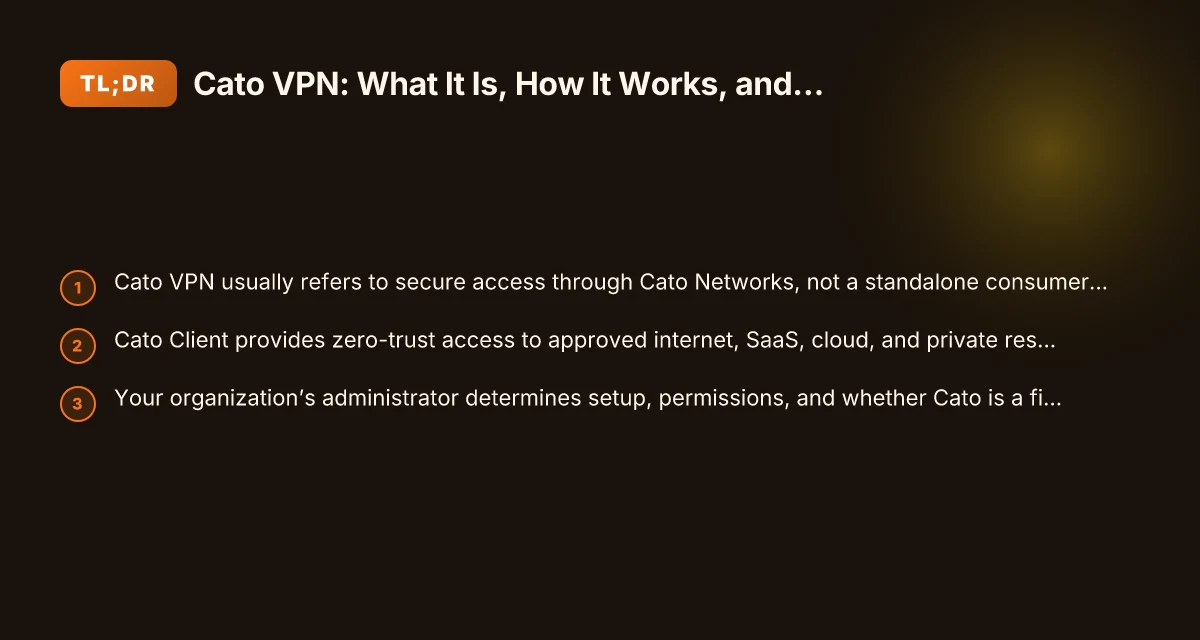
“Cato VPN” generally means using Cato Networks’ secure access services to connect to an organization’s resources. Cato Client is an endpoint agent designed to provide zero-trust access to resources on the internet, in SaaS applications, in the cloud, or on private networks. Unlike a typical consumer VPN, it is primarily an enterprise security and networking solution managed by an organization.
Editor's pick: NordVPN — fast, secure VPN — Strong encryption, a no-logs policy and apps for every device. 30-day money-back guarantee. Get NordVPN →
Compare Cato Client with a traditional VPN
| Factor | Cato Client | Traditional VPN |
|---|---|---|
| Main purpose | Connects users to Cato’s network | Connects users to a VPN service |
| Typical use | Business access to company resources | Remote access or online privacy |
| Network approach | Cloud-delivered security network | VPN server connection |
| Traffic routing | Depends on company configuration | Depends on VPN settings |
| Security controls | Set by the organization | Set by the provider or user |
| Account management | Usually managed by an organization | Usually managed by the user |
| Setup | Install and sign in with company details | Install, choose a server, and connect |
| Best fit | Employees and managed devices | Individual users or other VPN needs |
Compiled November 2026; check the provider's site for current details.
| VPN | Obfuscation | From / month | Plan | Free plan | Refund | Alipay | UnionPay | Crypto | Website opens in China | Trustpilot | |
|---|---|---|---|---|---|---|---|---|---|---|---|
 ZoogVPN | Turn on manually Shadow | $2.49/mo | 27 months: $59.99 | Yes | 7 days | ✓ | ✓ | ✓ | ✓ | Official site blocked; our special link opens (4.4 s) | 4.2/5 (195 reviews) |
 NordVPN | Turn on manually Obfuscated Servers / NordWhisper | $3.49/mo | 27 months: $94.23 | No | 30 days | ? | ✗ | ✓ | ✓ | ✗ Blocked | 4.2/5 (51,628 reviews) |
 ExpressVPN | ✓ On by default all servers | $3.00/mo | 28 months: $84 | No | 30 days | ✗ | ✗ | ✓ | ✗ | ✗ Blocked | 4.4/5 (29,706 reviews) |
 Surfshark | ✓ On by default Camouflage, with OpenVPN | See site | See site | No | 30 days | ✗ | ✗ | ✗ | ✓ | ✗ Blocked | 4.3/5 (31,823 reviews) |
 Proton VPN | Turn on manually Stealth, free plan too | $2.99/mo | 12 months: $35.88 | Yes | 30 days | ✗ | ✗ | ✗ | ✓ | ✗ Blocked | 2.1/5 (1,040 reviews) |
 Astrill VPN | Turn on manually StealthVPN / OpenWeb | $12.50/mo | 24 months: $300 | No | See site | ✗ | ✗ | ✗ | ✓ | ✗ Blocked | 1.3/5 (110 reviews) |
 Private Internet Access | Turn on manually Shadowsocks, OpenVPN only | $2.03/mo | 40 months: $81.2 | No | 30 days | ✗ | ✗ | ✗ | ✗ | ✗ Blocked | 4.2/5 (11,033 reviews) |
 CyberGhost | Turn on manually selected servers | $2.19/mo | 28 months: $61.32 | No | 45 days | ✗ | ✗ | ✗ | ✓ | ✗ Blocked | 4.0/5 (24,178 reviews) |
 PureVPN | Turn on manually switch to OpenVPN | $1.69/mo | 60 months: $101.55 | No | 31 days | ? | ? | ✗ | ✓ | ✗ Blocked | 4.4/5 (17,994 reviews) |
 AdGuard VPN | ✓ On by default TrustTunnel | $2.99/mo | 24 months: $71.76 | Yes | 30 days | ✓ | ✗ | ✓ | ✓ | Official site blocked; our special link opens (3.7 s) | 4.3/5 (290 reviews) |
 Mullvad | Turn on manually QUIC / Shadowsocks / LWO | $5.61/mo | €5/mo | No | 14 days | ✗ | ✗ | ✗ | ✓ | ✗ Blocked | 3.2/5 (192 reviews) |
 Windscribe | Turn on manually Stealth / WStunnel | $5.75/mo | 12 months: $69 | Yes | See site | ✗ | ✗ | ✗ | ✓ | ✗ Blocked | 4.7/5 (13,355 reviews) |
 StrongVPN | Turn on manually Scramble, OpenVPN TCP | See site | See site | No | 30 days | ✓ | ✗ | ✗ | ✗ | ✗ Blocked | 4.4/5 (2,695 reviews) |
 LightXtreme 闪连 | Not listed | $7.08/mo | 12 months: $84.99 | Yes | 30 days | ✓ | ✓ | ✓ | ✓ | ✓ Yes (3.5 s) | No page |
Prices checked 2026-11-10 on each vendor's pricing page (cheapest long plan, USD). Check the vendor's checkout for the final price.
Obfuscation checked 2026-11-14 on each vendor's site and help center: "on by default" = nothing to set; "turn on manually" = switch protocol or mode in settings; "not listed" = the vendor describes no obfuscation.
Payment methods checked 2026-11-10 on each vendor's payment pages: all 14 take cards and PayPal; ✗ = not listed, ? = the vendor's own pages disagree.
China access: whether the official website opens from mainland China networks (tests the website only, not the VPN connection). Last checked 2026-11-18 01:02 Beijing time.
Trustpilot score and review count checked 2026-11-10.
What is Cato VPN?
Cato Networks describes its offering as a unified SASE platform: a combination of networking and security services delivered through a shared architecture. In everyday workplace conversation, “Cato VPN” often refers to the secure connection an employee uses to reach company resources through that platform.
The Cato Client is the main application for endpoint access. It can help connect an authorized user to resources while applying the organization’s access and security policies. Cato also offers a lightweight browser extension for zero-trust access to private web applications.
The word “VPN” can be misleading here. A traditional VPN commonly creates a connection between a device and a corporate network. Zero-trust access instead focuses on granting access to approved resources according to identity, device, and organizational policy. The precise behavior depends on how the organization has configured its Cato environment.
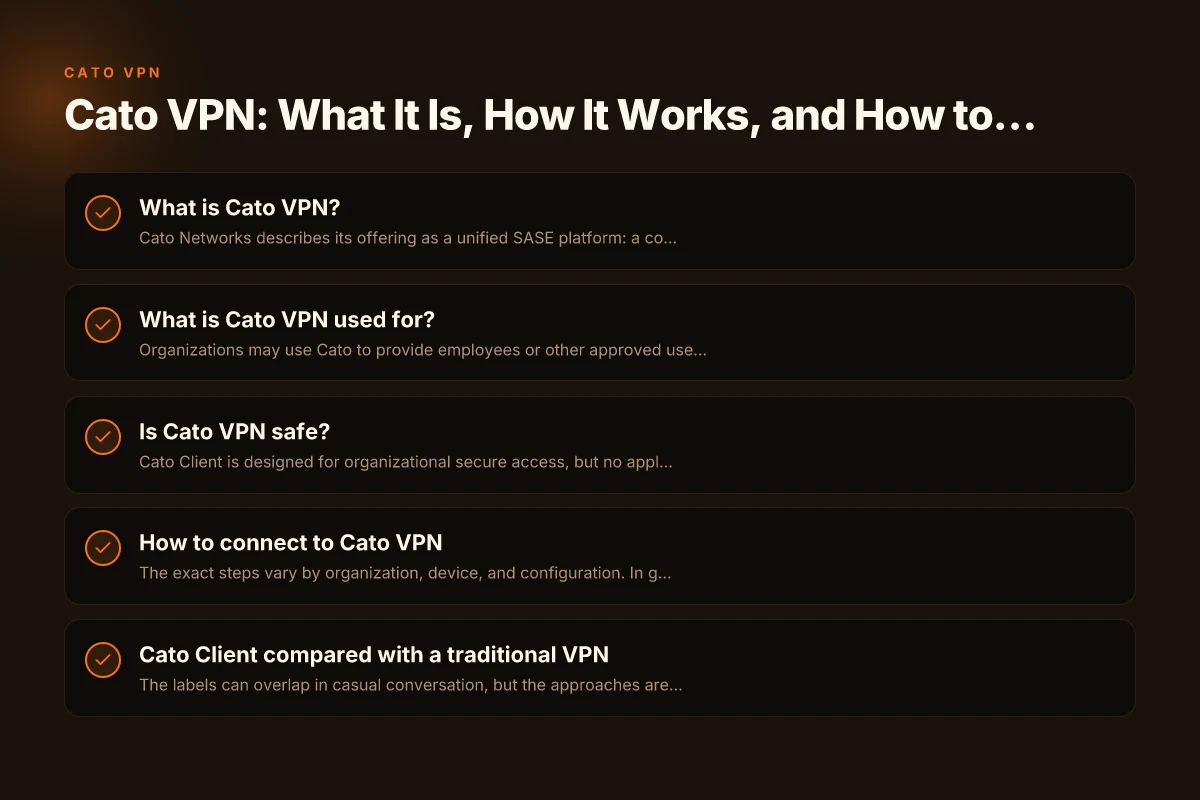
What is Cato VPN used for?
Organizations may use Cato to provide employees or other approved users with secure access to business systems, including: Free VPN for Edge: How to Choose a Safe Extension
- Private applications hosted in a company environment
- Cloud services and SaaS applications
- Internet access managed under company security policies
- Resources used by staff working remotely or across different locations
The goal is to give users access to what they need while helping the organization manage connectivity and security consistently. Cato’s platform is positioned as a way to bring networking and security functions together, rather than relying only on separate point solutions.
It is not automatically a tool for anonymous browsing or changing your apparent location for personal use. If you are looking for a personal VPN subscription, check that the service is intended for that purpose before installing anything.
Is Cato VPN safe?
Cato Client is designed for organizational secure access, but no application can guarantee that every connection or device is risk-free. Security depends on factors such as the organization’s configuration, account protections, endpoint health, and the resources being accessed.
For a work connection, use the client and download links provided by your employer or IT team. Do not install an unfamiliar copy or share your sign-in details. If you are unsure whether a Cato prompt is legitimate, contact your organization’s support team through a known channel. FortiClient VPN Download: Safe Installation Guide for Windows, macOS, Android, and iOS
Useful checks include:
- Confirm that the software came from an official Cato download source or an employer-provided link.
- Follow your organization’s sign-in and multifactor authentication instructions.
- Keep your operating system and security software updated.
- Report unexpected connection requests, warnings, or access-denied messages to IT.
- Ask whether your organization’s policies route or monitor particular traffic.
Cato is a network and security provider based in Israel. That fact alone does not determine whether a service is suitable for a particular organization. Buyers should evaluate its security controls, privacy terms, compliance needs, support, and fit with their own policies.
Questions to ask before using or adopting Cato
| Topic | Question to ask | Why it matters | What to confirm |
|---|---|---|---|
| Eligibility | Does my organization provide Cato access? | Access is typically organization-managed | Account and access instructions |
| Installation | Which Cato Client version should I use? | Requirements can vary by device | Supported operating system |
| Sign-in | What login method is required? | Authentication is set by the organization | Credentials and any extra verification |
| Access | Which company resources will be available? | Access depends on policy and configuration | Apps, networks, and permissions |
| Traffic | How is my internet traffic routed? | Routing affects access and privacy expectations | Company traffic policies |
| Monitoring | What activity can the organization see? | Visibility depends on organizational settings | Monitoring and data policies |
| Support | Who should I contact if connection fails? | Troubleshooting may require administrator help | IT contact and support process |
| Personal use | Is Cato intended for personal VPN use? | A business client may not meet personal needs | Approved use and alternatives |
Compiled November 2026; check the provider's site for current details. Urban VPN Edge: How to Install, Use, and Evaluate the Extension
How to connect to Cato VPN
The exact steps vary by organization, device, and configuration. In general, you will need access approved by your employer or organization and the correct client or browser extension.
- Ask your IT administrator which Cato access method you should use.
- Download Cato Client from the official source or the link supplied by your organization. For private web apps, your administrator may instead direct you to the browser extension.
- Install the software and sign in using the account and authentication method provided by your organization.
- Approve any requested device or sign-in checks according to your organization’s instructions.
- Open the business resource you need and confirm that it is accessible.
If the connection fails, first check your internet connection and make sure you are using the right account. Then follow your organization’s troubleshooting instructions. Access may be blocked because your account lacks permission, your device does not meet policy, or the client requires configuration from IT. Reinstalling the software or changing network settings may not resolve an organization-side issue.
Cato Client compared with a traditional VPN
The labels can overlap in casual conversation, but the approaches are not identical. The comparison below describes common differences. The actual setup depends on the organization.
| Area | Traditional VPN | Cato Client and zero-trust access |
|---|---|---|
| Access model | Often connects a device to a corporate network | Can provide access to approved resources under organizational policies |
| Typical users | Employees or contractors needing network access | Employees or other authorized users needing access to business resources |
| Management | May use a separate VPN service and related tools | Part of Cato’s wider networking and security platform |
| Private web apps | Often reached through a network connection | May be available through the client or a browser extension, depending on setup |
| Best fit | Environments built around network-level remote access | Organizations seeking integrated networking and resource-based access |
Neither approach is automatically the right choice for every organization. A business should consider its applications, existing network design, endpoint requirements, identity controls, operational capacity, and migration needs before replacing a traditional VPN. VPN PES: What It Does and Whether You Need One for eFootball
Choose the right connection option
| Need | Cato Client | Traditional VPN | What to check |
|---|---|---|---|
| Reach company resources | Suitable when provided by the organization | May work if configured for company access | Required company access method |
| Follow company security policy | Supports organization-managed policies | Depends on VPN and company setup | Approved client and configuration |
| Connect as an employee | Designed for managed organizational access | May be used by some organizations | Whether your employer supports it |
| Choose a VPN server yourself | Not typically the user’s primary choice | Commonly supported by consumer VPNs | Server selection options |
| Use a personal privacy service | Not designed as a general consumer VPN | Often a better fit | Provider privacy practices |
| Set up without an administrator | May require organizational setup | Often possible with a personal account | Account and configuration requirements |
| Get help with access problems | Contact the organization’s IT support | Contact the VPN provider | Support channel and responsibility |
Compiled November 2026; check the provider's site for current details.
What to ask before using or adopting Cato
If you are an employee, the most important questions are practical: which application should you install, how do you sign in, what resources should be available, and where should you get help?
If you are evaluating Cato for an organization, a product demonstration should be paired with a review of the real environment. Ask about: OpenVPN Connect: Download, Set Up, and Use the Official VPN Client
- Which applications and locations need to be supported
- How user and device access policies are configured
- How the service fits existing security and network tools
- What users will experience during setup and daily use
- How support, monitoring, and troubleshooting will work
- What migration steps are needed if replacing an existing VPN
Online discussions and vendor demonstrations can offer context, but they do not replace testing with your own applications, devices, and requirements.
Recommendation
Treat “Cato VPN” as a shorthand for organization-managed secure access through Cato Networks, rather than assuming it is a personal VPN app. If you need to connect for work, use the client or extension your IT team specifies and ask them about permissions or connection problems. If you are choosing a replacement for a traditional VPN, assess Cato against your organization’s access, security, and operational needs before making a decision.